


• About
  • Editor & Writers
  • Contact
  • Sitemap
No Result
View All Result
Support Our Mission
Monday, October 19, 2026
The Indian Tribal
  • Home
  • Achievers
    • उपलब्धिकर्ता
  • Cuisine
    • खान पान
  • Health
    • स्वास्थ्य
  • Legal
    • कानूनी
  • Music
    • संगीत
  • News
    • Updates
    • खबरें
  • Sports
    • खेलकूद
  • Variety
    • विविध
  • हिंदी
    • All
    • आदिवासी
    • उपलब्धिकर्ता
    • कला और संस्कृति
    • कानूनी
    • खबरें
    • खान पान
    • खेलकूद
    • जनजाति
    • भारत
    • विविध
    • संगीत
    • संस्कृति
    • स्वास्थ्य
    The Indian Tribal

    ओडिशा के आदिवासी हाटों से पोषण की नई पहल, स्वस्थ भोजन और स्वच्छता पर जोर

    The Indian Tribal

    भारत के टाइगर रिजर्व के सामने नई चुनौती: संरक्षण, आदिवासी अधिकार और पर्यटन का बढ़ता दबाव

    The Indian Tribal

    मेघालय के आदिवासी समुदाय बचा रहे जंगल और जल स्रोत, बालपाक्रम राष्ट्रीय उद्यान में संरक्षण की नई मिसाल

    The Indian Tribal

    ओडिशा के नबरंगपुर में आदिवासी किसानों की मक्का खेती ने कैसे बदली तस्वीर

    The Indian Tribal

    छत्तीसगढ़ में आदिवासी ट्रैकर्स और AI मिलकर बचा रहें हैं दुर्लभ वन्यजीव

    The Indian Tribal

    हाशिए से राष्ट्रीय केंद्र तक: बदल रही है भारत के आदिवासी समुदायों की कहानी

    The Indian Tribal

    शिक्षा, वन उपज में मूल्य संवर्धन से आदिवासी समुदायों के आर्थिक सशक्तीकरण की नई राह

    The Indian Tribal

    मणिपुर में संघर्ष के बीच आदिवासी कोचों ने संभाली नई पीढ़ी के खिलाड़ियों की कमान

  • Gallery
    • Videos
  • Latest News
No Result
View All Result
The Indian Tribal
No Result
View All Result
  • Home
  • Achievers
  • Cuisine
  • Health
  • Legal
  • Music
  • News
  • Sports
  • Variety
  • हिंदी
  • Gallery
  • Latest News
Support Our Mission
Home » The Indian Tribal / Variety » Durga Puja Among Santhals: How A Wider Hindu Festival Coexists With Indigenous Traditions

Durga Puja Among Santhals: How A Wider Hindu Festival Coexists With Indigenous Traditions

An ethnographic study of three Santhal-dominated villages in West Bengal documents Durga Puja alongside festivals rooted in nature, sacred groves and agricultural life. The findings offer a nuanced account of cultural exchange without suggesting that all Santhals share the same religious practices. The Indian Tribal reports

October 19, 2026
The Indian Tribal

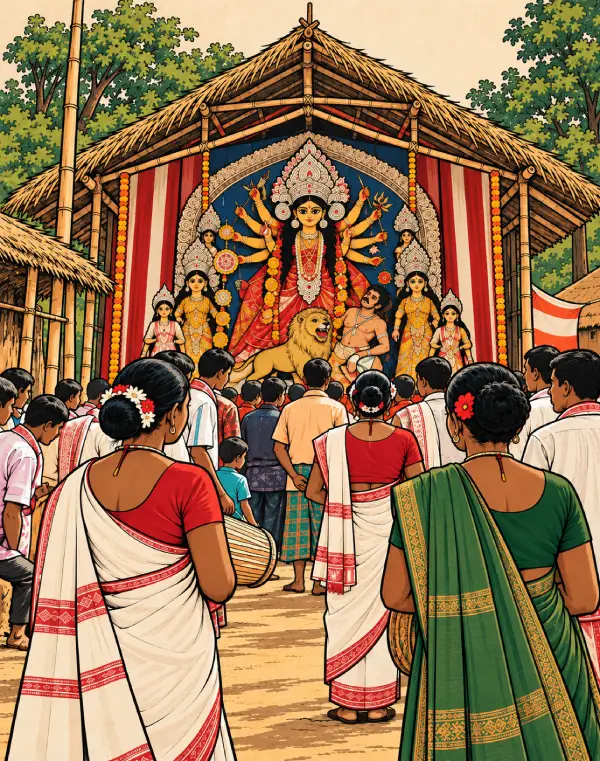
Durga Puja In A Santhal-Dominated Village

New Delhi/Jhargram

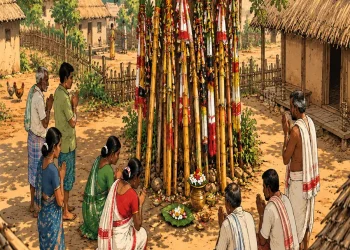
Durga Puja is widely celebrated across eastern India, but its place in the religious lives of tribal communities is neither uniform nor straightforward. Among the Santhals studied in parts of West Bengal, the festival has found a place in the wider seasonal calendar alongside indigenous observances associated with nature, sacred groves, agricultural life and community beliefs.

The relationship offers an important insight into cultural change: participation in a widely celebrated religious festival does not necessarily erase older traditions or make the religious practices of all tribal communities identical.

An ethnographic study published in the International Journal of Anthropology and Ethnology in 2021 examined the cultural and environmental knowledge of Santhal communities in three villages—Nakuijhuri, Gutbani and Rangamatiya—in West Bengal’s Jhargram district. The research, conducted by Koustab Majumdar and Dipankar Chatterjee, explored the community’s understanding of its environment, customary practices and religious and cultural observances.

The researchers documented festivals including Durga Puja, Sorhae or Sohrai, Sharul or Sarhul, Sarna, Mokor or Makar, and Bahaparab or Baha Parab. Their findings provide a useful starting point for understanding how a festival associated with the wider Hindu religious calendar can coexist with indigenous traditions.

The study’s scope, however, is important. It examined three villages and drew on interviews with 53 participants aged between 15 and 85. Its findings illuminate the experiences of the communities studied, but cannot establish how widely particular practices are followed among Santhals across West Bengal, Jharkhand, Odisha and other states.

The researchers describe Durga Puja as a festival adopted through interaction with non-tribal populations. Celebrated during September–October, it is described as a five-day festival. The study records the belief among the Santhals examined that Goddess Durga represents a source of energy and that worshipping her can bring social progress and help overcome evil.

This finding suggests that the festival can acquire significance within communities that participate in it, rather than remaining merely an outside cultural influence. At the same time, the study does not suggest that Durga Puja has replaced indigenous religious practices.

Instead, it documents a wider religious and cultural calendar in which different festivals have distinct meanings, rituals and associations.

Sacred Groves and the Relationship With Nature

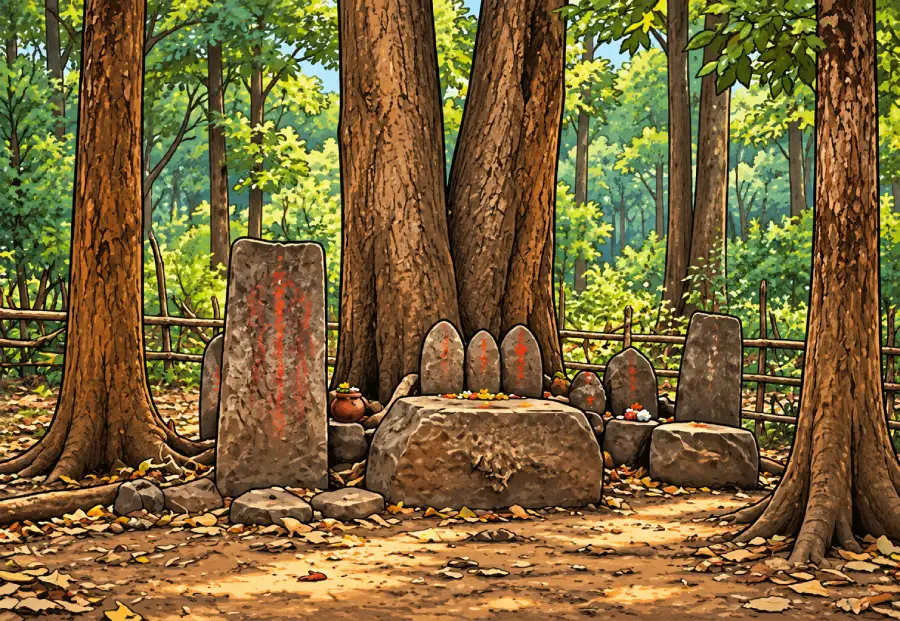
The study describes the Santhals in the villages examined as followers of Sarna traditions, in which nature-based deities and sacred places have an important role. The Jaherthan, a sacred grove or place of worship, is associated with community religious practices. The researchers identify Marang Buru as a supreme deity in the traditions they describe, with worship associated with the Jaherthan and the sal tree.

This relationship between culture and the natural environment is central to the study. Majumdar and Chatterjee conclude that Santhal environmental knowledge is deeply connected with cultural and religious practices. They describe the community’s worldview as one in which “the environment as a cultural entity” links the natural world with traditions, beliefs and collective identity.

The observation provides a broader context for understanding the Santhal festive calendar. Trees, flowering seasons, crops, animals and sacred places are not merely elements of the physical environment; they can also carry religious and cultural significance.
The Indian Tribal
Jaherthan, The Sacred Grove

Sarhul, celebrated around March–April when new flowers appear, is associated in the study with the worship of the sal tree and Mother Earth. Baha Parab, observed around February–March, marks the arrival of spring and is described as a flower festival.

Makar, celebrated in January, is associated with the first paddy harvest. The researchers record that households offer newly harvested paddy to Orabonga, the household deity.

These observances reflect a calendar in which seasonal changes, agricultural cycles, sacred places and community well-being are closely connected.

Sohrai And Thanksgiving For Cattle

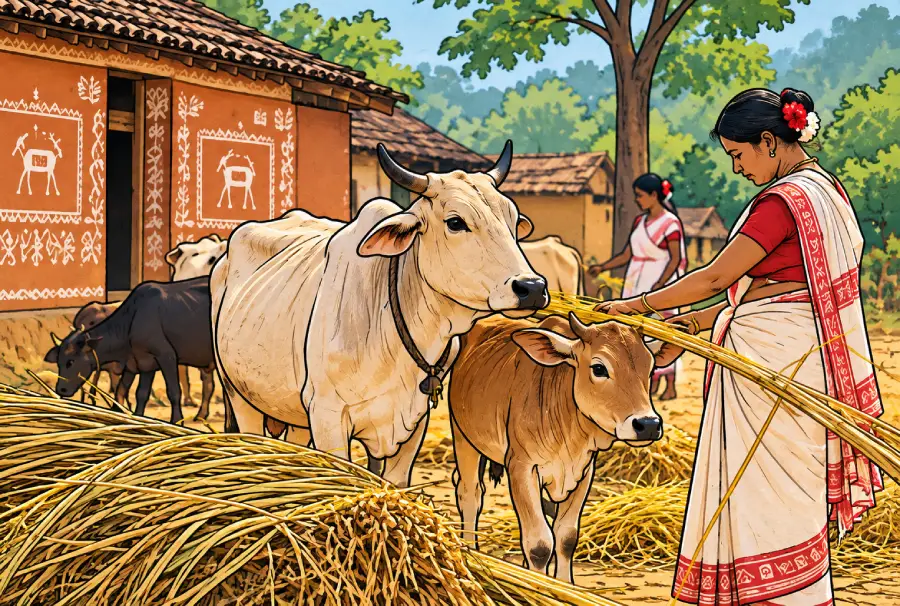
Sohrai, also spelt Sorhae in the study, is described as a thanksgiving festival associated with cattle. Observed during the Hindu month of Kartik, broadly corresponding to October–November, it honours livestock, including cows, goats and buffaloes.

Its agricultural associations illustrate how indigenous traditions retain a distinctive place in the seasonal calendar. Although its timing falls within the wider autumn festive period, Sohrai is not another name for Durga Puja or Dussehra. The festivals have different cultural and ritual meanings.

The study also documents customary practices relating to sacred places, household deities and the protection of totemic beings. It notes that the Santhals examined refrain from killing animals or birds regarded as their respective totems, reflecting beliefs about the relationship between these beings and the community.

Such findings underline the importance of understanding festivals through the beliefs and practices of the communities observing them, rather than imposing a single framework on different celebrations.

Cultural Exchange Without Uniformity

The Santhal example complicates a simple division between tribal and non-tribal religious life. Cultural interaction can lead communities to adopt festivals from neighbouring populations while older religious practices continue to hold significance.

The researchers’ wider conclusion is that traditional knowledge and environmental perceptions are embedded in Santhal social and religious systems. They write that such knowledge is “deeply rooted in various socio-cultural and religious systems of practice among Santhals.”

The observation is particularly relevant to discussions about cultural continuity. It suggests that understanding a community’s religious life requires examining more than its participation in a prominent public festival. Its customary practices, sacred spaces, relationship with nature and transmission of knowledge across generations are also important.

However, the study does not establish how many Santhals celebrate Durga Puja, whether participation differs between villages or generations, or how widespread the practices documented are across the larger Santhal population. Nor does it establish that all Santhals who participate in Durga Puja interpret the festival in the same way.

The findings should not be generalised to other tribal communities such as the Munda, Oraon, Ho, Gond or Kondh. Each community has its own history, customs and religious diversity.

For Jharkhand, where Santhals form an important part of the state’s tribal population, these distinctions are particularly relevant. Some Adivasi families participate in Durga Puja, while others maintain different religious observances or belong to other faiths. Practices and interpretations can also vary within the same community.

A fuller understanding would require additional fieldwork across different districts of Jharkhand, West Bengal and Odisha, including interviews with Santhal elders, traditional priests, researchers and families. Such research could establish how people describe their own religious identities and how their festival practices have evolved over time.

Understanding The Santhal Festive Calendar On Its Own Terms

The central lesson of the research is not that Durga Puja has become a universal Santhal festival, but that it can coexist with indigenous traditions in the communities studied.
The Indian tribal
Sohrai, Cattle And Agricultural Life

Durga Puja, Sohrai, Baha Parab, Sarhul and Makar do not have identical origins or meanings. Each belongs to a particular ritual and seasonal context, and their coexistence illustrates a more complex relationship between cultural exchange and continuity.

For journalists and researchers, the distinction matters. Tribal communities should not be portrayed as a single religious bloc, nor should participation in one festival automatically be interpreted as evidence that indigenous identity has disappeared.

The Santhal experience documented in Jhargram shows why India’s cultural diversity is best understood through the specific histories, practices and voices of its communities. It is a story not simply of one tradition replacing another, but of different practices occupying places in the lives of the people who observe them.


Root Woot | Online Puja Samagri Root Woot | Online Puja Samagri Root Woot | Online Puja Samagri

Support Our Mission

The Indian Tribal

For the past four-and-a-half years, we have travelled across India to bring to our readers the ‘Unknown, Lesser-Known Tribal Life’, which rarely finds space in the mainstream media.

We have done this without external funding, driven only by our conviction that India’s tribal heritage deserves to be documented with dignity, depth and authenticity.

If you like our work, and if it has informed, inspired or helped you understand India’s tribal/indigenous communities better, we invite you to become a part of this mission.

Your contribution will not merely fund a news platform. It will help preserve voices, traditions, histories and aspirations that form an invaluable part of India’s identity.

Because when an untold story is documented, a piece of India’s heritage is preserved forever.

Thanks
Editor

In Numbers

49.4 %
Female Literacy rate of Scheduled Tribes

Update

MoTA, Karmayogi Bharat join hands to empower tribals

The Ministry of Tribal Affairs (MoTA) and Karmayogi Bharat have signed a Memorandum of Understanding (MoU) to develop and operate the Tribal Affairs Capacity Building Platform under the iGOT Karmayogi framework. The MoU extends the capacity-building framework of Mission Karmayogi, hitherto focused on civil servants, to Adi Karmayogi Volunteers (AKVs) and functionaries responsible for implementing tribal development schemes at the grassroots level. The initiative is part of the Adi Karmayogi Abhiyan, under which the Ministry is institutionalising over 76,000 Adi Sewa Kendras (ASKs) and a network of over 1,54,000 AKVs as sustainable village-level platforms for facilitation, citizen engagement and last-mile convergence. According to data reported by States on the portal, 60,507 ASKs and 1,22,072 AKVs have been registered so far.
The Indian Tribal
आदिवासी

ओडिशा के आदिवासी हाटों से पोषण की नई पहल, स्वस्थ भोजन और स्वच्छता पर जोर

by The Indian Tribal
October 15, 2026

ओडिशा के आदिवासी गांवों के साप्ताहिक हाटों में एक विशेष परियोजना के जरिए पोषण जागरूकता, बेहतर खान-पान और स्वच्छता संबंधी आदतों को बढ़ावा दिया जा रहा है, लिखती हैं दीपान्विता गीता नियोगी

The Indian Tribal

Meet Rajasthan’s ‘Seed Mother’ Reviving Traditional Millets And Tribal Farming

October 12, 2026
The Indian Tribal

भारत के टाइगर रिजर्व के सामने नई चुनौती: संरक्षण, आदिवासी अधिकार और पर्यटन का बढ़ता दबाव

October 7, 2026
The Indian Tribal

Maoists Gone, Chhattisgarh Turns Former Security Base Into Tribal Hostels

October 5, 2026
The Indian Tribal

Discover The Treasures Of Odisha’s Purvasha Folk And Tribal Art Museum

October 3, 2026
The Indian Tribal

Tana Bhagat Movement, Gandhi And Congress: The Nationalist Story Behind The History

September 30, 2026
Previous Post

Jeypore Dussehra: How Tribal Communities Keep The Sacred Lathi-Worship Tradition Alive

Top Stories

The Indian Tribal
Adivasi

Jeypore Dussehra: How Tribal Communities Keep The Sacred Lathi-Worship Tradition Alive

October 17, 2026
The Indian Tribal
Adivasi

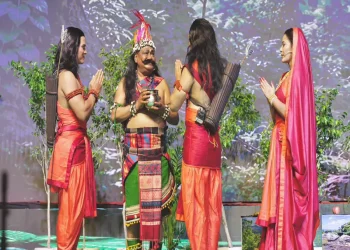
Union Tribal Affairs Minister Jual Oram Plays Nishadraj, Brings Adivasi Heritage To Delhi’s Iconic Ramlila Stage

October 16, 2026
The Indian Tribal
आदिवासी

ओडिशा के आदिवासी हाटों से पोषण की नई पहल, स्वस्थ भोजन और स्वच्छता पर जोर

October 15, 2026
Load More
  • About Us
  • Editor & Writers
  • Contact
  • Redressal
  • Copyright Policy
  • Privacy Policy And Terms Of Use
  • Disclaimer
  • Sitemap

  • Achievers
  • Cuisine
  • Health
  • India
  • News
  • Legal
  • Music
  • Sports
  • Trending
  • Chhattisgarh
  • Delhi
  • Gujarat
  • Jammu & Kashmir
  • Jharkhand
  • Kerala
  • Madhya Pradesh
  • Maharashtra
  • North East
  • Arunachal Pradesh
  • Assam
  • Manipur
  • Meghalaya
  • Mizoram
  • Nagaland
  • Sikkim
  • Tripura
  • Odisha
  • Telangana
  • West Bengal
  • Political News
  • Variety
  • Art & Culture
  • Entertainment
  • Adivasi
  • Tribal News
  • Scheduled Tribes
  • हिंदी
  • उपलब्धिकर्ता
  • कानूनी
  • खान पान
  • खेलकूद
  • स्वास्थ्य
  • संस्कृति
  • संगीत
  • विविध
  • कला और संस्कृति
  • खबरें
  • असम
  • अरुणाचल प्रदेश की ताज़ा ख़बरें
  • ओडिशा
  • केरल
  • गुजरात
  • छत्तीसगढ़
  • जम्मू और कश्मीर
  • झारखंड
  • तेलंगाना
  • दिल्ली
  • नॉर्थईस्ट
  • पश्चिम बंगाल
  • मध्य प्रदेश
  • महाराष्ट्र
  • त्रिपुरा
  • नागालैंड
  • मणिपुर
  • मिजोरम की ताज़ा ख़बरें
  • मेघालय
  • सिक्किम की ताज़ा ख़बरें
  • राजस्थान

About Us

The Indian Tribal is India’s first bilingual (English & Hindi) digital journalistic venture dedicated exclusively to the Scheduled Tribes. The ambitious, game-changer initiative is brought to you by Madtri Ventures Pvt Ltd (www.madtri.com). From the North East to Gujarat, from Kerala to Jammu and Kashmir — our seasoned journalists bring to the fore life stories from the backyards of the tribal, indigenous communities comprising 10.45 crore members and constituting 8.6 percent of India’s population as per Census 2011. Unsung Adivasi achievers, their lip-smacking cuisines, ancient medicinal systems, centuries-old unique games and sports, ageless arts and crafts, timeless music and traditional musical instruments, we cover the Scheduled Tribes community like never-before, of course, without losing sight of the ailments, shortcomings and negatives like domestic abuse, alcoholism and malnourishment among others plaguing them. Know the unknown, lesser-known tribal life as we bring reader-engaging stories of Adivasis of India.

Follow Us

All Rights Reserved

© 2026 Madtri Ventures [P] Ltd.

No Result
View All Result
  • Home
  • Achievers
  • Cuisine
  • Health
  • Health
  • Legal
  • Music
  • News
  • Sports
  • Variety
  • हिंदी
    • उपलब्धिकर्ता
    • खान पान
    • कानूनी
    • खेलकूद
    • खेलकूद
    • संगीत
    • संगीत
    • स्वास्थ्य
    • स्वास्थ्य
    • विविध
  • Gallery
  • Videos

© 2026 Madtri Ventures [P] Ltd.