






Agartala
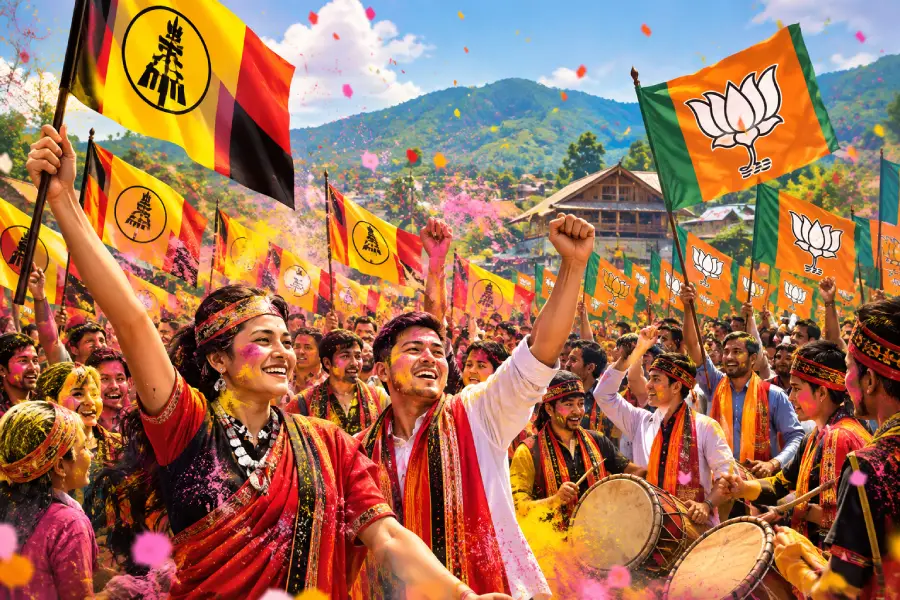
The Tipra Motha Party (TMP), a constituent of Tripura’s BJP-led government, continued its dominance in the State’s tribal belt, winning 3,428 of the 4,594 Village Committee seats for which results were declared in the 2026 elections.
The BJP won 859 seats, while Independents secured 173, CPI(M) 87, the Indigenous People’s Front of Tripura (IPFT) 33 and Congress 14. The results mean TMP accounted for 74.61 per cent of all declared seats, against 18.70 per cent for the BJP.
The elections to 587 Village Committees under the Tripura Tribal Areas Autonomous District Council (TTAADC) were held on September 28, with counting on October 5 and final results declared on Tuesday.
Of the 4,597 notified seats, 1,644 were decided uncontested and three remained without nominations, leaving 4,594 seats for which results were declared.
The scale of the victory of TMP, led by the titular head of Tripura’s former royal family Pradyot Debbarma, is significant because these Village Committees constitute the grassroots governance structure in the Sixth Schedule areas. The polls were held after a gap of about a decade: the previous elections took place in 2016 and the elected committees’ terms expired in 2021. The Supreme Court intervened this year to facilitate the long-delayed electoral exercise.
The election also recorded high voter participation. The State Election Commission put polling turnout at 81.01 per cent, rising to 81.21 per cent after election-duty votes were included. Female turnout was higher than male turnout, with 2.71 lakh women voting against 2.63 lakh men.
For the BJP-led alliance, the outcome presents a complex political picture. Chief Minister Manik Saha described the combined performance of the BJP, TMP and IPFT as an NDA victory, saying alliance-backed candidates had won 4,320 of the 4,597 seats. But the party-wise figures show that TMP, rather than the BJP, commands the overwhelming share of the alliance’s seats in the tribal Village Committees.
That distinction matters in a state where tribal politics has a direct bearing on wider electoral calculations. Twenty of Tripura’s 60 Assembly constituencies are reserved for Scheduled Tribes, while the TTAADC covers a large part of the State’s geographical area and is central to questions involving indigenous identity, land, language, political representation and development.
The result also comes against the backdrop of tensions within the BJP-TMP relationship. The two parties joined hands in the state government in 2024 following the Tiprasa Accord, under which the Centre, Tripura government and TMP agreed to work towards an “amicable” and time-bound resolution of issues concerning indigenous people, including land, political rights, culture, language and economic development.
Implementation of that agreement remains a key political issue. Recent reporting has documented differences between the allies over the accord, the empowerment and funding of the TTAADC and questions concerning the future of Kokborok.
TMP chief Pradyot Debbarma said the Village Committee results would “restore the power of the grassroots back to the tribal people”, describing the elections as a restoration of constitutional rights.
The political message from the results is therefore two-layered: the BJP-led alliance retains a numerical majority across the Village Committees, but TMP has demonstrated that its independent organisational and electoral base in Tripura’s tribal areas remains substantially stronger than that of its larger ally. How the alliance manages this asymmetry—and whether the Tiprasa Accord translates into tangible changes in land rights, local governance, resources and indigenous development—could shape the next phase of Tripura politics.
Earlier in April 2026, Tipra Motha firmly retained power in the 30-member TTAADC by securing a spectacular 24 out of 28 elected seats. Its bigger ally, BJP, could win just four seats.
For the tribal communities, however, the more immediate test will be whether the restoration of elected grassroots bodies after a decade leads to more accountable local governance and a greater say in development decisions.