








Raipur
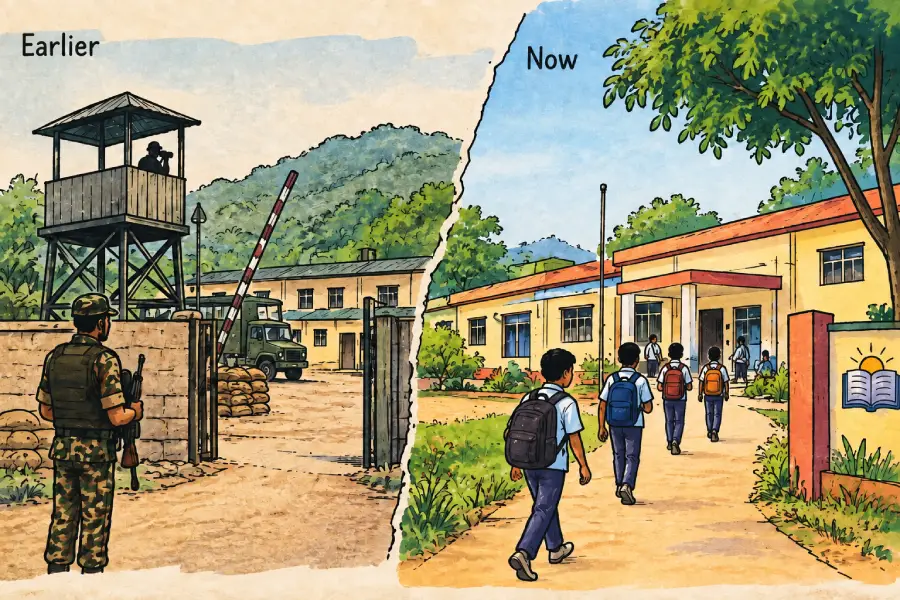
A security camp in Bhatpal village of Chhattisgarh’s Narayanpur district, once part of the Maoist-affected Abujhmad region, has been transformed into a hostel for tribal students, marking a significant shift in the use of infrastructure created during years of security operations.
The camp, which functioned as an important security force base for nearly 15 years, has now been repurposed to provide accommodation and educational support to students from remote and inaccessible villages.
The initiative is the first of its kind in the Bastar division. The camp was vacated following an improvement in the security situation, prompting the district administration to put the existing infrastructure to productive public use.
Chhattisgarh was declared free of the Naxal menace on March 31 this year. The Bastar division comprises seven districts, including Narayanpur.
Two ST Hostels Now Operating On The Campus
On the initiative of Narayanpur Collector Namrata Jain, the premises were turned into two facilities for Scheduled Tribe students.
The pre-matric ST boys’ hostel has a sanctioned capacity of 100 students studying in Classes 6 to 10. However, 114 students are currently staying there. The post-matric ST boys’ hostel, meant for students of Classes 11 and 12, has a sanctioned capacity of 50 and currently houses 39 students. The campus also caters to the residential requirements of students associated with the Education City at Kutul.
For children from remote villages, continuing their education often involves travelling long distances, limited transport options and the additional financial burden of arranging accommodation near schools. The Bhatpal hostel is helping address these challenges.
The government higher secondary school in Bhatpal is located just 50 metres from the hostel campus, allowing students to attend classes without having to undertake long daily journeys.
The availability of accommodation from the pre-matric to post-matric level is also expected to help students continue their education and reduce dropouts arising from logistical and financial constraints.
Students See Relief From Distance And Costs
News agency PTI quoted Class 9 student Ritesh Soni of Halamimunjmeta village as saying that students were happy with the new facility, which provides them with a safe environment, proximity to school and an opportunity to study alongside their peers.
For Class 12 student Komendra from Rajbeda village, the hostel has eased a particularly difficult situation. His school is located more than 20 kilometres from his village, and he earlier had to arrange accommodation near the school.
The hostel has now provided him with organised accommodation while reducing the financial burden on his family.
Collector Jain recently conducted a surprise inspection of the hostel, reviewing the rooms, food arrangements, cleanliness and other basic facilities. She also interacted with the students and heard their concerns and requirements.
The students’ accounts underline the practical significance of the transformation: infrastructure that once supported security operations in an inaccessible region is now being used to help young people remain in school.
From Security Infrastructure To Public Welfare
The transformation of the Bhatpal campus highlights the changing priorities in Narayanpur, where an improvement in the security situation is increasingly being accompanied by efforts to expand education, healthcare, roads, livelihoods and other basic services.
It also demonstrates how infrastructure established for security purposes can be repurposed for public welfare, particularly in areas that were once severely affected by Left Wing Extremism. The State government has earlier said that security camps in the Bastar region would gradually be converted into police stations, schools, hospitals, centres for the collection and processing of minor forest produce and other public facilities.
The Bhatpal initiative therefore represents more than a change in the use of a single campus. It reflects a broader effort to translate improved security access into permanent public infrastructure and services in some of the region’s most remote areas.