





New Delhi
The story of the Tana Bhagat movement is not only about resistance to colonial rule; it is also about how the history of that resistance has been recorded, interpreted and reconstructed.
For a long time, the experiences of tribal and peasant communities were largely understood through accounts produced by colonial administrators, missionaries and outside observers. A closer reading of the movement, however, opens up questions about its internal social dynamics, its relationship with land and forests, and the ways in which its ideas travelled through everyday community networks.
Historiographical Reinterpretation
The history of the Tana Bhagat movement raises a broader question about how tribal and peasant rebellions in colonial India have been understood and written about.
Traditionally, records of the Tana Bhagat movement written by administrators, missionaries and anthropologists often portrayed tribal conflicts as confrontations between tribal and non-tribal communities, insiders and outsiders, or lower and higher civilisations. More recent historiography has challenged such interpretations by drawing attention to the internal dynamics of tribal society and the ways in which communities themselves experienced and expressed resistance.
Historian Ranajit Guha, for instance, discusses the different ways in which insurgency was transmitted within tribal society. In the case of the Tana Bhagat movement, the spread of its ideas depended significantly on the networks created by Oraons who participated in the Tana sect across several villages.
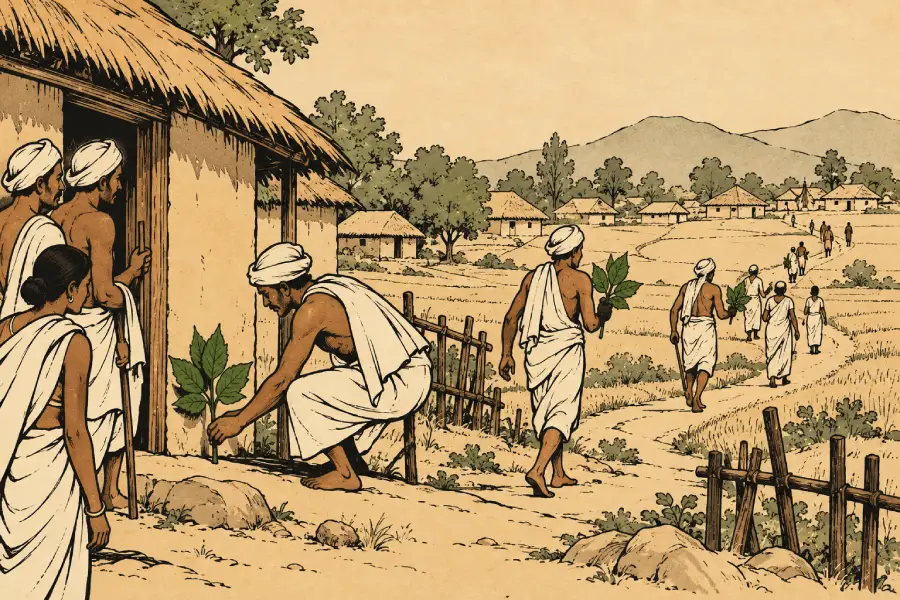
The transmission of these ideas did not depend solely on formal political organisation. Symbols, rumours and everyday interactions also played an important role. Leaves of Karam trees were placed outside villages, while fresh leaves were carried to the next village. Rumours and imagery could travel rapidly through these networks. One such belief held that if a battle took place between gods and men, the Oraons would emerge victorious because God would fight on their side.
How Ideas Travelled Through Villages And Haats
Village haats became important spaces through which the ideas of the movement could circulate. These were places of economic exchange, but they also provided opportunities for communication and interaction. Several sellers became preachers of the Tana sect, helping the movement’s ideas reach different communities and villages.
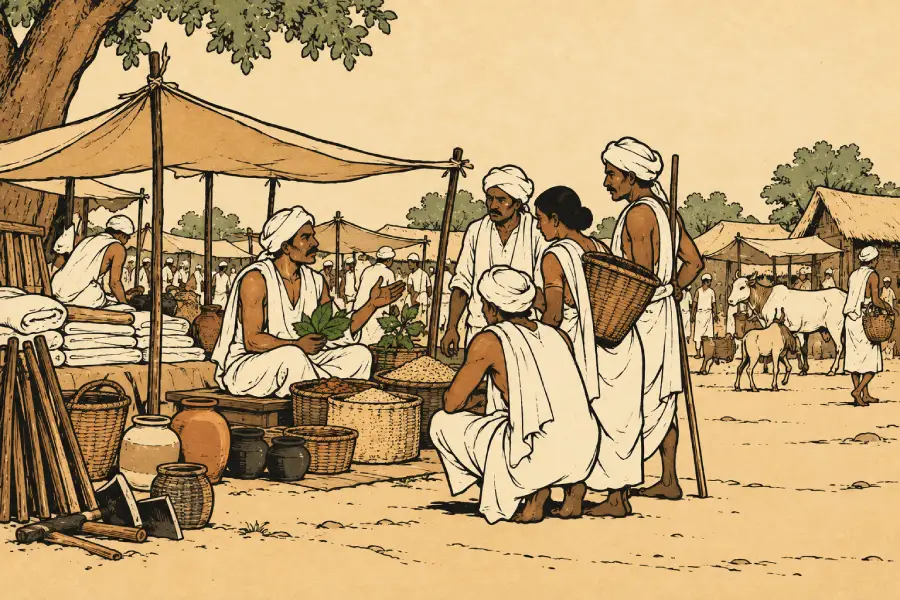
Material objects, too, acquired significance in this process. Villagers discarded utensils, agricultural tools and ornaments, and these objects became visible signs of their participation in the movement and the rejection of aspects of their earlier way of life.
As Ranajit Guha points out in his writings, studying Adivasi movements only through a political lens can limit our understanding of the other voices and practices through which such movements shaped everyday life. The Tana Bhagat movement therefore needs to be viewed not simply as a political revolt, but also as a social and cultural process expressed through beliefs, symbols, community networks and changes in everyday behaviour.
Faith, Land And Everyday Resistance
Colonial intervention in the agrarian system and land structure created conditions that contributed to the emergence of the tribal movement. Guha also discusses the ‘Sarkar-Zamindar-Sahukar’ nexus of exploitation of oppressed communities during the colonial period.
The Tana protest was directed not only against colonial authority but also against traditional leaders within the Oraon community. In challenging these leaders, the Tanas also questioned the hierarchical structure that had developed within the landed Oraon community.
The transformation from shifting cultivation to settled agriculture was another important element in this changing social and economic landscape. The shift contributed to a decline in the economy of Oraon society and marked the beginning of hardship after a period of prosperity.
The Tanas continued to relate themselves to the forests and to an earlier nomadic way of life. They performed folklore before the raja. When the raja offered them five villages so that they could settle, they reportedly preferred cattle as a reward.
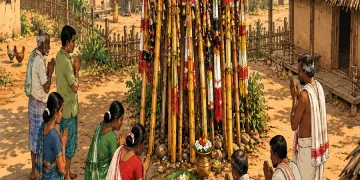
The main religious festival of the Oraons, Khaddi or Sarhul, is celebrated in spring. The festival also became associated with hunter-gatherers. Despite the shift in leadership of the movement from Tana Bhagat to Jatra Bhagat, the festival continued to remain a means of seeking a good rice harvest within the Oraon community.
The relationship between agriculture, forests and authority became particularly significant in regions where the colonial system found it difficult to impose clearly defined boundaries. In the central region of settled agriculture, after cultivation reached its peak, taxation and revenue patterns remained largely unchallenged. Other communities, including Brahmans, Rajputs, Banias, Marwaris and Muslims, often critiqued forest communities.
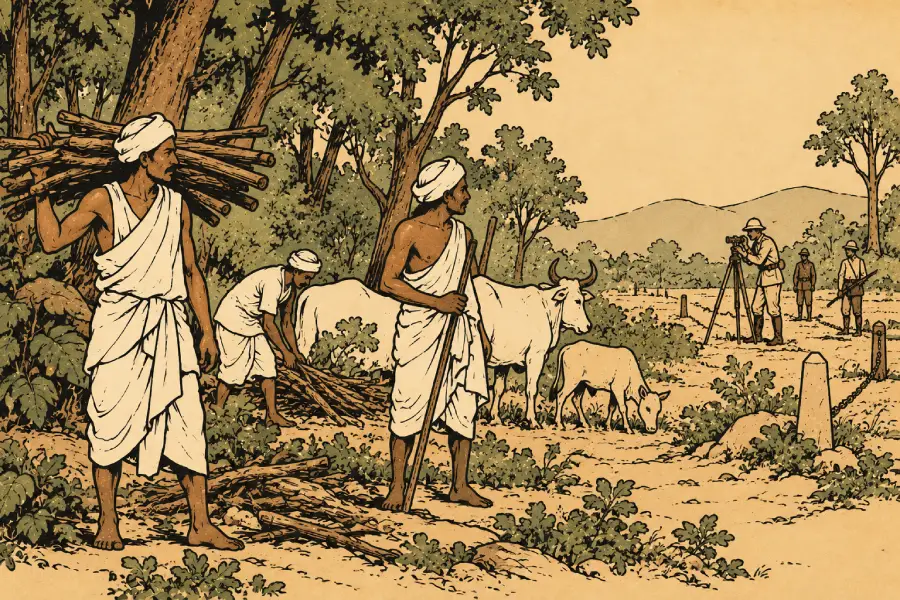
In the forested region of Palamau, however, boundaries could not be clearly demarcated and the standard pattern of survey had failed. The Tana Bhagats refused to pay rent or tax for cattle rearing in the forest and also collected wood for fuel without paying rent.
In the Satpahari jungles, where the price of food was high, Sibu argued that God did not want restrictions on food and drink. Tana Bhagat enjoyed sorho singar batiso ahar — all kinds of pleasure — and his followers and Sibu killed and ate a heifer.
The Gaps In The Colonial Narrative
The colonial narrative of the Tana Bhagat movement records events in a scattered manner, often presenting them as a relatively simple form of protest. Historians such as B. B. Chaudhari, however, argued that although tribal history was often valorised, historians reconstructing the Tana Bhagat movement gave it singularity, structure and continuity.
The movement also challenged more than external authority. Beliefs in ghosts were questioned, while the internal hierarchies of traditional leadership, including the authority of Pahans and Mahtos, were also contested. The jurisdiction of the Panch, the administrative body of the Oraons, was rejected.
The Tanas appeared dissatisfied with their everyday social order. Rituals were performed by the Pahan with the assistance of the Pujar, and the Tana sect protested against this arrangement. They retained control of the bhuinhari khunts, which could be appeased only in the presence of the Pahan. The Pahan and Mahto were strongly opposed to the movement because the Tana Bhagats questioned their authority. The Tanas, in turn, opposed them because of their involvement in surveys conducted by the colonial authorities.
Colonial accounts and missionary records also left out several events that did not fit easily into the dominant narrative of tribal resistance. The beliefs and expectations surrounding the movement provide examples of this gap. The Tanas, for instance, waited for the arrival of the new moon, which they believed would continue for five days. They imagined a period of continuous darkness followed by a long light in which elements including Hindus, Muslims, missionaries, police and officials would be burnt.
Other followers of the Tana sect believed that if they continued to practise their faith, Tana would become the master of their world, eat from gold plates, and bullets would melt into water while swords would twist in the hands of soldiers.
Sibu of the earlier period was believed to have been reborn as the Tana leader Sibu Bhagat. Several others in the procession claimed that they were Ramchadar and Hari.
Historian Pratima Banerjee, in her writings, mentions that this form of protest cannot be separated from the politics of the time and the everyday forms of resistance, including those seen in the context of the Santhal Rebellion.
Beyond ‘Rebels’ And ‘Tribesmen’
Analysing the Tana Bhagat movement in this way changes the central question. Instead of asking whether the Tanas were simply ‘rebels’ or ‘tribesmen’, it becomes more important to understand how they perceived their own social dynamics, how they imagined colonial and internal authority, and how they responded to external interference in their land and community.
Their history suggests that rebellion can also be understood through religious beliefs, symbols, rumours, village networks and changes in everyday behaviour. Seen from this perspective, the Tana Bhagat movement becomes not merely an episode of resistance but a window into the ways an indigenous community experienced and responded to profound changes in its social, economic and cultural world.
PART-3 to continue…
(Amit Kumar is a political analyst and a Post Graduate Member of the Royal Historical Society, London. Views expressed are personal.)