





Bhogapuram (Andhra Pradesh)
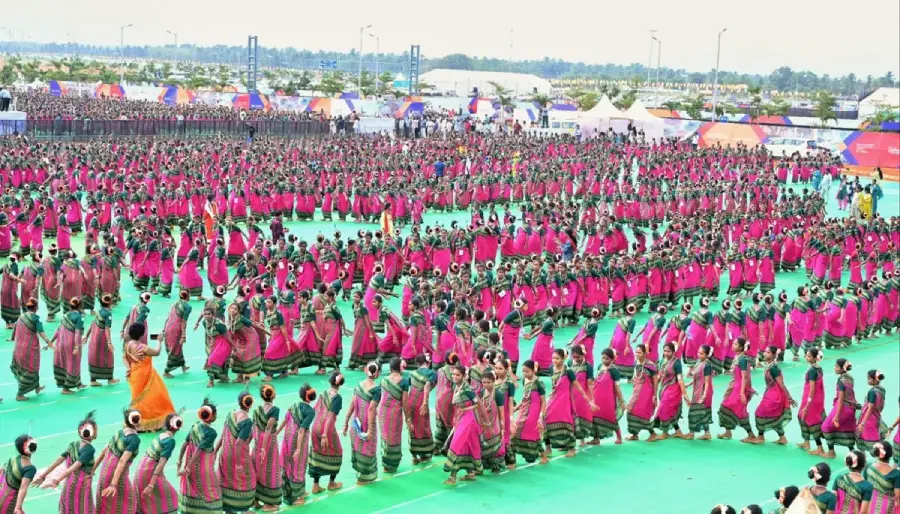
The rhythmic beat of the dappu drum echoed across Bhogapuram on Friday ahead of Prime Minister Narendra Modi’s scheduled inauguration of Alluri Sitarama Raju International Airport as 13,000 dancers, dressed in vibrant tribal attire, moved in perfect synchrony to perform Dhimsa, the iconic tribal dance of Andhra Pradesh’s Eastern Ghats.
What began generations ago in remote hill villages as a celebration of harvests, festivals and community life entered the global spotlight after the mass performance was recognised by Guinness World Records as the largest Dhimsa dance, marking a milestone for one of India’s oldest surviving indigenous dance traditions.
The tribal girls from Classes VIII, IX and X studying in schools under the Integrated Tribal Development Agency (ITDA) areas of Paderu, Seethampeta, Parvathipuram and Rampachodavaram came together dressed in coordinated pink traditional sarees with green borders paired with green blouses. The participants were arranged in 433 concentric circles, each comprising 50 dancers.
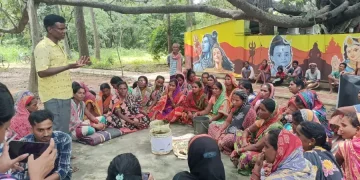
For the tribal communities of north coastal Andhra Pradesh, however, Dhimsa has never been about records. It is a living expression of identity. Performed predominantly by women belonging to tribes such as the Valmiki, Bagata, Kondadora, Gadaba, Jatapu, Konda Savara and Porja, the dance is woven into the social fabric of the Agency areas of Alluri Sitarama Raju district, Parvathipuram Manyam, Vizianagaram and parts of Anakapalli. Every major community occasion—from sowing and harvesting to marriages and annual festivals—finds expression through the graceful circular formations of Dhimsa.
On Saturday after inaugurating the airport, the PM lavished praise on the Dhimsa dancers, who welcomed him with their presentation, saying, “The enthusiastic ‘Dhimsa dance’ performed by over 13,000 students at the Bhogapuram Airport inauguration event captured my heart. This magnificent performance stands as a testament to the warmth of the people of Andhra Pradesh, the cultural splendor of the state—and especially the great traditions of our tribal communities.”
Anthropologists believe the dance evolved as a collective celebration of agrarian life in the forested hills of the Eastern Ghats. The word ‘Dhimsa’ is widely believed to derive from a tribal expression signifying coordinated movement or rhythmic group dancing, although linguistic interpretations differ across communities. Unlike classical Indian dance traditions that rely on codified grammar, Dhimsa has been preserved almost entirely through oral tradition, with each generation learning by observing elders rather than through formal instruction.
One of the most striking features of Dhimsa is its simplicity. Women usually stand shoulder-to-shoulder or hold one another around the waist, moving in circles with measured footwork that mirrors the rhythms of nature. Men accompany the performance by playing indigenous percussion instruments such as the dappu, mori, tudumu and other traditional drums, while folk songs recount stories of forests, rivers, agriculture, romance and collective labour. Different variants—including Boda Dhimsa, Goddi Bela, Kunda Dhimsa and Bagh Dhimsa—are performed for different occasions, reflecting the remarkable diversity within the tradition.
Over the decades, Dhimsa has travelled beyond the hills. It has become a cultural ambassador for Andhra Pradesh, featuring in state festivals, Republic Day celebrations, tourism campaigns and national tribal cultural events. Yet cultural scholars have repeatedly cautioned that while stage performances have increased the dance’s visibility, its deeper social meaning lies in the village community where participation matters more than perfection. In its original setting, there are no spectators—everyone joins the circle.
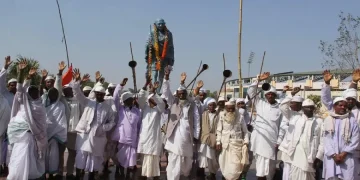
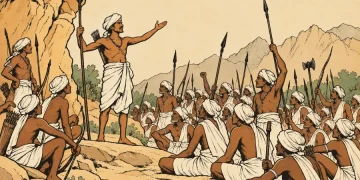
The Guinness recognition has therefore been welcomed not merely as a numerical achievement but as international acknowledgement of India’s indigenous cultural wealth. Thousands of performers converged at Bhogapuram to execute a synchronised Dhimsa performance that earned global recognition, turning a traditional community dance into an international cultural spectacle. The event coincided with Prime Minister Narendra Modi’s inauguration of the Alluri Sitarama Raju International Airport, itself named after the legendary tribal freedom fighter who led the Rampa rebellion in the Eastern Ghats a century ago.
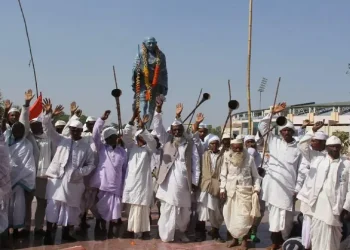
The symbolism was difficult to miss. The same hills that nurtured Alluri Sitarama Raju’s resistance against colonial rule also nurtured Dhimsa, a dance that has survived despite rapid social and economic change. For tribal elders, the performance was not simply about creating history but about ensuring younger generations remain connected to a cultural inheritance that predates modern state boundaries and written records.
The international recognition could also provide a fresh boost to cultural tourism in Andhra Pradesh. Visitors to Araku Valley, Lambasingi, Paderu and other tribal regions often regard Dhimsa performances as among the most authentic cultural experiences in the Eastern Ghats. Greater global visibility may create new livelihood opportunities for tribal artists while encouraging documentation, research and inter-generational transmission of the tradition.
Records, by their nature, may eventually be broken. But for the communities that have preserved Dhimsa through centuries of change, Friday’s achievement represents something far more enduring: the moment when a dance born in forest villages found a place on the world’s cultural map without losing sight of the people whose lives continue to give it rhythm.