





New Delhi
In a move aimed at strengthening tribal welfare through science-led conservation and sustainable livelihoods, the Ministry of Tribal Affairs (MoTA) has signed a three-year Memorandum of Understanding (MoU) with the CSIR-National Botanical Research Institute (CSIR-NBRI), Lucknow, to promote research and development for the conservation and ethnobotanical assessment of tribal bioresources across India.
The primary objective of the partnership is to establish a sustained institutional collaboration between the Ministry of Tribal Affairs and CSIR-NBRI for conserving tribal bioresources, documenting traditional knowledge, and ensuring that scientific research directly benefits tribal communities while safeguarding their rights over biological resources.
The agreement seeks to integrate scientific research with community-led conservation by placing tribal welfare, local participation and equitable benefit sharing at the centre of all research activities.
Focus On Conservation Of Threatened Medicinal Plants
Under the MoU, the two institutions will work towards conserving Rare, Endangered and Threatened (RET) medicinal plant species through scientific interventions such as tissue culture facilities and specialised seed banks. The initiative also aims to strengthen long-term conservation by training tribal youth in plant propagation, conservation techniques and biodiversity management.
Officials said capacity building at the grassroots will enable local communities to play a leading role in protecting biodiversity while creating opportunities for sustainable livelihoods linked to medicinal plants and other bioresources.
Community Consent Mandatory For Research
One of the key features of the agreement is its emphasis on community rights and legal safeguards.
All field surveys, ethnobotanical assessments and research activities will require Prior Informed Consent (PIC) from concerned Gram Sabhas and tribal communities in accordance with the provisions of the Biological Diversity Act, 2002.
Every joint research proposal under the partnership will include a dedicated budget for community development, local value addition and capacity building to ensure that scientific programmes generate direct socio-economic benefits for tribal populations.
Protecting Traditional Knowledge And Ensuring Benefit Sharing
The agreement also lays down safeguards against the unauthorised commercial exploitation of traditional knowledge.
Any intellectual property generated through collaborative research will be jointly owned by the Ministry of Tribal Affairs and CSIR-NBRI, while being held in trust for, or equitably shared with, the tribal communities that contribute knowledge or biological resources.
Financial benefits arising from such intellectual property will be channelled through National or State Biodiversity Funds as well as dedicated welfare schemes of the Ministry of Tribal Affairs.
The MoU recognises traditional knowledge as the intangible cultural heritage of tribal communities and mandates strict compliance with India’s Access and Benefit Sharing (ABS) framework to ensure fair compensation and prevent biopiracy.
Bridging Indigenous Knowledge And Modern Science
The collaboration also envisages regular thematic workshops, seminars and knowledge exchange programmes involving traditional healers, community practitioners and scientists.
By creating sustained interaction between indigenous knowledge holders and botanical researchers, the initiative aims to strengthen evidence-based conservation while preserving traditional ecological knowledge that has been passed down through generations.
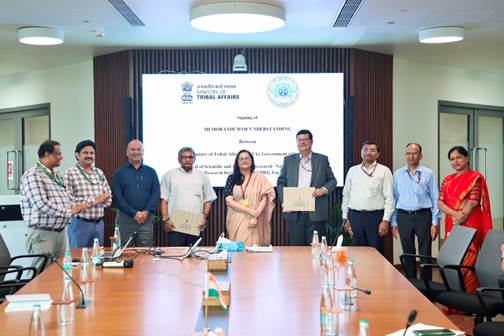
The Memorandum of Understanding was signed by Manish Thakur, Additional Secretary, Ministry of Tribal Affairs, and Ajit Kumar Shasany, Director, CSIR, in the presence of Ranjana Chopra, Secretary, Ministry of Tribal Affairs.
The event was attended by Sharad Srivastava, Chief Scientist, CSIR; Sachitra Ratha, Scientist, CSIR; Manish Bhoyar, Scientist, CSIR; and senior officials of the Ministry of Tribal Affairs.
Background
India is home to one of the world’s richest repositories of biological diversity and traditional medicinal knowledge, much of which is conserved and practised by tribal communities. The Biological Diversity Act, 2002, and the Access and Benefit Sharing (ABS) framework were introduced to regulate access to biological resources while ensuring that communities sharing traditional knowledge receive equitable benefits from its commercial or scientific use.
The latest collaboration reflects a growing policy emphasis on combining scientific research with indigenous knowledge systems, while strengthening community participation, biodiversity conservation and livelihood generation in tribal regions.