








Kolkata/New Delhi
With more than 11 lakh claims under the Forest Rights Act (FRA), 2006, still pending across India, the Union Ministry of Tribal Affairs (MoTA) has called on eight States to accelerate claim disposal, review rejected applications and strengthen the implementation of recognised forest rights through digitisation, updated land records and livelihood support.
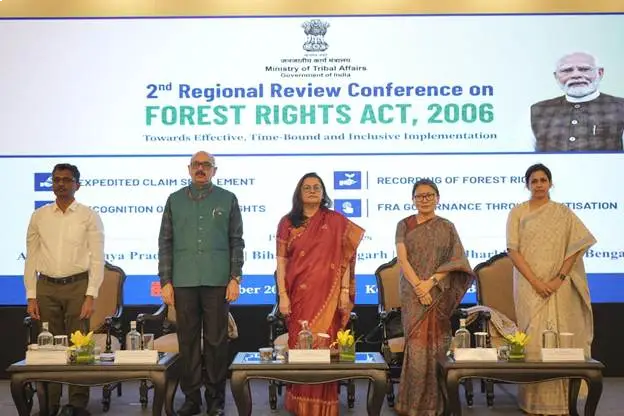
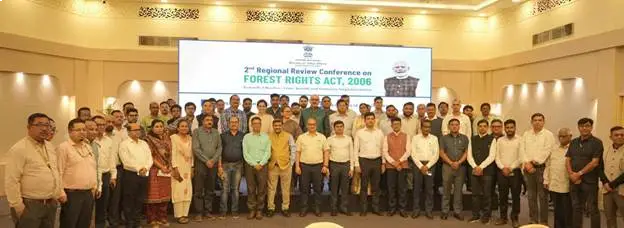
At the Second Regional Review Conference on the implementation of the Scheduled Tribes and Other Traditional Forest Dwellers (Recognition of Forest Rights) Act, 2006, held in Kolkata on Friday, the Centre also emphasised the need to expedite the recognition of Community Forest Resource Rights (CFRR) and habitat rights for Particularly Vulnerable Tribal Groups (PVTGs), while ensuring that forest-dwelling communities can effectively exercise their legally recognised rights.
According to data presented by the Ministry, more than 54 lakh claims had been received nationally as of August 31, 2026, and around 25 lakh titles had been distributed. Approximately 11 lakh claims remained pending at various stages, while more than 18 lakh claims had been rejected.
Madhya Pradesh, Odisha and Assam account for substantial pendency, with backlogs concentrated in particular districts. The conference called for focused administrative intervention in these areas and time-bound action to resolve outstanding claims.
Officials from West Bengal, Assam, Tripura, Jharkhand, Odisha, Bihar, Madhya Pradesh and Chhattisgarh participated in the review, along with senior district-level functionaries from areas reporting high pendency. Andhra Pradesh was invited to share its experience in digitising forest rights records, integrating titles into government databases and linking rights holders with livelihood schemes and credit facilities.
From recognition of rights to their effective implementation
A key emphasis of the conference was that distributing forest rights titles must be followed by their incorporation into revenue and forest records, accurate mapping of recognised rights and access to development benefits.
The MoTA stressed that Community Forest Resource Rights must translate into effective community control and management. Gram Sabhas need institutional and technical support to prepare and implement Community Forest Resource Management Plans, with the authority of Gram Sabhas remaining central to the process.
States were urged to operationalise the joint advisory of the Ministry of Tribal Affairs and the Ministry of Environment, Forest and Climate Change, which provides for the integration of community forest management plans with the working and management plans of Forest Departments.
Financial assistance under the Dharti Aaba Janjatiya Gram Utkarsh Abhiyan (DA-JGUA) is available to support Gram Sabha capacity-building and the preparation and implementation of community forest management plans, the Ministry said.
The conference also called for PVTG-specific roadmaps for recognising habitat rights. These must be developed sensitively, with the active participation of traditional institutions and Gram Sabhas across the concerned villages.
The Ministry highlighted Odisha and Chhattisgarh for their experience in recognising PVTG habitat rights and their record in recognising individual forest rights claims. Andhra Pradesh’s initiatives in digitisation and maintaining records of rights holders were also cited as practices that other States could adapt.
Digital records and district-level action plans
Digitisation and the integration of forest rights data emerged as another priority. The Ministry demonstrated the national FRA portal and mobile application, which can support digitisation, geospatial integration and data-driven decision-making in forest rights administration.
States were urged to integrate their existing FRA databases with the national system through application programming interfaces (APIs), reconcile discrepancies in reported data and address delays in submitting monthly progress reports.
The Ministry also emphasised the need to incorporate recognised forest rights into revenue and forest records in accordance with its June 24, 2026, advisory. Officials were asked to prepare action plans to strengthen Gram Sabhas, spread awareness of rights under the Act and provide post-title support to beneficiaries.
Convergence with government programmes covering productive land use, housing, livelihoods and credit was identified as essential to ensure that recognised rights lead to tangible improvements in the lives of forest-dwelling communities.
State representatives presented their respective implementation status, including pending and rejected claims, progress on individual and community rights, PVTG habitat rights, record integration and digitisation. They also outlined proposed measures for time-bound disposal of claims and stronger coordination among Tribal Welfare, Revenue and Forest Departments.
The Kolkata meeting followed the first regional review conference, held in Bengaluru on September 10, 2026, for southern States. The latest review placed the focus on district-level accountability, better data management and a shift from the formal recognition of forest rights to their effective exercise and linkage with development support.