








Today marks the beginning of the 10-day festival of Lord Ganesha. Over the centuries, Lord Ganesha’s worship has evolved into a powerful public and community celebration. Today, the idol moves from the sculptor’s workshop to homes and streets before finally returning to water, completing a remarkable cycle of creation, celebration and farewell.
Few Hindu deities are as instantly recognisable as Ganesha, yet behind that familiar elephant-headed form lies a vast collection of stories, symbols and traditions. Different Puranas, regional traditions, temple legends and oral narratives have added their own layers to his story. As a result, the same episode may appear with different characters, circumstances or explanations, without necessarily diminishing its importance.
A Boy at the Door
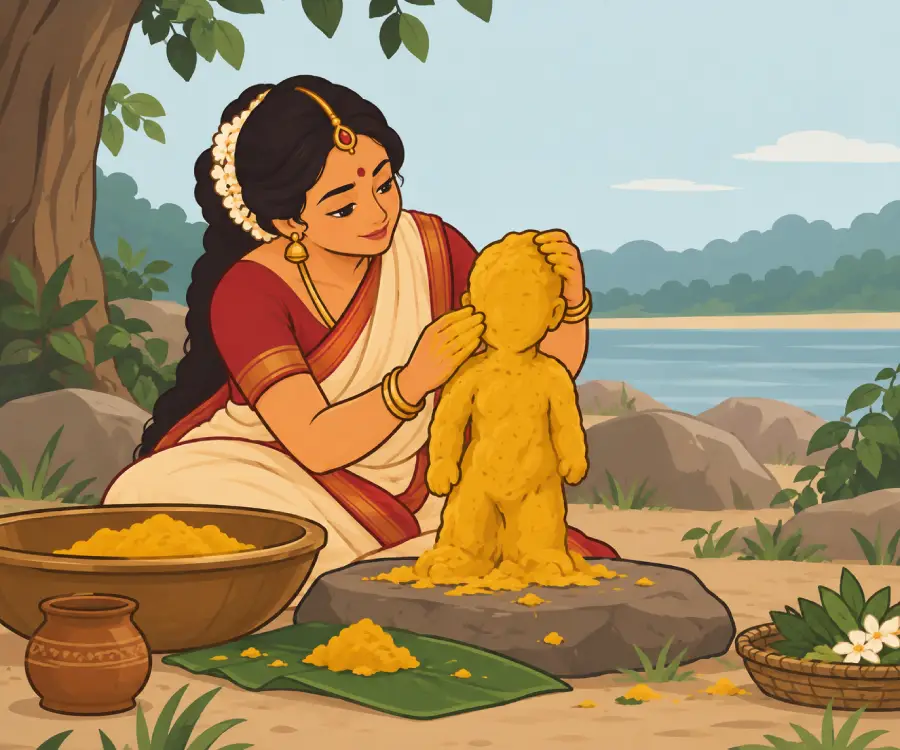
In one of the most widely told versions of Ganesha’s birth, Parvati wished to bathe without being disturbed. She fashioned a boy from the turmeric/sandalwood paste or material from her own body and brought him to life. She then gave him a simple instruction: guard the entrance and allow no one inside.
When Shiva returned, the boy stopped him. He did not know who Shiva was. More importantly, he had been told not to let anyone pass. Shiva’s attendants tried to move him. The boy refused. A confrontation followed. In the popular telling, Shiva, enraged by the defiance, severed the boy’s head.
Parvati’s grief and fury transformed the quarrel into a crisis. To restore her son, Shiva ordered that the head of the first suitable living being found be brought. An elephant was found, and his head was placed on the boy’s body. Thus, Ganesha was restored.
The Elephant Head
The elephant is associated with strength, memory and deliberation. It is powerful without being hurried. That makes it an apt image for a deity invoked before beginnings and remembered as Vighnaharta, the remover of obstacles. The human head symbolizes ego and ignorance, while the elephant head signifies the triumph of divine consciousness and humility.
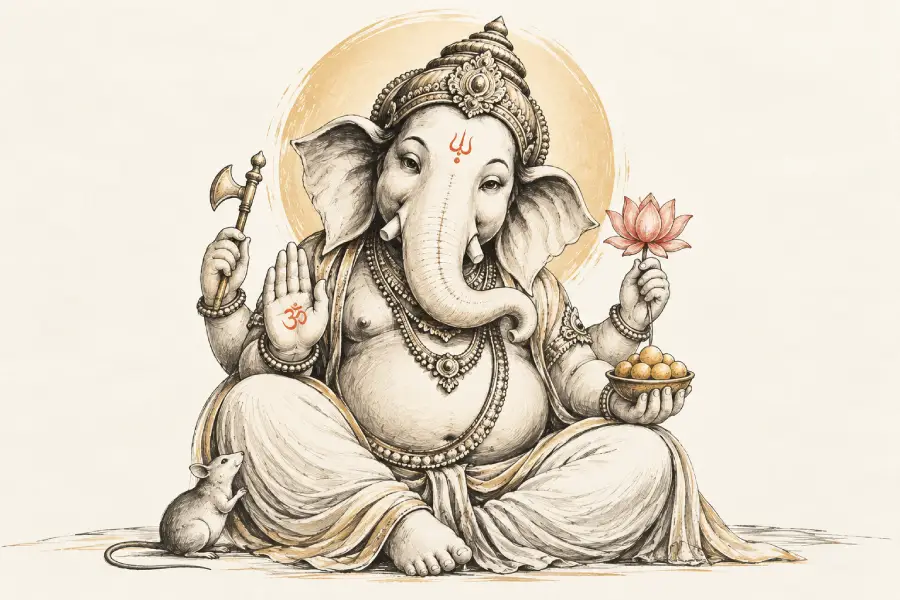
The broad head, large ears, and curved trunk create a figure that appears powerful and alert rather than warlike.
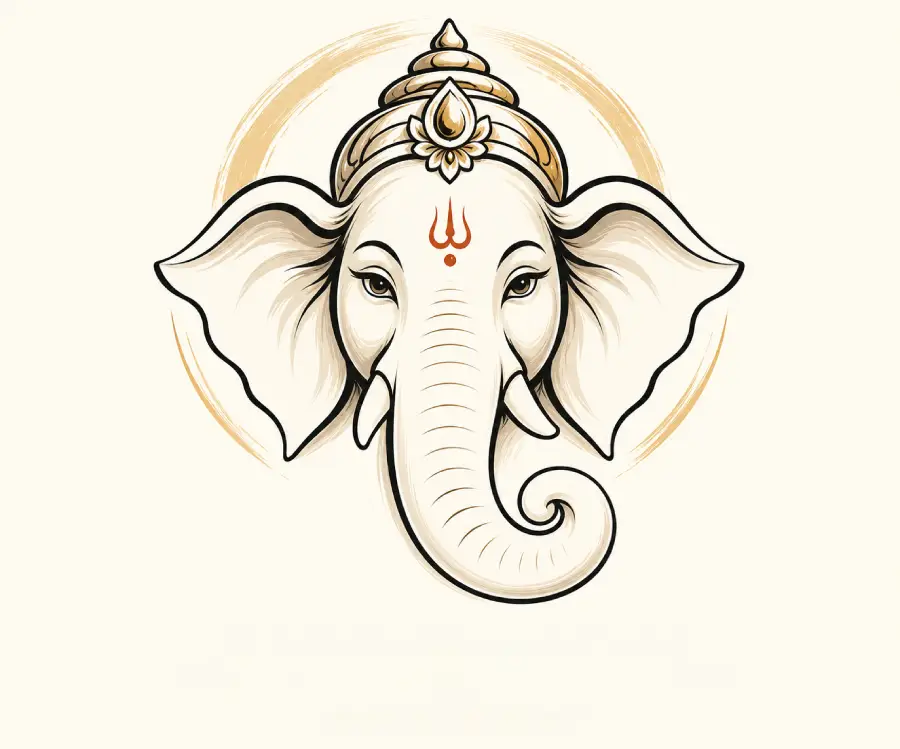
The ears are traditionally associated with listening, while the small eyes are linked with concentration. The trunk offers another striking contrast: it can move something heavy and handle something delicate. Together, they belong to one face rather than a catalogue of symbols.
Why is Ganesha worshipped first?
One of the most popular stories about Ganesha’s wisdom tells of a contest between him and his brother Kartikeya. Shiva and Parvati challenged their sons to circle the world and return first. Kartikeya immediately mounted his peacock and set off, confident that his speed would win the race.
Ganesha, knowing that his mouse could never match the peacock, paused to think. He then respectfully walked around Shiva and Parvati and declared that he had completed his journey around the world because his parents represented his entire universe.
Impressed by his insight, Shiva and Parvati declared Ganesha the winner. Different traditions vary on the details: some versions describe three circumambulations, while the Shiva Purana gives seven in connection with a marriage contest.
The story endures as a simple lesson in wisdom over haste. Kartikeya travelled across the world; Ganesha understood that sometimes the greatest journey is achieved through knowledge, discernment and devotion.
Him being worshipped before other deities is thus associated with beginnings, wisdom and the removal of obstacles.

The broken tusk
Ganesha is known as Ekadanta, the one-tusked one. One of the best-known traditions connects the broken tusk to the writing of the Mahabharata. According to the story, when Ganesha’s writing instrument broke while recording Vyasa’s dictation, he broke off his own tusk and continued. The image has stayed alive for centuries because it is so physical: a broken writing tool, a task that cannot stop, and a tusk turned into an instrument. It also gives Ganesha an unusual imperfection. The God is not represented with an untouched, flawless face. One side is visibly different from the other.
The belly, the mouse and the modak
The round belly is traditionally associated with the ability to contain and digest life’s experiences—the pleasant as well as the difficult.
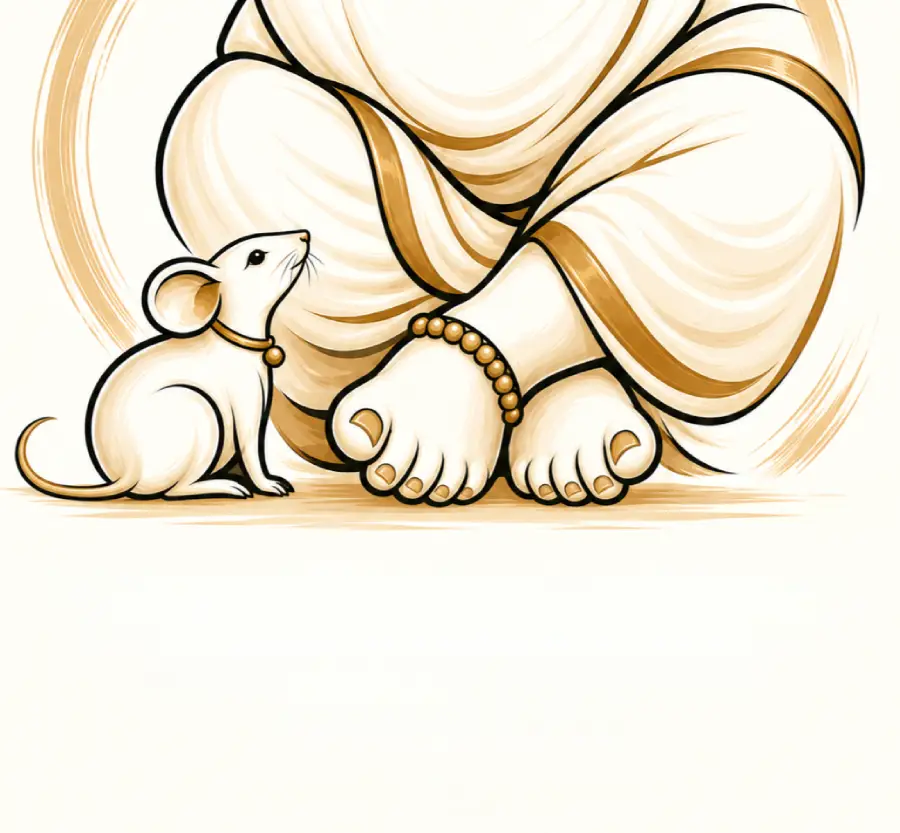
Ganesha rides a mouse, which represents human desire and ego. A mouse is naturally restless and chews through everything. By sitting on it, Ganesha shows that he has completely controlled his desires and ego.
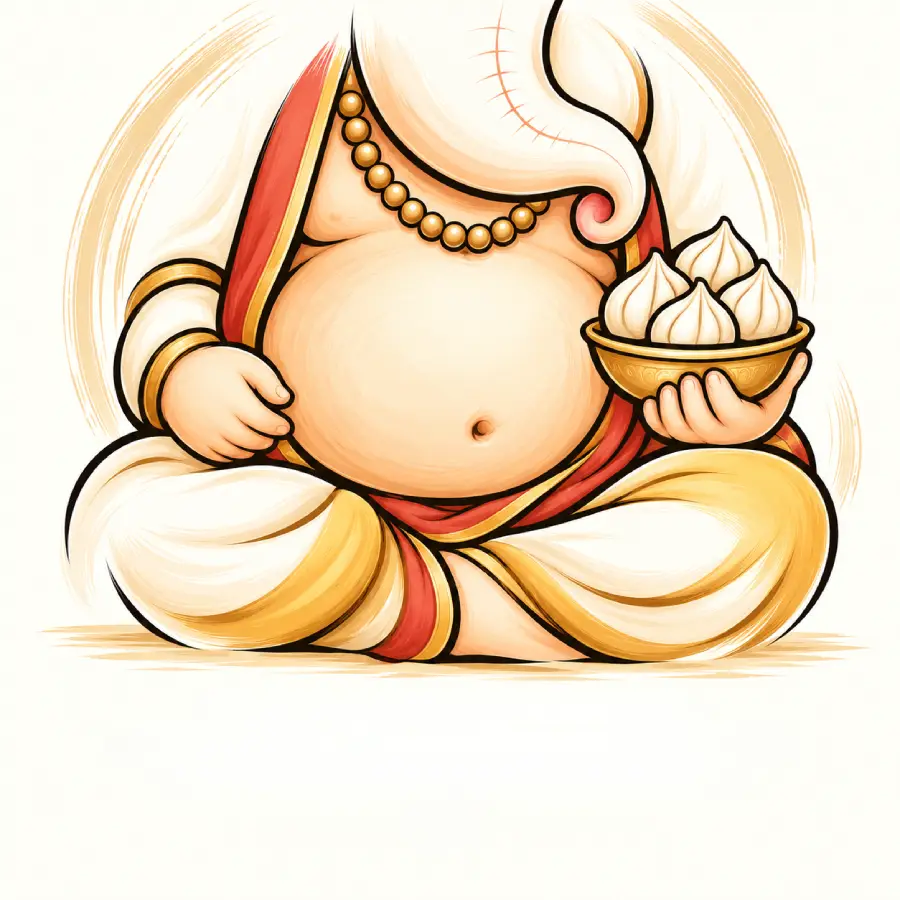
The modak in Ganesha’s hand adds another layer. Traditionally associated with the sweetness or reward of knowledge and spiritual effort, it is also simply the sweet that children look forward to seeing beside the idol, and of course, eating it too after the Puja.
Perhaps that is part of Ganesha’s appeal. His image can carry an elaborate philosophical meaning while remaining familiar enough for a child to point at the mouse and ask why a god would ride it.
Before the city wakes, the sculptors are already at work. In a small workshop, the floor is coated with dried clay and has a reminiscing of a faint, earthy smell, and rows of Ganesha idols sit waiting- some no taller than a hand and some so big it requires a ladder to reach the top. An artisan leans forward to give the tusk its final touch. Another carefully paints the eyes. Outside, devotees have already arrived to find the one to take home. For the shopkeeper, it’s the final stage of weeks of work, but for people outside, it’s the beginning of Ganesh Chaturthi. Soon, the idol will sit in homes or pandals. But pause before the first aarti and look at Ganesha; isn’t he uniquely made? An elephant’s head sits where we expect a human one. Enormous ears sit beside small, concentrated eyes. His trunk curves downwards. One tusk is broken. His stomach is round. A tiny mouse waits beneath him. Even the day on which this familiar figure arrives is not an arbitrary date marked on a modern calendar. The festival is thus tied to the moon’s position in relation to the sun. That is why its date moves from year to year on the Gregorian calendar.
How did Ganesha humble Kubera, God of wealth?
Another tale brings Ganesha’s appetite into the picture. Kubera, the God of Wealth, is said to have grown proud of his riches and invited Shiva and Parvati to a lavish feast, eager to display his abundance. They sent Ganesha instead. Ganesha ate. And kept eating.
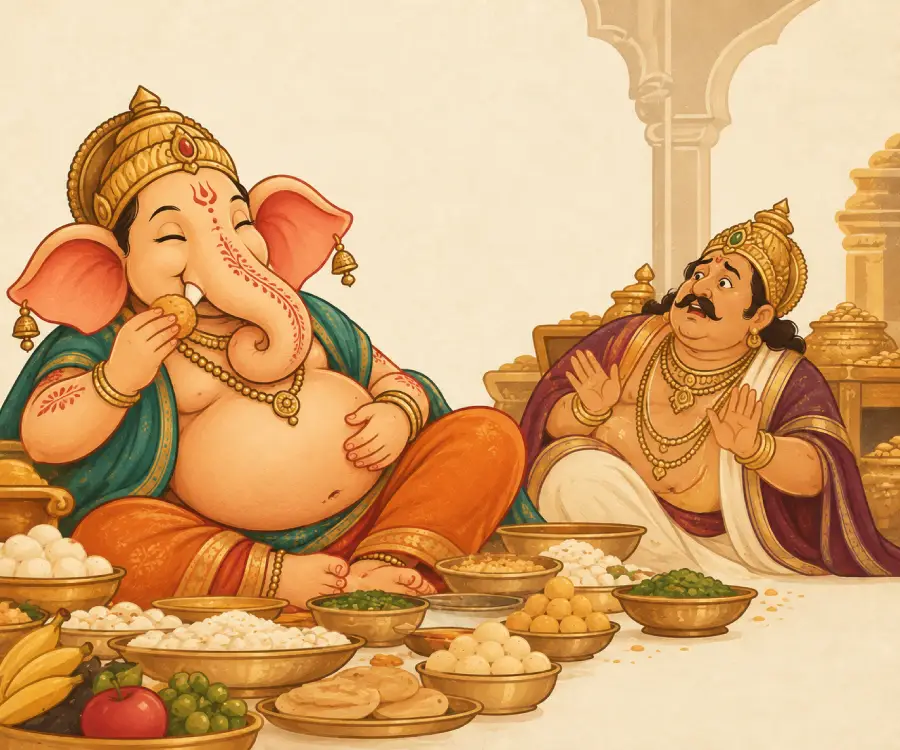
Kubera’s kitchens could not keep up. His stores were emptied, but Ganesha’s hunger remained. In popular retellings, a humbled Kubera finally turns to Shiva, who tells him to offer Ganesha a simple meal with humility rather than pride. It also explains why the large belly and the love of food have remained part of the popular imagination around Ganesha.
Why do some avoid looking at the moon on Ganesh Chaturthi?
Ganesh Chaturthi makes the Moon part of the festival, in an unwanted way going by a traditional belief: That one should avoid looking at the Moon on that day. The belief is linked to a story in which Chandra, the Moon god, laughed at Ganesha’s appearance after seeing him riding his mouse. Angered by the mockery, Ganesha cursed Chandra. In later tradition, the curse became associated with the belief that seeing the Moon on Ganesh Chaturthi could bring false accusations or undeserved blame.
The belief belongs to mythology and religious tradition, not astronomy.
Yet the Moon has another role in the festival, one that is entirely tied to the way the date itself is calculated.
A date written in the sky
Ganesh Chaturthi is observed on Shukla Paksha Chaturthi, the fourth tithi of the waxing fortnight in the Hindu month of Bhadrapada. The Gregorian calendar on the wall is solar. The traditional Hindu calendar is broadly lunisolar, combining the Moon’s cycles and the solar year into one system.
From one new moon to the next is about 29.5 days. Twelve lunar months add up to roughly 354 days, around 11 days shorter than a solar year. Without periodic adjustments, lunar observances would gradually drift through the seasons. The calendar therefore uses an additional month, adhika masa, when required to bring the lunar and solar cycles back into alignment. The word Chaturthi carries a finer calculation.
A tithi is not simply a numbered calendar date. In traditional astronomical calculation, each tithi corresponds to a 12-degree increase in the angular separation between the Sun and Moon. Chaturthi is the fourth such interval.
So, the festival date printed on a phone or wall calendar is, in a sense, the modern translation of a relationship being measured in the sky.
How did Ganesh Chaturthi become a public festival during the British Government?
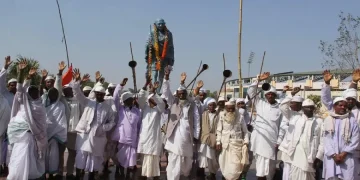
Ganapati worship existed long before the modern public festival, but in the late 19th century Bal Gangadhar Tilak helped turn Ganesh Chaturthi into a larger public celebration in Maharashtra. At a time when colonial rule restricted political mobilization, community gatherings around the festival offered a space where people could come together, and cultural programs and nationalist ideas could circulate.
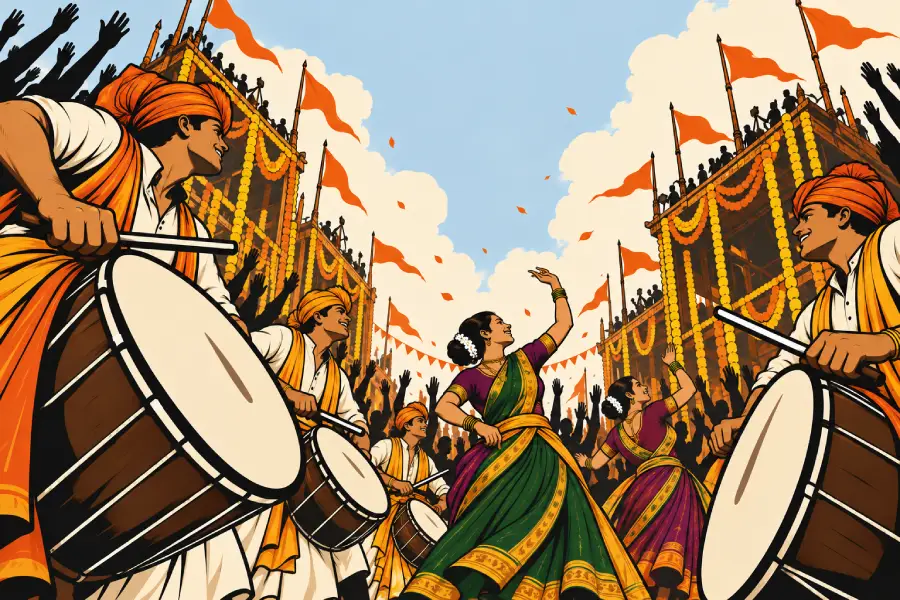
The change can still be seen every year. Ganesha leaves the private shrine and enters the street. The pandal becomes a temporary meeting place, and worship is joined by music, food, art, and the sheer activity of a neighbourhood.
Why is Ganesh Chaturthi celebrated for 10 Days?
The major public observance of Ganesh Chaturthi traditionally runs from Bhadrapada Shukla Chaturthi to Anant Chaturdashi, when Ganesh Visarjan takes place. This is why the festival is commonly described as a 10-day celebration.
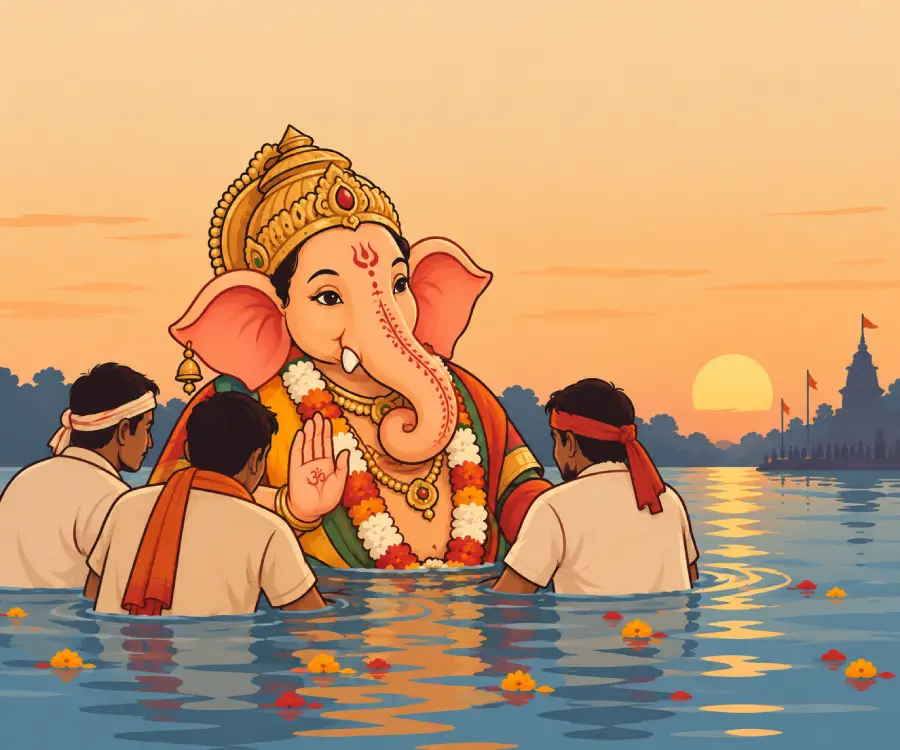
There is also a popular story that connects the ten days with the writing of the Mahabharata. According to tradition, sage Vyasa dictated the epic while Ganesha wrote it without stopping. The work is said to have continued for ten days. By the end, Ganesha’s body had become heated from the uninterrupted effort, and water immersion was believed to cool him. This is how the ritual of Visarjan (immersion) too is said to have started.
Those days allow the festival to expand beyond the moment of installation. Ganesha becomes part of the rhythm of daily life: morning prayers, evening aartis, visitors, offerings, and neighborhood gatherings.
(Disclaimer: There is no single universally authoritative version of the many tales associated with Lord Ganesha. The above compilation is made based purely on popular versions. Images are AI-generated)