








Mumbai/New Delhi
The protest by tribal students in Maharashtra over hostel eligibility, living conditions and rules governing government-run residential facilities has widened politically into a larger confrontation over the state’s tribal education policy even as students continued their agitation despite partial changes announced by the government.
The immediate trigger was a government resolution issued on August 5 imposing a 26-year upper age limit for admission to government tribal hostels and restricting residents from participating in hunger strikes, protest marches and similar activities. Following protests across the state, the government revised the order on August 14, removing the explicit restrictions on protests and raising the age ceiling to 30.
But the concessions failed to end the agitation.
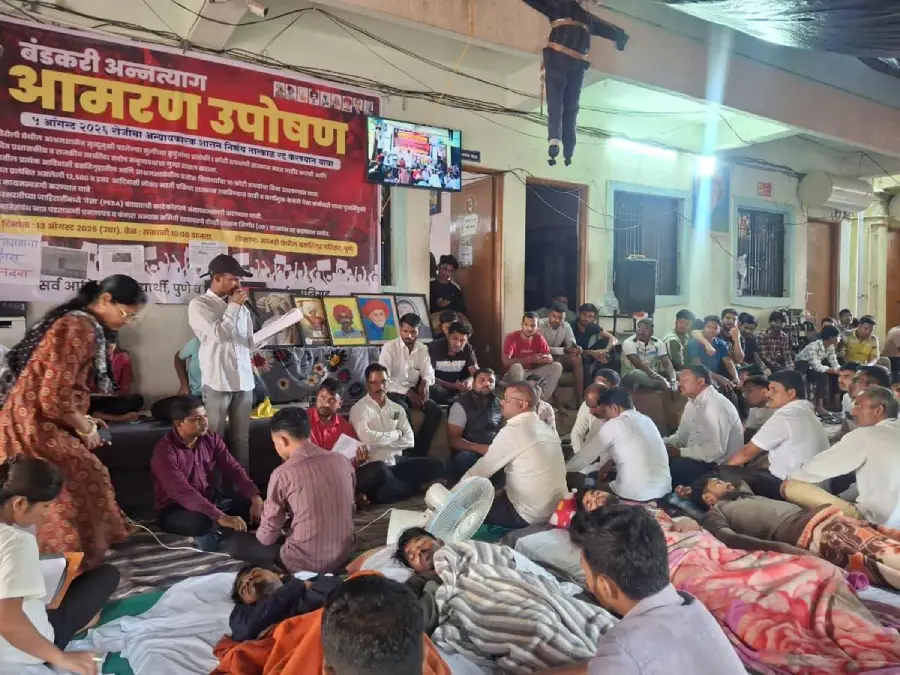
At the Adivasi Government Boys’ Hostel in Manjari, Pune, six students remained on an indefinite hunger strike on Tuesday, with one of them hospitalised after his health deteriorated. Other students continued a sit-in at the hostel, while protesters demanded withdrawal of the August 5 and August 14 government resolutions and issuance of a fresh order.
The students’ demands extend beyond the age issue. Their memorandum seeks removal of the 30-year ceiling, changes to medical requirements for female students, inflation-linked revision of maintenance allowances, improved hostel infrastructure and safety, a separate central hostel for tribal women in Pune, recruitment against more than 12,500 vacancies in hostels and ashram schools and greater student representation in policymaking.
Rahul asks Fadnavis to intervene
The issue acquired a national political dimension after Congress leader Rahul Gandhi met tribal students during his ‘Chhatron Ki Goonj’ programme in Pune on August 22.
In an open letter to Maharashtra Chief Minister Devendra Fadnavis on August 24, Rahul said tribal students had been on hunger strike for more than 10 days and described the rules brought to his notice as measures that “strip them of their dignity and shut off their path to education”. He specifically referred to the 30-year age limit, “humiliating rules”, unsafe facilities and what students described as pregnancy checks for women returning after an extended absence.
“These students, coming from remote villages and towns, are not asking for charity, they are demanding what is theirs by right,” Rahul said, urging Fadnavis to meet the students personally and resolve their grievances immediately.
The allegation concerning pregnancy tests has become one of the most contentious aspects of the dispute. The students and Rahul have raised it as a question of dignity, while the government has denied that any such test is mandated. Maharashtra Tribal Development Minister Ashok Uike has said students returning after extended leave are asked to produce a fitness certificate for health reasons.
That competing account makes the underlying government orders and departmental instructions particularly important. The documentary record, rather than political claims from either side, will ultimately establish what medical examination is actually prescribed.
Uike hits back at Rahul
Uike responded sharply to Rahul’s intervention, accusing him of arriving late to the issue.
“Rahul Gandhi ji, whenever you come, you always arrive late!” Uike said in a post on X. He claimed that tribal students in Nagpur and Chandrapur had withdrawn their hunger strikes before Rahul’s Pune programme and accused Congress leaders of failing to give him complete information. He also described Rahul’s Pune programme as a “paid PR program”.
The Minister argued that the government had already responded to the students by raising the hostel age limit from 26 to 30. The revised order itself records that the change was made after student representatives raised difficulties with the earlier limit.
The government has also sought to address the concern of students who cross the hostel age limit through the Pandit Deendayal Upadhyay Swayam Yojana, under which eligible students can receive financial assistance instead of hostel accommodation. Officials have argued that the intention is to ensure that no tribal student’s education is discontinued merely because hostel accommodation is unavailable. Yet that argument has not persuaded the protesters in Pune.
Aaditya says students have still not been heard
The continuing hunger strike has provided the Opposition with an opportunity to challenge the government’s claim that the issue is being resolved.
Shiv Sena (UBT) leader Aaditya Thackeray, reacting to Uike’s response, said: “His (Uike’s) press conference didn’t really have an impact because the students are still protesting and have not yet felt heard.”
Other Opposition leaders have also joined the issue. NCP (SP) MLA Rohit Pawar and Sujat Ambedkar visited the protest site on Tuesday, while NCP (SP) MP Supriya Sule spoke to students by phone and assured them that a discussion with the government would be held.
Government’s concessions have produced mixed results
The government’s response has therefore produced a mixed outcome. The first major concession came after the August 5 GR triggered protests: the government withdrew the provision explicitly preventing hostel residents from participating in protests. It also increased the age limit from 26 to 30. More than 1,000 ST students had earlier joined a sit-in in Nagpur, forcing the government into discussions with student representatives and eventually the revised GR.
The result has been a partial de-escalation in some places. Students in Nagpur and Chandrapur have suspended their agitation following assurances from government representatives. But the Pune protest has continued, demonstrating that the concessions have not addressed the protesters’ wider demands.
On Tuesday, a delegation of Pune protesters met Uike in Mumbai in a meeting that lasted about five hours. Uike asked them to end their hunger strike before a meeting with Fadnavis could be arranged. The students, however, insisted that they would not call off the fast without written assurances or concrete changes to the government resolutions.