









Patna
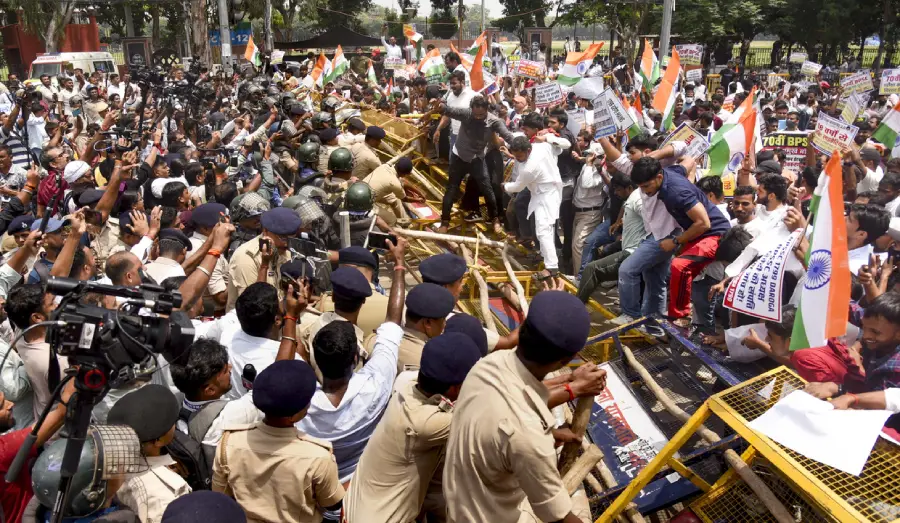
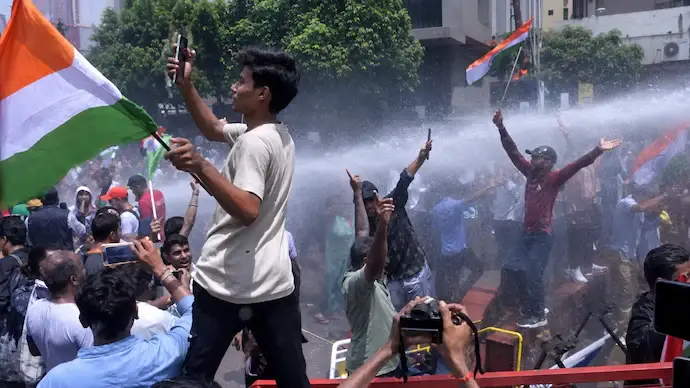
The ongoing protests by aspirants over the controversial 70th Bihar Public Service Commission examination escalated into a confrontation with police in Patna on Tuesday, with demonstrators breaking through barricades in their bid to gherao the Chief Minister’s residence and the police using water cannons and lathi charge. There were instances of stone-pelting too leading to injuries to some police personnel.
The protesters were marching from Gandhi Maidan when they encountered heavy barricading at Dak Bungalow Chowk. More than 200 police personnel have been deployed in the area, as authorities attempted to prevent the demonstrators from moving into the restricted zone.
The immediate demand is the cancellation of the 70th BPSC Combined Competitive Examination, which has been at the centre of an extended dispute over alleged irregularities, paper-leak claims and the Commission’s decision to conduct a re-examination only for candidates at an affected Patna centre. The students have been protesting at Patna’s Gardanibagh area for weeks, with their main demands including a single-tier examination in BPSC-TRE 4, transparency in the recruitment process, recruitment exams by the Bihar Staff Selection Commission (BSSC) and fair opportunities for Hindi-medium candidates.
The confrontation in Bihar comes against the backdrop of student mobilisations in Delhi and Jharkhand over alleged examination irregularities and paper leaks, making the latest Patna agitation part of a wider national conversation about the credibility of competitive examinations and the handling of student protests.
The protests in Delhi by the newly-formed Cockroach Janata Party led to violence and subsequent police action but ultimately culminated in the resignation of the then Union Education Minister Dharmendra Pradhan.
In Jharkhand, protests over recruitment examinations escalated a few days ago, with police using tear gas, batons and water cannon after demonstrators marched towards the state legislature. While the State government moved to cancel an array of competitive examinations, the Jharkhand High Court has since stayed the decisions, laying the ground for another round of confrontation between the two sides.
Why are students demanding cancellation of the 70th BPSC exam?
The dispute dates back to the preliminary examination held on December 13, 2024. The controversy initially centred on the Bapu Pariksha Parisar examination centre in Patna, where candidates alleged irregularities, including problems relating to the distribution and handling of question papers. BPSC subsequently annulled the examination held at that centre and conducted a re-examination for the affected candidates on January 4, 2025.
The Commission, however, rejected demands for cancellation of the examination across Bihar. Its position was that the problems were confined to the affected centre and did not justify scrapping an examination conducted at hundreds of other centres.
BPSC Examination Controller Rajesh Kumar Singh had maintained that the examination would not be cancelled and that the main examination would proceed as scheduled. The Commission’s position effectively established the central fault line in the dispute: whether an irregularity affecting one centre can be treated as a localised problem or whether allegations surrounding the integrity of the examination require a state-wide re-test.
The argument over a statewide re-examination
For protesting aspirants, the issue has never been limited to Bapu Pariksha Parisar. Their argument has been that if one centre’s examination had to be annulled because of irregularities, the Commission should establish beyond doubt that candidates elsewhere were not similarly disadvantaged.
That demand received political backing from leaders including RJD leader and Bihar Assembly Leader of Opposition Tejashwi Yadav. During the earlier phase of the agitation, Yadav supported the demand for cancellation and re-examination, citing allegations that question papers were distributed late at some centres and that papers were allegedly not properly sealed.
Union minister and Lok Janshakti Party (Ram Vilas) leader Chirag Paswan had also supported the demand for cancellation during the earlier agitation, saying he had been told that question papers were inadequate at some centres and were printed after the examination had begun. He questioned why a re-examination had been ordered for one centre if the Commission was completely satisfied with the examination process elsewhere.
The political backing has, however, evolved over time. The latest protest is taking place under a different political and administrative context from the original 2024-25 agitation.
A crucial development: the 70th BPSC cycle has already ended
The present controversy has an unusual dimension. The 70th BPSC final result was declared in June 2026, after the preliminary examination, mains examination and interview process had been completed. Shraddha Pandey topped the final merit list with 593 marks, while Shashank Gaurav and Ayush Bijoy finished second and third respectively. More than 5,400 candidates who cleared the mains were interviewed before the final merit list was released.
This means the present demand is no longer simply for a fresh preliminary examination before the recruitment process advances. It seeks to reopen and effectively invalidate a recruitment exercise that has already passed through the mains, interview and final-result stages. That raises difficult administrative and legal questions: what happens to candidates who have already been selected; whether appointments flowing from the final result can be disturbed; what evidentiary threshold would justify reopening the entire process; and how the rights of successful candidates would be balanced against claims of candidates who allege that the original process was compromised.
These questions remain central to the dispute and require authoritative answers from the Commission and the state government.
New demands broaden the protest
The Patna agitation has also expanded beyond the 70th BPSC examination. Protesters are also seeking a single-stage Teacher Recruitment Examination-4 (TRE 4.0) and abolition of negative marking besides unresolved concerns involving the BPSC, Bihar Staff Selection Commission and Sub-Inspector recruitment processes.
The distinction matters. The demand to cancel the 70th BPSC examination is a specific institutional demand; concerns over TRE 4.0, BSSC examinations, recruitment schedules and examination rules represent a much wider governance issue.
Government says most demands have been addressed
The Bihar government has rejected the suggestion that it is ignoring students.
Education Minister Mithilesh Tiwari said the issues over which the students had been sitting in protest had largely been resolved and invited the protesters for discussions. He said the government remained open to dialogue.
“Let the students come, talk, and get their issues resolved; the government belongs to them,” Tiwari said, according to ANI.
JD(U) leader Shravan Kumar also defended the government’s handling of recruitment-related concerns and said the administration was addressing demands according to rules and law. He linked the state’s recruitment programme to Chief Minister Nitish Kumar’s stated objective of providing one crore jobs and employment opportunities between 2025 and 2030, while accusing the Opposition of attempting to exploit the students’ concerns politically.
The government’s position therefore rests on two arguments: that many grievances have already been addressed, and that the remaining dispute should be resolved through dialogue rather than street confrontation.
Tejashwi attacks BPSC over ‘dog-barking’ remark
The political temperature rose further after BPSC Examination Controller Rajesh Kumar’s reported response to questions about allegations of irregularities. Kumar invoking a Hindi proverb that translated to “An elephant walks through the market while a thousand dogs bark.” It instantly triggered an immediate political backlash.
Tejashwi Yadav demanded that Kumar be removed and apologise, arguing that such language towards protesting students was unacceptable. He also accused the government of failing to establish accountability for repeated examination controversies.
The controversy over the remark is important because it changes the political framing of the dispute. What began as a technical argument about examination integrity has increasingly become a question of whether public institutions are treating aspirants with the respect and sensitivity expected of recruitment authorities.
From Delhi to Jharkhand to Bihar: a wider youth trust deficit?
The Patna confrontation comes at a time when examination-related protests have become a recurring national political flashpoint.
In Delhi, youth protests over examination controversies escalated into a much larger mobilisation during July and August. The Supreme Court has since constituted a special panel to examine allegations of violence connected with recent youth protests, including allegations concerning police action. Delhi Police has separately told the Supreme Court that facial-recognition technology used during a Jantar Mantar protest was targeted at known criminals or history-sheeters and that police exercised what it described as “maximum restraint but minimum required force”.
In Jharkhand, protests over alleged irregularities and paper leaks in government recruitment examinations began in July and escalated in August. Thousands of young people marched towards the state legislature, where police used tear gas, batons and water cannon after the demonstration intensified. The state government subsequently agreed to several demands, including cancellation of examinations and investigations into alleged irregularities, while protesters continued to press for wider accountability.
What happens next?
The immediate question is whether the Bihar government can move the dispute from the streets to a credible institutional forum. The administration has invited students for dialogue, while protesters continue to demand cancellation of the 70th BPSC examination and changes in other recruitment processes.
With the Jharkhand instance in mind, the more difficult question is whether cancellation remains administratively possible or legally sustainable now that the examination cycle has culminated in a final merit list.
Bihar CM Launches ‘Vidyarthi Sahyog Shivir’
Amid the ongoing protests by students and job aspirants in Patna’s Gardanibagh area and the resultant police action, Bihar Chief Minister Samrat Choudhary on Tuesday inaugurated a ‘Vidyarthi Sahyog Shivir’ (student support camp) at Bihar College of Engineering in Vaishali’s Bidupur as part of the ‘Saat Nishchay-3′ programme. The initiative aims to ensure effective and time-bound resolution of students’ grievances in educational institutions across Bihar. The camps, which would be organised on the fourth Tuesday of every month at educational institutions, will ensure that complaints and suggestions related to academic arrangements, examinations, hostels, drinking water, toilets, canteens and other student-related issues are heard and addressed.