










New Delhi
The Supreme Court on Monday issued notices to the Centre, Jharkhand government, Jharkhand Public Service Commission (JPSC), CBI and other respondents on a public interest petition seeking an independent and time-bound investigation into alleged irregularities in the Jharkhand Combined Civil Services Preliminary Examination.
A Bench headed by Chief Justice Surya Kant and comprising Justices Joymalya Bagchi and V Mohana sought responses from the respondents on the petition filed by social activist Harisharan Devgan through advocate Satyam Singh Rajput. Senior advocate Manan Kumar Mishra, appearing for the petitioner, told the court that the plea seeks either a CBI investigation or an inquiry by a former Supreme Court judge.
The petition, filed under Article 32 of the Constitution, raises what it describes as serious concerns over the “integrity, fairness, transparency and credibility” of the Jharkhand Combined Civil Services Preliminary Competitive Examination-2025. The examination was conducted by JPSC on April 19, 2026, pursuant to Advertisement No. 01/2026, and is also referred to as the 14th JPSC Civil Services Preliminary Examination.
What is at the centre of the JPSC controversy?
The immediate controversy intensified after the preliminary examination results were declared on July 2. According to the petition, a carbon copy of an OMR answer sheet of a successful candidate subsequently circulated on social media, prompting questions about the evaluation process. The petitioner has alleged that the candidate was shown as having qualified despite having attempted only 48 of the 100 questions in Paper I. The allegation has not been established as fact and is among the issues the proposed investigation is intended to examine.
The petition seeks a probe covering the entire examination chain, rather than focusing only on individual candidates. It specifically refers to question-paper preparation and printing, coding, storage, transportation and distribution; conduct of the examination; collection and custody of OMR sheets; scanning, coding and decoding; evaluation; electronic examination data; and generation and publication of results.
The petitioner has also sought immediate preservation of physical and digital evidence, including original OMR sheets, candidate-held carbon copies, question papers, answer keys, attendance and biometric records, CCTV footage, dispatch registers, examination-centre reports, scanning records, server audit logs and evaluation and result-generation data. The stated objective is to prevent any possible alteration or loss of evidence while the allegations are examined.
CJI flags need for investigation, forensic examination
During Monday’s hearing, Mishra proposed either a CBI inquiry or an investigation by a former Supreme Court judge. The Chief Justice, however, indicated that the allegations appeared to require an investigation rather than a conventional inquiry, pointing to the possible need for forensic examination and other investigative techniques.
“These are not inquiries. This is an investigation. There is forensic examination required or something else. All these things can be done by an agency,” the CJI observed.
The petition alternatively seeks an independent committee headed by a retired Supreme Court judge or a retired Chief Justice or judge of a High Court from outside Jharkhand, with experts in forensic science, information technology, examination security, OMR evaluation, cybersecurity and public administration. It has also sought independent audits of OMR scanning, coding, evaluation and result-generation systems.
Importantly, the petition itself acknowledges that allegations or protests alone cannot establish malpractice. It says the question of whether the examination should ultimately be relied upon should be determined on the basis of objective and scientifically verifiable evidence.
Examination row amid wider Jharkhand recruitment crisis
The Supreme Court development comes against the backdrop of a wider and increasingly contentious dispute over the integrity of government recruitment examinations in Jharkhand. The state government recently announced the cancellation of 22 recruitment examinations, including the 11th to 13th JPSC examinations, following weeks of protests over alleged irregularities, while ordering investigations into other recruitment tests.
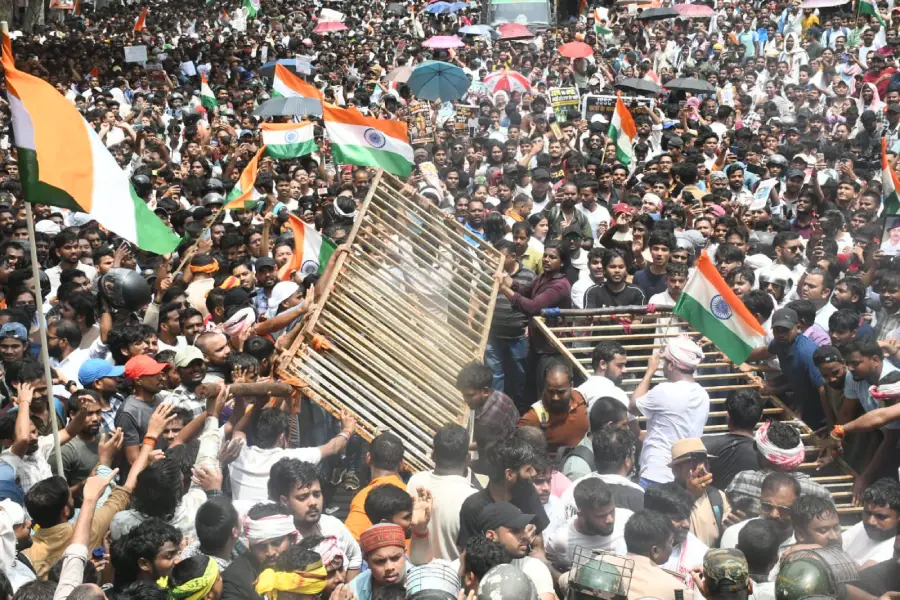
The JPSC controversy is separate from, but politically connected to, the broader agitation by aspirants demanding greater transparency and accountability in the state’s recruitment system. The protests have included hunger strikes and demonstrations, while tensions have also resulted in clashes and police cases in Ranchi.
The legal landscape has simultaneously become more complicated. The Jharkhand High Court on August 20 stayed the state government’s decision concerning cancellation of appointments arising from the 11th and 13th JPSC examinations, adding another layer of uncertainty for candidates and employees affected by the government’s wider recruitment-exam decisions.
Why the Supreme Court notice matters
Factually, Monday’s order does not establish that the JPSC examination was leaked, manipulated or otherwise compromised. Issuance of notice means that the respondents have been asked to respond to the allegations and reliefs sought in the petition; it is not a judicial finding that malpractice occurred.
The larger policy question, however, goes beyond this particular examination. Public recruitment examinations determine entry into the state machinery, and doubts over the integrity of the process can affect both candidates who may have been wrongly excluded and those who qualified fairly. A credible investigation, if ordered, could therefore have implications for how JPSC and other state recruitment bodies secure question papers, maintain OMR and digital evidence, conduct automated evaluation and publish results.
The case also has a wider national resonance. India has witnessed repeated controversies surrounding competitive and public recruitment examinations, making questions of paper security, digital audit trails, independent oversight and accountability increasingly central to examination governance. For Jharkhand, where a series of recruitment controversies has already triggered protests and government action, the Supreme Court’s scrutiny could become an important test of whether the state can restore confidence in its recruitment architecture.