






Chennai
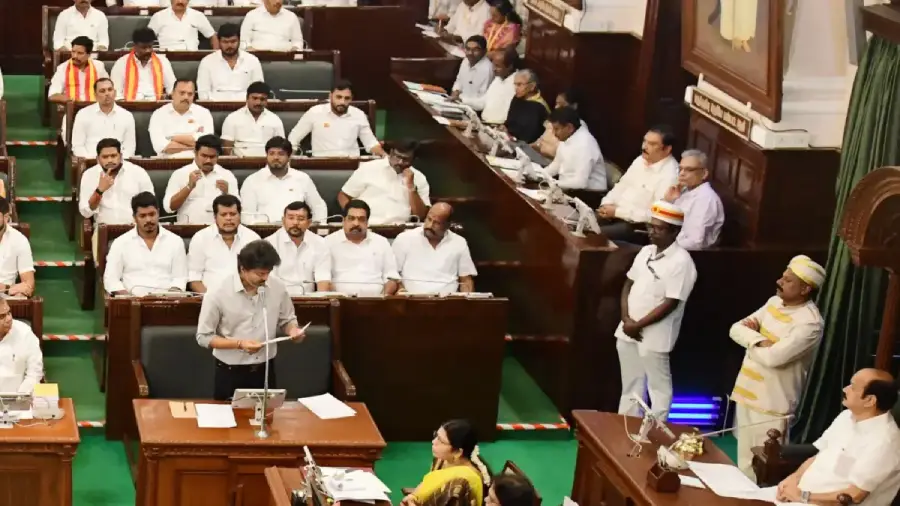
Tamil Nadu Chief Minister C Joseph Vijay on Monday announced a fresh package of welfare measures, including three free LPG cooking-gas cylinders a year for eligible households and a major expansion of the state’s free bus travel scheme for women and transgender persons.
Under the ‘Annapoorani Super Six’ scheme, the government will provide the cost of three LPG cylinders annually to eligible families, with the programme scheduled to begin during the Pongal festival in January. The scheme is expected to cover around 1.30 crore families and entail an annual expenditure of approximately Rs 4,000 crore.
Beneficiaries will reportedly purchase the cylinders through the existing distribution system, with the eligible amount subsequently credited to their bank accounts. The benefit is aimed at families with annual incomes of up to Rs 2.5 lakh.
The Chief Minister also announced an expanded ‘Vetri Payanam’ scheme, under which free bus travel for women will be extended to a wider range of government bus services from October 2, Mahatma Gandhi’s birth anniversary. The expanded facility will cover women travelling on services including Express, Low Speed Shuttle and Deluxe buses in urban and metropolitan areas, besides ordinary-fare government buses operating on mofussil and hilly routes.
Transgender persons will also be brought within the ambit of the expanded free-travel scheme. Reports put the annual cost to the state exchequer at around Rs 6,000 crore, with no income ceiling or limit on the number of journeys.
The announcements deepen the welfare orientation of the Tamilaga Vettri Kazhagam (TVK) government, which came to power in May after breaking the decades-long alternation between the DMK and AIADMK. Vijay’s government had already rolled out or announced a series of measures covering free electricity, women’s safety, education, farmer relief, healthcare, employment and social welfare. Its first Cabinet meeting had outlined a 436-scheme ‘Vetri Tamizhagam Vision Document’, organised around pillars including women’s welfare, youth, farmers, education, healthcare, infrastructure and transparent governance.
Politically, the latest package allows Vijay to reinforce one of the strongest traditions of Tamil Nadu politics — welfare as a direct instrument of social and electoral mobilisation — while also establishing a distinct identity for a government led by a first-time political formation.
The timing is significant because the TVK government has been using its first months in office to demonstrate that its extensive election promises can translate into visible benefits. The emphasis on women, low-income households and transgender citizens also gives the administration a broad social constituency beyond its core political base. This is an analysis based on the policy pattern rather than a claim about voter response.
Socially, the measures address two recurring household pressures: cooking-fuel costs and access to affordable public transport. The LPG reimbursement could reduce recurring expenditure for lower-income households, while the expansion of fare-free bus travel could improve women’s mobility for employment, education, healthcare and other essential activities.
Extending the transport benefit to transgender persons gives the scheme an explicit inclusion dimension. However, the longer-term social impact will depend on effective beneficiary identification, timely reimbursements, adequate bus capacity and whether the enhanced mobility translates into greater economic participation.
The immediate question, however, is not merely how popular the new sops prove to be, but how the government will finance and administer them alongside its wider commitments. The LPG scheme alone is projected to cost about Rs 4,000 crore annually and the expanded bus scheme around Rs 6,000 crore, putting the combined estimated annual burden at roughly Rs 10,000 crore before accounting for the cost of other welfare commitments.
The welfare announcements came on the same day that Vijay announced the scrapping of the proposed Parandur greenfield airport project near Chennai, saying the project would affect agricultural land and the livelihoods of farmers and residents. The government said it would look for an alternative site with a lower impact on agriculture.
The airport decision adds another dimension to the government’s emerging policy positioning: balancing infrastructure-led growth with concerns over land, agriculture and local livelihoods. The move has already triggered political criticism. Former Chief Minister M K Stalin described the decision as an “irreversible setback” to Tamil Nadu’s development, while K Annamalai warned that finding an alternative site and securing approvals could delay Chennai’s second airport by another decade.
“The competing arguments point to a larger policy challenge for Vijay: Tamil Nadu must sustain its position as one of India’s major manufacturing and investment destinations while meeting the social expectations generated by its long-established welfare model. Reuters reported that Tamil Nadu accounts for roughly 15% of India’s factory output and manufacturing employment, underscoring the economic stakes surrounding infrastructure decisions such as the second airport,” an observer said.