

Koraput
The Ministry of Tribal Affairs on Thursday launched a three-year national initiative to conserve medicinal plant biodiversity and develop sustainable livelihood opportunities for tribal communities across 16 identified hotspots in 13 states and Union Territories. The project seeks to combine traditional tribal knowledge of medicinal plants with scientific research, cultivation technologies and bioresource-based enterprises, enabling communities to derive economic benefits from their natural resources.
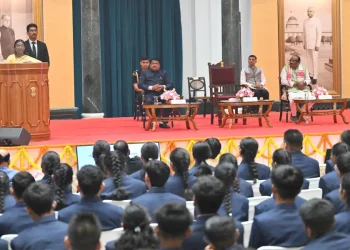
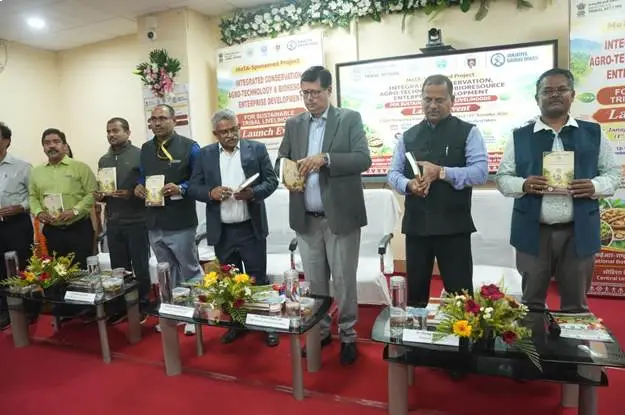
Titled ‘Integrated Conservation, Agro-Technology and Bioresource Enterprise Development for Sustainable Tribal Livelihoods in Tribal Hotspots of India’, the initiative was formally launched at the Central University of Odisha in Koraput in collaboration with the CSIR-National Botanical Research Institute (CSIR-NBRI), Lucknow.
Tribal-dominated districts and regions in Andhra Pradesh, Assam, Chhattisgarh, Gujarat, Jharkhand, Karnataka, Kerala, Ladakh, Madhya Pradesh, Maharashtra, Odisha, Uttar Pradesh and Uttarakhand have been selected.
The project aims to document approximately 200–300 medicinal plant species, scientifically propagate 30–40 rare, endangered and threatened (RET) species, and establish 16 community nurseries and 16 seed banks. It also envisages distributing 40,000–50,000 quality planting materials to support conservation and sustainable cultivation, while building the capacity of tribal communities to develop enterprises based on locally available bioresources.
The 16 selected hotspots are Alluri Seetharama Raju in Andhra Pradesh, Kokrajhar in Assam, Narayanpur in Chhattisgarh, Navsari in Gujarat, East Singhbhum in Jharkhand, Kodagu in Karnataka, Wayanad in Kerala, Kargil in Ladakh, Anuppur in Madhya Pradesh, Gadchiroli and Nashik in Maharashtra, Kandhamal, Balangir and Koraput in Odisha, Sonbhadra in Uttar Pradesh, and Dharchula in Uttarakhand.
An important component of the initiative is the documentation and preservation of traditional medicinal knowledge held by tribal communities, particularly traditional healers and other knowledge holders. The project seeks to ensure that this knowledge is linked with scientific validation, conservation practices and sustainable economic activities.
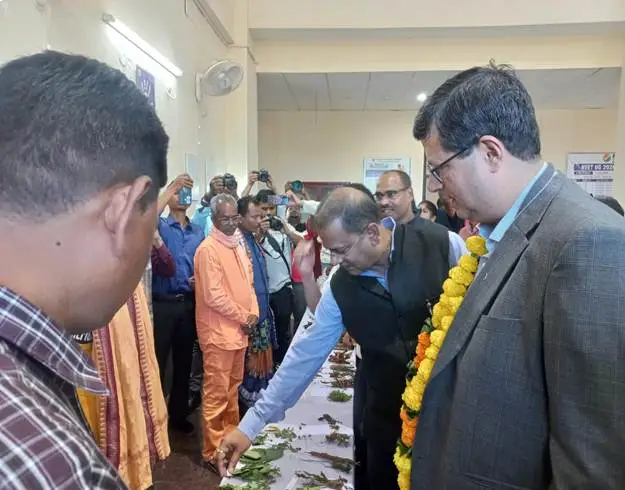
Initial fieldwork has already been undertaken by CSIR-NBRI in Sonbhadra district of Uttar Pradesh during October. The research team interacted with 146 tribal knowledge holders across 12 villages and documented traditional medicinal practices. It collected 97 field numbers, representing approximately 200 medicinal and economically important plant samples. Another 25 live orchid samples were collected for germplasm conservation and multiplication at the CSIR-NBRI Botanical Garden.
The initiative places tribal communities at the centre of biodiversity conservation and livelihood development, with specific emphasis on involving tribal farmers, traditional healers, women and rural youth. It proposes linkages among scientific institutions, Krishi Vigyan Kendras, Van Dhan Vikas Kendras, state Tribal Welfare and Forest Departments and local communities to facilitate cultivation, capacity building and the development of value chains for medicinal plants and other bioresources.
A special technical session titled ‘From Tribal Knowledge to Enterprise’ was organised during the launch programme, bringing together scientists, experts, industry representatives and other stakeholders to explore ways of translating traditional knowledge and medicinal plant resources into sustainable economic opportunities.
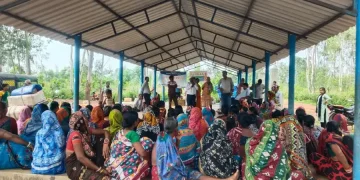
The programme was attended by officials of the Ministry of Tribal Affairs, representatives of CSIR-NBRI, the Central University of Odisha, scientists from the ICMR-National Institute of Health Research, Bhubaneswar, and tribal community representatives. An interaction with tribal farmers and traditional knowledge holders, followed by a field visit to the Koraput tribal hotspot, is scheduled for November 13.
The Ministry aims to develop a replicable institutional model integrating biodiversity conservation, scientific research, preservation of indigenous knowledge and community-led enterprise development.
The initiative also seeks to recognise tribal communities not merely as beneficiaries of conservation programmes but as custodians of India’s biological resources and traditional knowledge, while creating opportunities for them to participate in and benefit economically from the sustainable use of these resources.