


New Delhi
From crafting weapons out of salvaged shipwreck iron to navigating coral reefs in hand-built canoes, the Sentinelese have developed a way of life shaped entirely by their natural surroundings. Protected by strict government non-interference policies, they represent a rare and irreplaceable part of humanity’s ancient cultural heritage.
Who Are They?
The Sentinelese live on North Sentinel Island in the Andaman and Nicobar archipelago. Their continued resistance to outside contact makes them one of the world’s most isolated indigenous communities. They sustain themselves through hunting, fishing and gathering, depending on the island’s forests and surrounding waters.
The Government of India recognizes them as a Particularly Vulnerable Tribal Group (PVTG). Their small population and vulnerability to diseases introduced from outside make protection especially important. The government follows an ‘eyes-on and hands-off’ approach, protecting their territory while respecting their preference for non-contact.
History And Origin
Anthropological and genetic studies place the Andamanese within the broader history of early human migration out of Africa. One proposed route followed the southern Asian coastline approximately 55,000 years ago. The precise ancestry and migration history of the Sentinelese remain difficult to establish because direct research is restricted.
The Sentinelese are generally classified among the indigenous Negrito populations of the Andaman Islands. Their ancestors are believed to have reached the archipelago from mainland Southeast Asia, although the exact route and timing remain uncertain. Nineteenth-century British encounters included forced contact and the kidnapping of islanders. Exposure to outside diseases contributed to resistance towards outsiders. After Independence, government policy increasingly emphasised non-interference and territorial protection.
Geography And Habitat
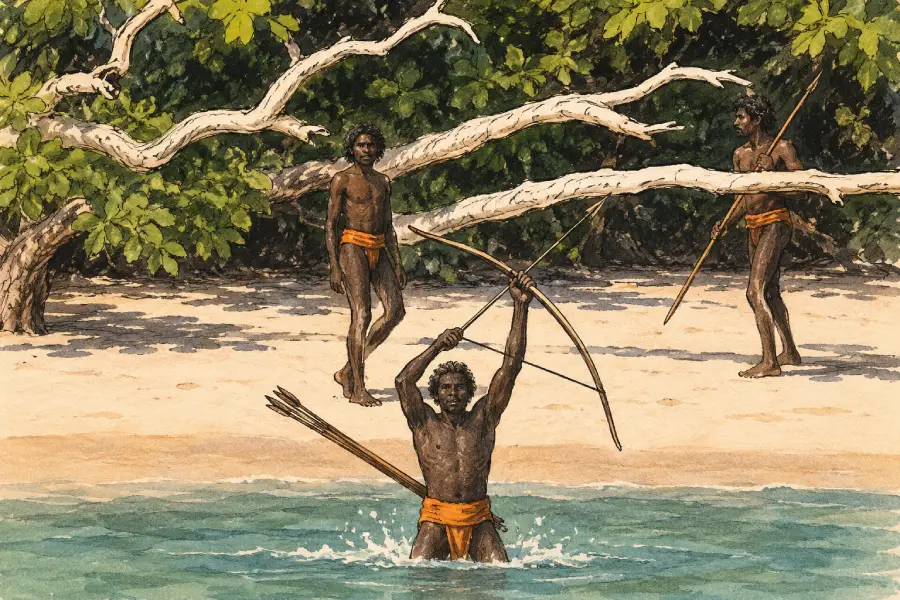
The Sentinelese inhabit North Sentinel Island, a roughly 60-square-kilometre landmass in the Bay of Bengal. Administratively, it falls under the South Andaman district of the Andaman and Nicobar Islands union territory, lying about 50 kilometers west of Port Blair. Encircled by narrow sandy beaches, mangroves, and extensive coral reefs, and lacking natural harbors, the island’s interior rises gently into dense tropical evergreen forests.
Living in deep ecological harmony with their unlogged surroundings, the community depends entirely on these forests and shallow reefs for wild boars, fish, and shellfish. Their remote, reef-ringed habitat keeps them geographically isolated, though its low elevation leaves them vulnerable to cyclones and seismic shifts like the 2004 tsunami crisis.
Demography And Population
Because physical enumeration is barred under the state’s non-interference policy, no current population count exists. The 2011 Census recorded 15 individuals via shoreline observation, while a February 2019 PIB release cited a rough estimate of 50.
Offshore headcounts declined from 39 in the 2001 Census to 15 in 2011, reflecting a critically small, stagnant demographic. Anthropological records show small bands shifting between temporary beach lean-tos and larger communal forest dwellings.
Language And Communication
The tribe speaks Sentinelese, an unclassified tongue tentatively grouped within the Andamanese language family. Purely oral without any written script, it remains mutually unintelligible even to neighboring Ongan speakers like the Jarawa and Onge, who failed to understand it during Anthropological Survey of India (AnSI) expeditions.
Classified as critically endangered because of its tiny speaker base, the language shows no linguistic assimilation. While the Central Institute of Indian Languages documents endangered Andamanese dialects, active fieldwork on Sentinelese is barred to protect the community.
Distinctive Identity – The Most Unique Aspect
Shipwreck Cold-Forging: Anthropological Survey of India (AnSI) records highlight an extraordinary metalworking adaptation; lacking mining or smelting skills, the Sentinelese cold-forge scrap iron salvaged from wrecked freighters—notably MV Rusley (1977) and MV Primrose (1981)—into razor-sharp arrowheads, harpoons, and adzes using stone hammers.
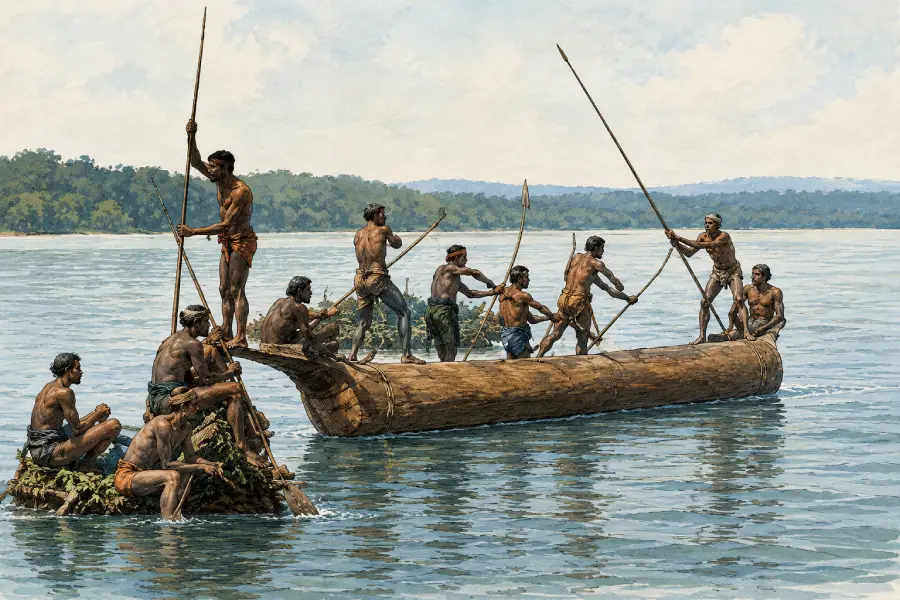
Shallow-Water Canoe Engineering: Equally distinct is their maritime technology; unlike neighbouring Andamanese groups such as the Jarawa, they build narrow wooden outrigger canoes steered upright with long punting poles, gliding effortlessly over coral reefs to spear fish and harvest turtles.
Food And Cuisine
- Staples & Foraged Foods: They consume zero cultivated grains, salt, or sugar, relying on wild tubers, pandanus fruit, wild honey, mud crabs, molluscs, turtle eggs, and small birds.
- Preparation & Preservation: They roast food directly over open hearths without complex utensils and consume it immediately rather than storing it on a large scale.
- Seasonal Shifts & Continuity: Foraging alternates seasonally between coastal lagoons and interior forests during monsoons, showing no dietary modernization aside from coconuts gifted in the 1990s.
Traditional Attire And Adornments
- Traditional Clothing: Both sexes wear no woven cloth; men don tight bark-fibre waist belts to hold weapons, while women wear narrow plant-fibre girdles around their hips.
- Ornaments & Body Art: Adornments include seashell necklaces, fibre armbands, and headbands, complemented by white clay or ochre body paint and short-cropped hair, with no documented tattoos.
- Materials & Continuity: Crafted strictly from local tree bark, creepers, and shells, their attire serves practical and social roles while remaining completely unchanged by modern textiles.
Livelihood And Economic Status
- Economy & Occupations: They maintain a cashless hunter-gatherer and fishing economy with zero farming, livestock, or commercial handicraft trade.
- Resource Rights & Markets: Protected under ANPATR 1956, they hold exclusive island access without outside markets, formal employment, or financial institutions.
- Security & State Aid: Self-reliant for food and rejecting all government welfare rations, their sole economic vulnerability stems from climate or reef disruptions.
Social and Cultural Life
- Structure & Leadership: They follow an egalitarian, kin-based band structure without formal chiefs, relying on collective consensus for group decisions.
- Gender Roles: Men handle hunting and coastal defense while women manage gathering and child-rearing, though women actively join shore defense.
- Rituals & Expression: While deities and birth, marriage, or death rites remain undocumented due to non-interference, rhythmic beach dances, chanting, and pig-skull displays in huts have been observed.
Government Intervention And Development Initiatives
- Constitutional & Legal Safeguards: Protected under Article 342, ANPATR 1956, and SC/ST (Prevention of Atrocities) Act, 1989, notifying a 5-kilometre sea buffer. PESA and the Forest Rights Act remain inapplicable due to non-contact.
- UT & PVTG Initiatives: AAJVS replaces mainland PM-JANMAN housing with an “eyes-on and hands-off” policy, enforcing a Protocol of Circumnavigation via Coast Guard patrols.
- Impact, Recent Plans & Gaps: Surveillance prevents epidemics, and proposed Census 2027 aerial counting avoids landings, though a March 2025 trespass arrest shows coastal policing gaps.