








New Delhi
Despite adequate iodine levels, nearly one in eight tribal children in southern Rajasthan was found to have an enlarged thyroid gland, a study has said, pointing to thyroid autoimmunity as a possible contributing factor. Thyroid autoimmunity is a condition in which the immune system mistakenly attacks the thyroid gland.
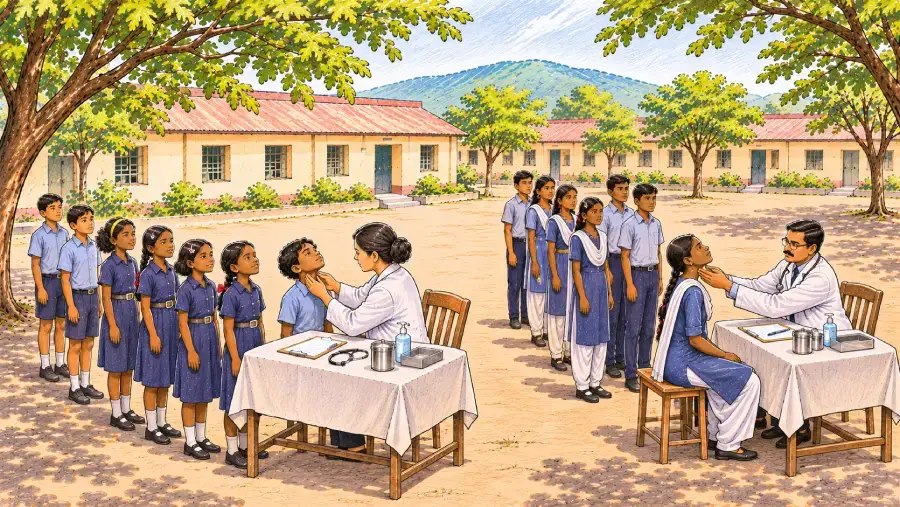
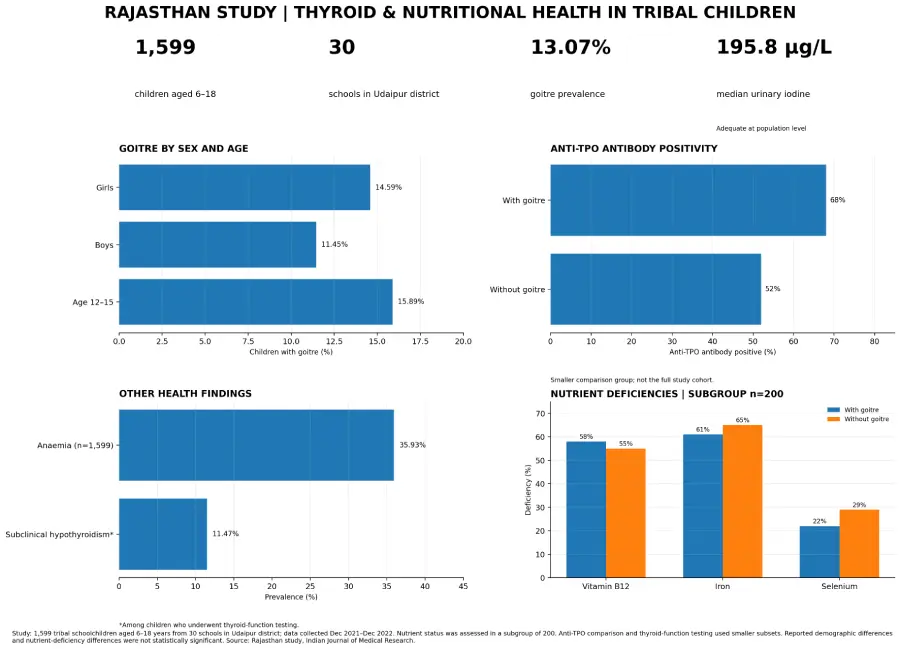
The study, published in the latest issue of the Indian Journal of Medical Research, examined 1,599 tribal children aged six to 18 years from 30 schools in Udaipur district. Researchers found goitre in 13.07% of the children, although the median urinary iodine concentration was 195.8 micrograms per litre, indicating adequate iodine nutrition at the population level.
Goitre is an enlargement of the thyroid gland, located at the front of the neck. It can occur due to iodine deficiency, autoimmune thyroid disease and other thyroid conditions. Some children may have an enlarged gland without obvious symptoms, while an underlying thyroid disorder can affect metabolism, growth and development.
India introduced universal salt iodisation in 1986 to address iodine deficiency disorders. Iodine is essential for the production of thyroid hormones, which regulate metabolism and are particularly important for the physical and neurological development of children.
According to the Rajasthan study, a closer examination of children with and without goitre found a significantly higher prevalence of anti-thyroid peroxidase (anti-TPO) antibodies among those with an enlarged thyroid. Nearly 68% of children with goitre tested positive for these antibodies, compared with 52% of those without the condition in a smaller comparison group.
Anti-TPO antibodies are associated with autoimmune thyroid disorders, in which the immune system mistakenly attacks thyroid tissue. Their higher prevalence among children with goitre suggests that thyroid autoimmunity may be an important contributing factor in this population, although the study cannot establish that it caused the enlargement.
The study was conducted by Dr Mona Sood, Dr Mohd Asif Patel, Dr Sandeep Kansara and Dr Shelesh Kumar Swami from the Department of Endocrinology and Multidisciplinary Research Unit at Rabindra Nath Tagore Medical College, Udaipur. The researchers collected data between December 2021 and December 2022.
The burden was higher among girls, with goitre prevalence at 14.59%, compared with 11.45% among boys. However, the difference was not statistically significant. Children aged 12 to 15 years recorded the highest prevalence, at 15.89%.
The findings also draw attention to wider health challenges among the children. Anaemia was detected in 35.93% of the 1,599 participants. Subclinical hypothyroidism — in which thyroid-stimulating hormone levels are raised while thyroid hormone levels remain within the normal range — was found in 11.47% of children who underwent thyroid-function testing.
The researchers also assessed iron, selenium and vitamin B12 status in a smaller group of 200 children. They found that deficiencies were common among both children with and without goitre. Vitamin B12 deficiency was found in 58% of children with goitre and 55% of those without it. Iron deficiency was recorded in 61% and 65%, respectively, while selenium deficiency was found in 22% and 29%.
None of these differences was statistically significant, suggesting that the deficiencies examined were not independently associated with goitre in this comparison. However, the high prevalence of anaemia remains a separate public-health concern requiring attention, noted the study’s lead author, Dr Mona Sood.
Although the Rajasthan study was limited to tribal schoolchildren in one district and cannot be considered representative of all tribal children in the state or elsewhere in India, its findings acquire wider significance when seen alongside a nationwide study published recently in The Lancet Regional Health – Southeast Asia. The ICMR-SALT-T 1 study assessed 8,903 schoolchildren aged 10 to 18 years across eight centres in India, nearly four decades after the introduction of the Universal Salt Iodisation programme.
It found an overall goitre prevalence of 10.3%. The figure marks a substantial decline from the 23.5% reported in a nationwide assessment in 2003, indicating the long-term gains made through salt iodisation.
The national study found that more than 90% of surveyed households reported using iodised salt, while 89% of the 1,615 salt samples tested contained iodine above 15 parts per million. The median urinary iodine concentration was 133.2 micrograms per litre, within the range indicating adequate iodine nutrition at the population level.
However, the study also found that anti-TPO positivity was associated with higher odds of goitre. Children who tested positive for the antibodies had 2.5 times the odds of having goitre. Girls and children with obesity also had higher odds of thyroid enlargement. Subclinical hypothyroidism was observed in 13% of children who underwent thyroid-function testing.
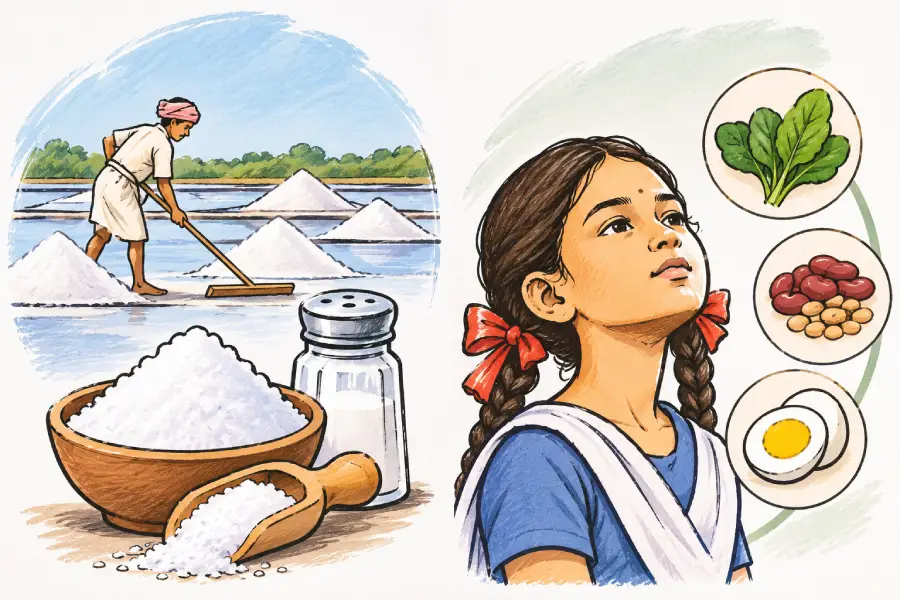
The researchers concluded that goitre prevalence had steadily declined, reflecting the positive long-term impact of universal salt iodisation, but called for follow-up studies to understand the high rates of thyroid autoimmunity and thyroid dysfunction.
Together, the two studies point to an evolving picture of thyroid health among Indian children. While iodine deficiency remains an important preventable cause of goitre, it may not explain every case in communities where iodine nutrition is adequate.
The Rajasthan findings add to the evidence that thyroid autoimmunity deserves attention, particularly in children with persistent thyroid enlargement.
Hence, while the decline recorded in the nationwide study shows the public-health gains achieved through this intervention, the persistence of goitre in iodine-sufficient populations points to the need for a broader approach.
The authors advised that school-health programmes must continue to promote the use of adequately iodised salt while ensuring that children with thyroid enlargement are assessed for possible underlying disorders. Depending on clinical findings, this may require thyroid-function tests and antibody investigations.
India currently produces around 65 lakh metric tonnes of iodised salt every year, sufficient to meet domestic demand. Food-safety regulations also prohibit the sale of non-iodised common salt for direct human consumption.