


• About
  • Editor & Writers
  • Contact
  • Sitemap
No Result
View All Result
Support Our Mission
Wednesday, August 12, 2026
The Indian Tribal
  • Home
  • Achievers
    • उपलब्धिकर्ता
  • Cuisine
    • खान पान
  • Health
    • स्वास्थ्य
  • Legal
    • कानूनी
  • Music
    • संगीत
  • News
    • Updates
    • खबरें
  • Sports
    • खेलकूद
  • Variety
    • विविध
  • हिंदी
    • All
    • आदिवासी
    • उपलब्धिकर्ता
    • कला और संस्कृति
    • कानूनी
    • खबरें
    • खान पान
    • खेलकूद
    • जनजाति
    • भारत
    • विविध
    • संगीत
    • संस्कृति
    • स्वास्थ्य
    The Indian Tribal

    आदिवासी महोत्सव में झारखंड के विद्यार्थियों को मिलेगा फिल्म निर्माण सीखने का अवसर

    The Indian Tribal

    ‘ट्री ऑफ लाइफ’ सखुआ: पत्तों से रोजगार, बीजों से उद्योग, राल से औषधि और संरक्षण में छिपा भविष्य

    The Indian Tribal

    रांची से उठेगी सखुआ क्रांति: क्यों है सखुआ झारखंड की संस्कृति, आस्था और प्रकृति का प्रहरी?

    The Indian Tribal

    दिशोम गुरु शिबू सोरेन की विरासत ही झारखंड की दिशा: पहली पुण्यतिथि पर बोले हेमंत

    The Indian Tribal

    ओडिशा के PVTGs की अनूठी विवाह व्यवस्था: वधू मूल्य नहीं, सामाजिक साझेदारी का प्रतीक

    The Indian Tribal

    झारखंड के पलामू टाइगर रिजर्व में आदिवासी परंपराएं बनीं बाघ संरक्षण की नई ताकत

    The Indian Tribal

    झारखंड को मिलेगा अपना फिल्म एंड टेलीविजन इंस्टीट्यूट, SRFTI के साथ हुआ समझौता

    The Indian Tribal

    ओडिशा के आदिवासी किसान की देशी धान की विलुप्त होती किस्मों को बचाने का मिशन

  • Gallery
    • Videos
  • Latest News
The Indian Tribal
  • Home
  • Achievers
    • उपलब्धिकर्ता
  • Cuisine
    • खान पान
  • Health
    • स्वास्थ्य
  • Legal
    • कानूनी
  • Music
    • संगीत
  • News
    • Updates
    • खबरें
  • Sports
    • खेलकूद
  • Variety
    • विविध
  • हिंदी
    • All
    • आदिवासी
    • उपलब्धिकर्ता
    • कला और संस्कृति
    • कानूनी
    • खबरें
    • खान पान
    • खेलकूद
    • जनजाति
    • भारत
    • विविध
    • संगीत
    • संस्कृति
    • स्वास्थ्य
    The Indian Tribal

    आदिवासी महोत्सव में झारखंड के विद्यार्थियों को मिलेगा फिल्म निर्माण सीखने का अवसर

    The Indian Tribal

    ‘ट्री ऑफ लाइफ’ सखुआ: पत्तों से रोजगार, बीजों से उद्योग, राल से औषधि और संरक्षण में छिपा भविष्य

    The Indian Tribal

    रांची से उठेगी सखुआ क्रांति: क्यों है सखुआ झारखंड की संस्कृति, आस्था और प्रकृति का प्रहरी?

    The Indian Tribal

    दिशोम गुरु शिबू सोरेन की विरासत ही झारखंड की दिशा: पहली पुण्यतिथि पर बोले हेमंत

    The Indian Tribal

    ओडिशा के PVTGs की अनूठी विवाह व्यवस्था: वधू मूल्य नहीं, सामाजिक साझेदारी का प्रतीक

    The Indian Tribal

    झारखंड के पलामू टाइगर रिजर्व में आदिवासी परंपराएं बनीं बाघ संरक्षण की नई ताकत

    The Indian Tribal

    झारखंड को मिलेगा अपना फिल्म एंड टेलीविजन इंस्टीट्यूट, SRFTI के साथ हुआ समझौता

    The Indian Tribal

    ओडिशा के आदिवासी किसान की देशी धान की विलुप्त होती किस्मों को बचाने का मिशन

  • Gallery
    • Videos
  • Latest News
No Result
View All Result
The Indian Tribal
No Result
View All Result
  • Home
  • Achievers
  • Cuisine
  • Health
  • Legal
  • Music
  • News
  • Sports
  • Variety
  • हिंदी
  • Gallery
  • Latest News
Support Our Mission
Home » The Indian Tribal / Health » How Bhil Midwives Keep Rajasthan’s Tribal Childbirth Traditions Alive

How Bhil Midwives Keep Rajasthan’s Tribal Childbirth Traditions Alive

The Bhils of Rajasthan offer a compelling example of how indigenous knowledge continues to shape maternal care. Among India's largest tribal communities, the Bhils have preserved a holistic system in which childbirth, nature, spirituality and community life are deeply interconnected, Dr Darshan Kalasua writes. Part-1

August 12, 2026
The Indian Tribal

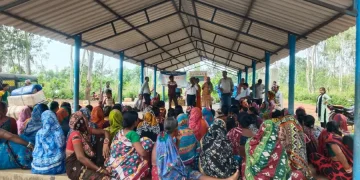
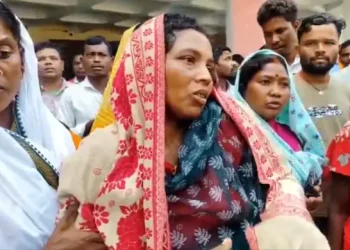
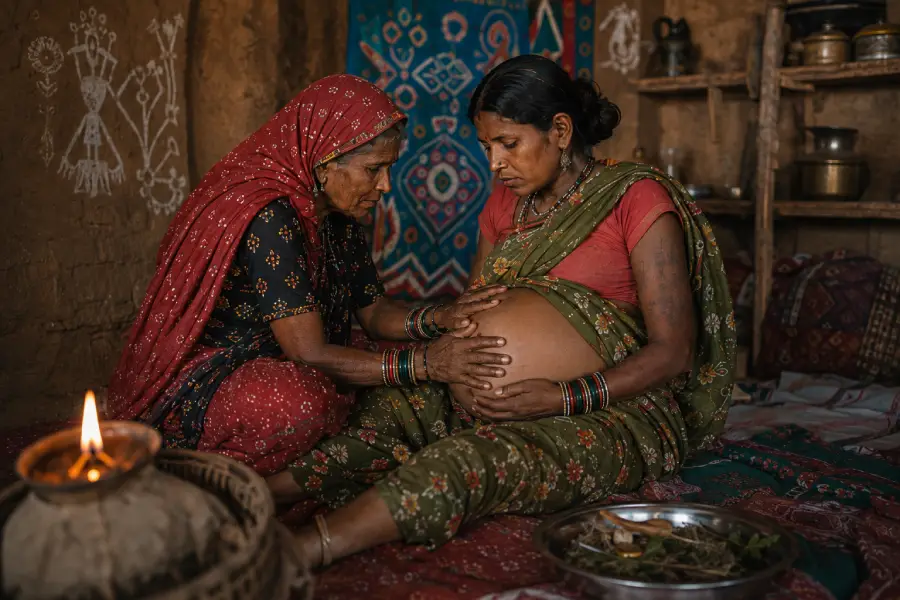
A Bhil Midwife Attends To A Pregnant Woman

New Delhi

The United Nations marked the International Day of the World’s Indigenous Peoples on August 9, with this year’s theme, “Honouring Indigenous Midwives: Safeguarding Life and Well-being,” highlighting their contribution to community health. Established in 1994, the Day recognises indigenous peoples who comprise about 6 per cent of the global population but continue to face poverty, displacement and inadequate access to healthcare and education.

This year’s focus acknowledges midwives not only as birth attendants but also as custodians of traditional knowledge. It also draws attention to discrimination against Indigenous healing practices and their need for greater recognition within formal healthcare systems.

Where The UN Theme Comes Alive

Nowhere is this year’s theme more vividly reflected than in the hilly, forested landscapes of southern Rajasthan—Banswara, Dungarpur, Pratapgarh, and parts of Udaipur and Sirohi—home to the Bhils, India’s largest tribal community and the most populous Scheduled Tribe in Rajasthan.

Alongside them live the Garasias, Meenas and the Sahariyas of Baran, one of India’s officially recognised Particularly Vulnerable Tribal Groups (PVTGs). Together, these communities represent a way of life shaped over centuries by the Aravalli hills and forests, where the wisdom of traditional midwives and the community’s relationship with its land remain deeply intertwined.

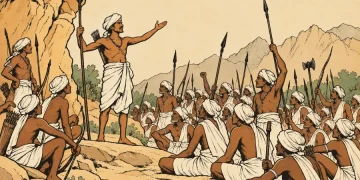
Anthropologists regard the Bhils as one of the oldest tribal communities in the Indian subcontinent, although their precise ethnic origins remain a subject of scholarly debate. Their name is widely believed to derive from the Dravidian word villu (or vil), meaning “bow”—a fitting description of a people renowned for their archery skills, who once served as bowmen and forest guardians to the rulers of Mewar.
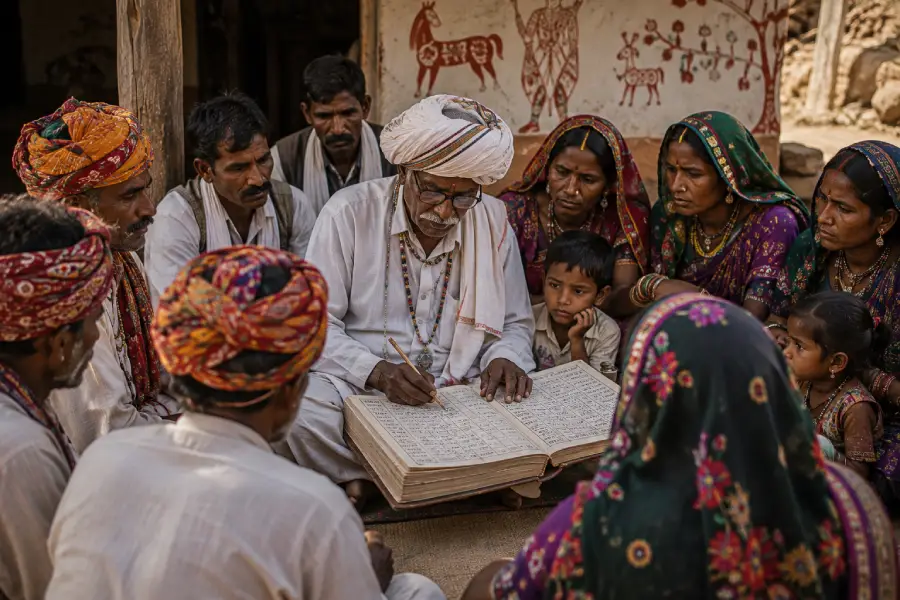
The Indian Tribal
Bhils Are Among India’s Largest Tribal Communities

Today, the Bhils account for nearly two-fifths of Rajasthan’s tribal population, with related communities spread across Gujarat, Madhya Pradesh and Maharashtra. Several towns, including Dungarpur, trace their origins to Bhil rulers, underscoring the community’s enduring place in Rajasthan’s history rather than at its margins.

Midwifery Rooted In Culture, Nature And Community

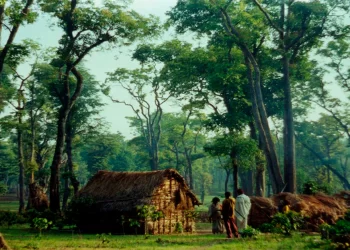
For generations, Bhil life has centred on small forest settlements, mud-and-thatch homes and hillside farming. Families traditionally revere an ancestral tree that is never felled. Village disputes are settled by community elders, customary ceremonies are conducted by hereditary priests known as Bhagats, and traditional healers, or Badvas, are consulted for both physical and spiritual ailments. In the Bhil worldview, the two are inseparable.

This holistic understanding naturally extends to pregnancy and childbirth—the very relationship the United Nations seeks to recognise through this year’s theme. Among the Bhils, childbirth has traditionally been assisted by respected elder women whose knowledge combines generations of experience, locally available medicinal plants and rituals intended to protect both mother and child during one of life’s most significant transitions.

Health studies describe Bhil approaches to illness and childbirth as a blend of practical herbal treatment, cultural rituals and community support. Maternal care is closely linked to the surrounding forest ecosystem, reflecting an indigenous healthcare tradition in which medicine, spirituality and nature function as an integrated whole rather than as separate domains.

While modern healthcare services have expanded in many tribal areas, traditional midwives continue to command deep trust because they understand local customs, speak the community’s language and provide emotional reassurance that institutional healthcare often struggles to replicate.

A Living Culture, Not A Museum Piece

Bhil culture is woven into everyday life rather than preserved as a relic of the past. Traditional art forms such as the Ghoomar dance, the ceremonial Gair dance-drama and the vibrant Mandana wall paintings around Udaipur’s Inya Parvat continue to flourish. Equally important are the hereditary Bhads—genealogists who preserve oral histories while recording births, deaths and family lineages, creating a living archive passed down through generations.
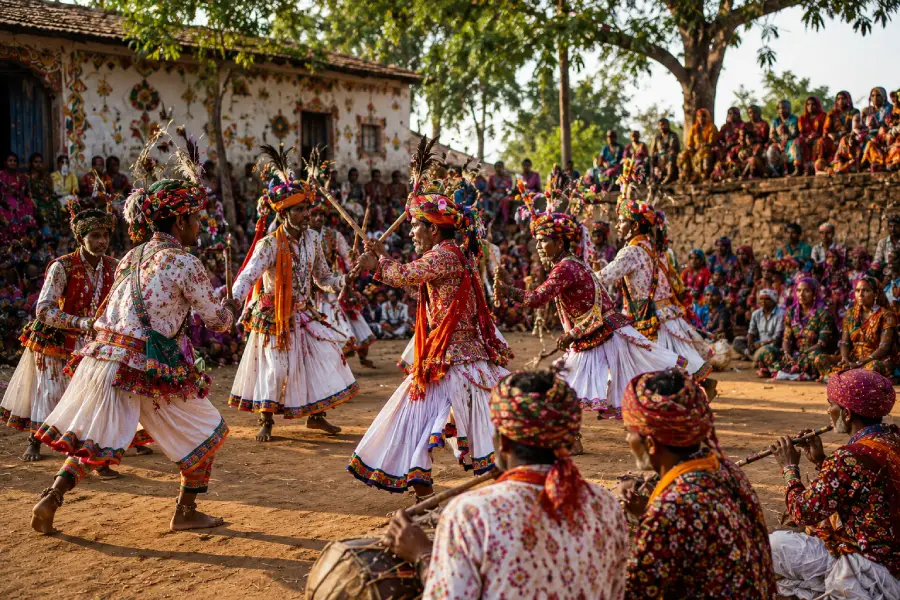
The Indian Tribal
Gair Dancers (Pics – AI Generated)

Nature lies at the heart of Bhil spiritual life. The community venerates the Panchatattva—the five elements of earth, water, fire, air and space—and regards trees, hills, rivers and open landscapes as sacred. Local deities such as Gramdev and Kuldev are viewed less as separate gods than as manifestations of these natural forces. Worship generally takes place beneath sacred trees, on hilltops or beside water bodies rather than inside permanent temples.

Within this tradition, Badvas and Bhagats work together to restore harmony when illness or misfortune is believed to have disturbed the balance between people, nature and the spiritual world. Their healing practices combine herbal remedies with prayers, chants and rituals that have been preserved over generations.

This spiritual tradition also shaped Bhil resistance against colonial rule. The Bhagat reform movement led by Govind Guru combined religious reform with political mobilisation, culminating in the 1913 Mangarh massacre—an event that remains central to Bhil collective memory and identity.

Language is another pillar of that identity. Most Bhils speak Bhili, an Indo-Aryan language with strong Gujarati, Marathi and Rajasthani influences. Predominantly oral in nature, Bhili has long faced challenges in formal education systems dominated by Hindi and English. Initiatives such as the Ministry of Tribal Affairs’ Adi Vaani platform are helping preserve Bhil oral literature and traditional knowledge for future generations.

(The writer is an Assistant Professor at University School of Management & Entrepreneurship, Delhi Technological University. Views expressed are personal.) Contd...


Root Woot | Online Puja Samagri Root Woot | Online Puja Samagri Root Woot | Online Puja Samagri

Support Our Mission

The Indian Tribal

For the past four-and-a-half years, we have travelled across India to bring to our readers the ‘Unknown, Lesser-Known Tribal Life’, which rarely finds space in the mainstream media.

We have done this without external funding, driven only by our conviction that India’s tribal heritage deserves to be documented with dignity, depth and authenticity.

If you like our work, and if it has informed, inspired or helped you understand India’s tribal/indigenous communities better, we invite you to become a part of this mission.

Your contribution will not merely fund a news platform. It will help preserve voices, traditions, histories and aspirations that form an invaluable part of India’s identity.

Because when an untold story is documented, a piece of India’s heritage is preserved forever.

Thanks
Editor

In Numbers

49.4 %
Female Literacy rate of Scheduled Tribes

Update

Centre notifies Act mandating political reservation for tribals in Goa Assembly

The Centre has notified the Act that grants political reservation for the Scheduled Tribe (ST) community in the 40-member Goa legislative Assembly. The Act passed earlier by Parliament mandates reservation of four seats for tribal candidates in the Goa Assembly for the first time. Goa Chief Minister Pramod Sawant recently met Union Home Minister Amit Shah urging him to expedite the process of reservation for the ST community in the Assembly, which will go to polls early next year. Sawant expressed his “deep gratitude” to Prime Minister Narendra Modi and Home Minister Amit Shah. Tribal leader and BJP MLA Govind Gaude called it a big victory of social justice movement.
The Indian Tribal
Adivasi

Why Tribal Midwives Still Lead Childbirths Despite Push For Institutional Deliveries

by The Indian Tribal
August 8, 2026

As we mark the International Day of the World's Indigenous Peoples (on August 9), themed "Honouring Indigenous Midwives: Safeguarding Life and Well-being", Archana Jyoti dishes out two recent studies revealing why traditional midwives remain indispensable in tribal communities

The Indian Tribal

‘ट्री ऑफ लाइफ’ सखुआ: पत्तों से रोजगार, बीजों से उद्योग, राल से औषधि और संरक्षण में छिपा भविष्य

August 6, 2026
The Indian Tribal

रांची से उठेगी सखुआ क्रांति: क्यों है सखुआ झारखंड की संस्कृति, आस्था और प्रकृति का प्रहरी?

August 5, 2026
The Indian Tribal

दिशोम गुरु शिबू सोरेन की विरासत ही झारखंड की दिशा: पहली पुण्यतिथि पर बोले हेमंत

August 4, 2026
The Indian Tribal

ओडिशा के PVTGs की अनूठी विवाह व्यवस्था: वधू मूल्य नहीं, सामाजिक साझेदारी का प्रतीक

August 3, 2026
The Indian Tribal

How Dhimsa Danced Its Way Into Guinness World Records In Bhogapuram

August 1, 2026
Previous Post

JPSC-JSSC Protest Leads To Political Flashpoint: BJP Observes Jharkhand Bandh, NDA Takes Issue To Parliament

Top Stories

The Indian Tribal
India

JPSC-JSSC Protest Leads To Political Flashpoint: BJP Observes Jharkhand Bandh, NDA Takes Issue To Parliament

August 11, 2026
The Indian Tribal
India

JPSC-JSSC Protest: Students Lathicharged, Teargassed; BJP Calls Bandh, CM Soren Cautions Students Against Opposition’s Narrative

August 10, 2026
The Indian Tribal
India

JPSC-JSSC Protest: Jharkhand Govt Agrees to Cancel 14th JPSC Exam, But CBI Probe Demand Keeps Standoff Alive

August 9, 2026
Load More
  • About Us
  • Editor & Writers
  • Contact
  • Redressal
  • Copyright Policy
  • Privacy Policy And Terms Of Use
  • Disclaimer
  • Sitemap

  • Achievers
  • Cuisine
  • Health
  • India
  • News
  • Legal
  • Music
  • Sports
  • Trending
  • Chhattisgarh
  • Delhi
  • Gujarat
  • Jammu & Kashmir
  • Jharkhand
  • Kerala
  • Madhya Pradesh
  • Maharashtra
  • North East
  • Arunachal Pradesh
  • Assam
  • Manipur
  • Meghalaya
  • Mizoram
  • Nagaland
  • Sikkim
  • Tripura
  • Odisha
  • Telangana
  • West Bengal
  • Political News
  • Variety
  • Art & Culture
  • Entertainment
  • Adivasi
  • Tribal News
  • Scheduled Tribes
  • हिंदी
  • उपलब्धिकर्ता
  • कानूनी
  • खान पान
  • खेलकूद
  • स्वास्थ्य
  • संस्कृति
  • संगीत
  • विविध
  • कला और संस्कृति
  • खबरें
  • असम
  • अरुणाचल प्रदेश की ताज़ा ख़बरें
  • ओडिशा
  • केरल
  • गुजरात
  • छत्तीसगढ़
  • जम्मू और कश्मीर
  • झारखंड
  • तेलंगाना
  • दिल्ली
  • नॉर्थईस्ट
  • पश्चिम बंगाल
  • मध्य प्रदेश
  • महाराष्ट्र
  • त्रिपुरा
  • नागालैंड
  • मणिपुर
  • मिजोरम की ताज़ा ख़बरें
  • मेघालय
  • सिक्किम की ताज़ा ख़बरें
  • राजस्थान

About Us

The Indian Tribal is India’s first bilingual (English & Hindi) digital journalistic venture dedicated exclusively to the Scheduled Tribes. The ambitious, game-changer initiative is brought to you by Madtri Ventures Pvt Ltd (www.madtri.com). From the North East to Gujarat, from Kerala to Jammu and Kashmir — our seasoned journalists bring to the fore life stories from the backyards of the tribal, indigenous communities comprising 10.45 crore members and constituting 8.6 percent of India’s population as per Census 2011. Unsung Adivasi achievers, their lip-smacking cuisines, ancient medicinal systems, centuries-old unique games and sports, ageless arts and crafts, timeless music and traditional musical instruments, we cover the Scheduled Tribes community like never-before, of course, without losing sight of the ailments, shortcomings and negatives like domestic abuse, alcoholism and malnourishment among others plaguing them. Know the unknown, lesser-known tribal life as we bring reader-engaging stories of Adivasis of India.

Follow Us

All Rights Reserved

© 2026 Madtri Ventures [P] Ltd.

No Result
View All Result
  • Home
  • Achievers
  • Cuisine
  • Health
  • Health
  • Legal
  • Music
  • News
  • Sports
  • Variety
  • हिंदी
    • उपलब्धिकर्ता
    • खान पान
    • कानूनी
    • खेलकूद
    • खेलकूद
    • संगीत
    • संगीत
    • स्वास्थ्य
    • स्वास्थ्य
    • विविध
  • Gallery
  • Videos

© 2026 Madtri Ventures [P] Ltd.