



• About
  • Editor & Writers
  • Contact
  • Sitemap
No Result
View All Result
Support Our Mission
Wednesday, September 16, 2026
The Indian Tribal
  • Home
  • Achievers
    • उपलब्धिकर्ता
  • Cuisine
    • खान पान
  • Health
    • स्वास्थ्य
  • Legal
    • कानूनी
  • Music
    • संगीत
  • News
    • Updates
    • खबरें
  • Sports
    • खेलकूद
  • Variety
    • विविध
  • हिंदी
    • All
    • आदिवासी
    • उपलब्धिकर्ता
    • कला और संस्कृति
    • कानूनी
    • खबरें
    • खान पान
    • खेलकूद
    • जनजाति
    • भारत
    • विविध
    • संगीत
    • संस्कृति
    • स्वास्थ्य
    The Indian Tribal

    ओडिशा के नबरंगपुर में आदिवासी किसानों की मक्का खेती ने कैसे बदली तस्वीर

    The Indian Tribal

    छत्तीसगढ़ में आदिवासी ट्रैकर्स और AI मिलकर बचा रहें हैं दुर्लभ वन्यजीव

    The Indian Tribal

    हाशिए से राष्ट्रीय केंद्र तक: बदल रही है भारत के आदिवासी समुदायों की कहानी

    The Indian Tribal

    शिक्षा, वन उपज में मूल्य संवर्धन से आदिवासी समुदायों के आर्थिक सशक्तीकरण की नई राह

    The Indian Tribal

    मणिपुर में संघर्ष के बीच आदिवासी कोचों ने संभाली नई पीढ़ी के खिलाड़ियों की कमान

    The Indian Tribal

    ओडिशा के आदिवासी किसान ने 10 सालों में बचाईं धान की 100 से ज्यादा देशी किस्में

    The Indian Tribal

    आदिवासी समुदायों में पारंपरिक दाइयों की भूमिका क्यों अब भी कायम है, जब सरकार संस्थागत प्रसव पर दे रही है जोर?

    The Indian Tribal

    ओडिशा के विशेष रूप से कमजोर जनजातीय समूहों की सदियों पुरानी विवाह संस्कृति एवं परंपराएँ बदलाव के दौर में भी कायम

  • Gallery
    • Videos
  • Latest News
The Indian Tribal
  • Home
  • Achievers
    • उपलब्धिकर्ता
  • Cuisine
    • खान पान
  • Health
    • स्वास्थ्य
  • Legal
    • कानूनी
  • Music
    • संगीत
  • News
    • Updates
    • खबरें
  • Sports
    • खेलकूद
  • Variety
    • विविध
  • हिंदी
    • All
    • आदिवासी
    • उपलब्धिकर्ता
    • कला और संस्कृति
    • कानूनी
    • खबरें
    • खान पान
    • खेलकूद
    • जनजाति
    • भारत
    • विविध
    • संगीत
    • संस्कृति
    • स्वास्थ्य
    The Indian Tribal

    ओडिशा के नबरंगपुर में आदिवासी किसानों की मक्का खेती ने कैसे बदली तस्वीर

    The Indian Tribal

    छत्तीसगढ़ में आदिवासी ट्रैकर्स और AI मिलकर बचा रहें हैं दुर्लभ वन्यजीव

    The Indian Tribal

    हाशिए से राष्ट्रीय केंद्र तक: बदल रही है भारत के आदिवासी समुदायों की कहानी

    The Indian Tribal

    शिक्षा, वन उपज में मूल्य संवर्धन से आदिवासी समुदायों के आर्थिक सशक्तीकरण की नई राह

    The Indian Tribal

    मणिपुर में संघर्ष के बीच आदिवासी कोचों ने संभाली नई पीढ़ी के खिलाड़ियों की कमान

    The Indian Tribal

    ओडिशा के आदिवासी किसान ने 10 सालों में बचाईं धान की 100 से ज्यादा देशी किस्में

    The Indian Tribal

    आदिवासी समुदायों में पारंपरिक दाइयों की भूमिका क्यों अब भी कायम है, जब सरकार संस्थागत प्रसव पर दे रही है जोर?

    The Indian Tribal

    ओडिशा के विशेष रूप से कमजोर जनजातीय समूहों की सदियों पुरानी विवाह संस्कृति एवं परंपराएँ बदलाव के दौर में भी कायम

  • Gallery
    • Videos
  • Latest News
No Result
View All Result
The Indian Tribal
No Result
View All Result
  • Home
  • Achievers
  • Cuisine
  • Health
  • Legal
  • Music
  • News
  • Sports
  • Variety
  • हिंदी
  • Gallery
  • Latest News
Support Our Mission
Home » Adivasi » ‘Home Gardens Can Solve Hunger, Nutrition Issues In Tribal Areas’

‘Home Gardens Can Solve Hunger, Nutrition Issues In Tribal Areas’

They could be India's weapon to fight against food insecurity, malnutrition and poverty in tribal areas, according to a study by an international team of researchers. The Indian Tribal delves into its details

April 7, 2023
A Home Garden In Odisha

A Home Garden In Odisha (Pic: Braj Das)

New Delhi

Amidst climate change-induced global food crisis and soaring food prices, home gardens —producing millet, pulses, fresh fruits and vegetables — could be a strategy to enhance household food security, nutrition and economic growth for vulnerable groups like tribals, an international team of researchers has reasoned.

Economics researchers from the Alliance of Bioversity International and The International Center for Tropical Agriculture (CIAT) reached at this conclusion after studying about 1,900 households within the tribal communities in Odisha.

They evidenced that home gardens can improve food security, dietary quality, and income in these rural farming communities.

The study, “Home gardens, household nutrition and income in rural farm households in Odisha, India,” was recently published in the Journal of Agricultural Economics.

The project in Odisha was part of the Government of India’s program that aims to reach over 27,300 beneficiaries with home garden interventions to help increase their production and consumption of highly nutritious home-produced foods, and ultimately improve their food and nutrition security by improving the quality of their diet.

Sylvester Ogutu, a researcher for the Alliance of Bioversity International and CIAT and the paper’s lead author, said that having a home garden increased annual home-produced food by nearly 90 percent.
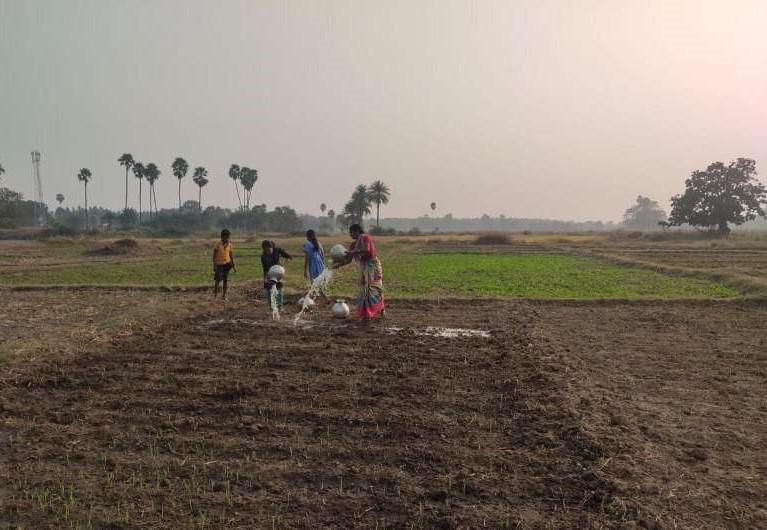
Tribals In The Process Of Setting Up A Home Garden (Pic: Braj Das)

“Our findings also suggest that home gardens can be a poverty-reducing strategy for resource-poor farmers and vulnerable population groups,” Ogutu said, adding the monthly value of home-produced and consumed food per adult rose by over half, increasing the probability of greater food security among adopters of home gardens.

“Having a home garden also increased monthly per adult equivalent incomes by 37% and reduced the prevalence of poverty by 11.7 percentage points,” he pointed out.

Jonathan Mockshell, an agricultural economist at the Alliance of Bioversity International and CIAT, study lead, and the co-author of the paper, said that programs aimed at teaching vulnerable population groups how to start or improve home gardens started in Odisha in 2017 and are ramping up, with three quarters of the home garden interventions completed between 2020 and 2021.

“Home gardens can also complement government programs, such as the National Nutrition Mission, to improve nutrition and also contribute toward achievement of the Sustainable Development Goals, especially those related to poverty, zero hunger, and good health and well-being,” Mockshell said.

For his part, James Garrett, a co-author, said: “Promotion of home gardens in India can help curb widespread malnutrition problems, such as anemia in women, by improving the quality of diets that are typically less diverse, dominated by cereals, and/or characterized by low intakes of fruits and vegetables.”

The initiative is being implemented by Vigyan Prasar and supported by Science for Equity, Empowerment & Development (SEED) Division of Department of Science & Technology, Government of India. It aims to present an easy-to-use information resource on locally adaptable tools and techniques for tribal women based in Jharkhand, Bihar, Odisha, and West Bengal to optimise production and enhance livelihood options.

All About Home Garden

  • Globally, home gardens have been documented as one related to food production on small plots, adjacent to human settlements, contributing to food and nutritional security and livelihoods.
  • Literature wise, home gardens are classified as mixed, kitchen, backyard, farmyard, compound or homestead garden. Besides India, it’s in Sri Lanka that home gardening has been practiced for centuries.
  • The home garden model was first prepared on a scientific basis in India by Krishi Vigyan Kendra, Ranchi to provide a nutritive and diversified diet to tribal communities having small parcels of land i.e. about 6×6 m2 area, which is normally available with every household in rural areas.
  • Seasonal vegetables including leafy ones, cucurbits, leguminous vegetables and root vegetables are grown in this garden after preparation of land. A minimum of 10 types of vegetables is grown in each season so that vegetables are available for consumption throughout the year.
  • The model was demonstrated among more than 150 tribal farmers of Ranchi district. Women farmers replicated it in more areas, indicating that the model is successful, socially acceptable, environment-friendly and viable in tribal areas. The garden is managed by household members using only organic manures and pesticides.
  • Fruit plants may be planted on the boundary in a direction, which doesn’t prevent sunlight from coming. This garden can produce about 350 Kg of vegetables annually, which is sufficient to meet the minimum needs of nutrients for a small family having four members.
  • The home gardening project is now being implemented by Vigyan Prasar and supported by the Science for Equity, Empowerment & Development (SEED) Division of Department of Science & Technology, Government of India. The initiative has been well adopted by the 
    tribal women of Jharkhand, Bihar, Odisha, and West Bengal.

Root Woot | Online Puja Samagri Root Woot | Online Puja Samagri Root Woot | Online Puja Samagri

Support Our Mission

The Indian Tribal

For the past four-and-a-half years, we have travelled across India to bring to our readers the ‘Unknown, Lesser-Known Tribal Life’, which rarely finds space in the mainstream media.

We have done this without external funding, driven only by our conviction that India’s tribal heritage deserves to be documented with dignity, depth and authenticity.

If you like our work, and if it has informed, inspired or helped you understand India’s tribal/indigenous communities better, we invite you to become a part of this mission.

Your contribution will not merely fund a news platform. It will help preserve voices, traditions, histories and aspirations that form an invaluable part of India’s identity.

Because when an untold story is documented, a piece of India’s heritage is preserved forever.

Thanks
Editor

In Numbers

49.4 %
Female Literacy rate of Scheduled Tribes

Update

NSTDFC, HPCL sign MoU

The National Scheduled Tribes Finance and Development Corporation (NSTFDC) and Hindustan Petroleum Corporation Limited (HPCL) have signed a Memorandum of Understanding (MoU) for establishment of integrated Computer Lab-cum-Smart Classroom facilities in 29 functional Eklavya Model Residential Schools (EMRS) across 11 districts of Rajasthan. The project, with a total budget of ₹16.01 crore approved by the HPCL Board, is planned to be completed within six months from the date of signing of the MoU. Under the project, each school will have four smart classrooms equipped with 86-inch interactive flat panels, pre-loaded licensed software, curated open educational resources and audio-visual equipment, including speakers and webcams. Each school will also have a fully networked computer laboratory with desktops and UPS backup, structured LAN, multi-function printer, furniture, air-conditioning, electrical refurbishment and safety systems. In addition, 10 tablets pre-loaded with coaching material for competitive examinations will be provided in each school. Internet connectivity, including wiring, installation and a one-year subscription, will also be provided.
The Indian Tribal
आदिवासी

छत्तीसगढ़ में आदिवासी ट्रैकर्स और AI मिलकर बचा रहें हैं दुर्लभ वन्यजीव

by The Indian Tribal
September 12, 2026

वन विभाग की पहल से उदंती-सीतानदी टाइगर रिजर्व में शिकार में कमी आई है और मालाबार पाइड हॉर्नबिल और विशाल गिलहरी जैसी दुर्लभ प्रजातियां अब फिर से जंगलों में दिखाई देने लगी हैं। दीपन्विता गीता नियोगी की रिपोर्ट

The Indian Tribal

हाशिए से राष्ट्रीय केंद्र तक: बदल रही है भारत के आदिवासी समुदायों की कहानी

September 11, 2026
The Indian Tribal

शिक्षा, वन उपज में मूल्य संवर्धन से आदिवासी समुदायों के आर्थिक सशक्तीकरण की नई राह

September 10, 2026
The Indian Tribal

How Meghalaya’s Indigenous Communities Are Protecting Forests, Water And Wildlife Around Balpakram National Park

September 8, 2026
The Indian Tribal

Tribal Educators Walk The Extra Mile To Impart Life-Changing Lessons

September 7, 2026
The Indian Tribal

Jharkhand Minister Sudivya Kumar Sonu Dies, JMM Loses Key Hemant Soren Aide

September 6, 2026
Tags: AdivasiAgricultureHome GardenindigenouscommunitiesOdishaScheduled TribesThe Indian TribalTribal LivelihoodTribalsTribes
Previous Post

Centre’s Ambitious Janjatiya Gaurav Corridor To Connect Tribal Regions

Next Post

Madam President Takes Historic Sortie In A Fighter Jet

Top Stories

The Indian Tribal
India

The Ganesha We Know, The Stories We Miss

September 14, 2026
The Indian Tribal
आदिवासी

छत्तीसगढ़ में आदिवासी ट्रैकर्स और AI मिलकर बचा रहें हैं दुर्लभ वन्यजीव

September 12, 2026
The Indian Tribal
आदिवासी

हाशिए से राष्ट्रीय केंद्र तक: बदल रही है भारत के आदिवासी समुदायों की कहानी

September 11, 2026
Load More
  • About Us
  • Editor & Writers
  • Contact
  • Redressal
  • Copyright Policy
  • Privacy Policy And Terms Of Use
  • Disclaimer
  • Sitemap

  • Achievers
  • Cuisine
  • Health
  • India
  • News
  • Legal
  • Music
  • Sports
  • Trending
  • Chhattisgarh
  • Delhi
  • Gujarat
  • Jammu & Kashmir
  • Jharkhand
  • Kerala
  • Madhya Pradesh
  • Maharashtra
  • North East
  • Arunachal Pradesh
  • Assam
  • Manipur
  • Meghalaya
  • Mizoram
  • Nagaland
  • Sikkim
  • Tripura
  • Odisha
  • Telangana
  • West Bengal
  • Political News
  • Variety
  • Art & Culture
  • Entertainment
  • Adivasi
  • Tribal News
  • Scheduled Tribes
  • हिंदी
  • उपलब्धिकर्ता
  • कानूनी
  • खान पान
  • खेलकूद
  • स्वास्थ्य
  • संस्कृति
  • संगीत
  • विविध
  • कला और संस्कृति
  • खबरें
  • असम
  • अरुणाचल प्रदेश की ताज़ा ख़बरें
  • ओडिशा
  • केरल
  • गुजरात
  • छत्तीसगढ़
  • जम्मू और कश्मीर
  • झारखंड
  • तेलंगाना
  • दिल्ली
  • नॉर्थईस्ट
  • पश्चिम बंगाल
  • मध्य प्रदेश
  • महाराष्ट्र
  • त्रिपुरा
  • नागालैंड
  • मणिपुर
  • मिजोरम की ताज़ा ख़बरें
  • मेघालय
  • सिक्किम की ताज़ा ख़बरें
  • राजस्थान

About Us

The Indian Tribal is India’s first bilingual (English & Hindi) digital journalistic venture dedicated exclusively to the Scheduled Tribes. The ambitious, game-changer initiative is brought to you by Madtri Ventures Pvt Ltd (www.madtri.com). From the North East to Gujarat, from Kerala to Jammu and Kashmir — our seasoned journalists bring to the fore life stories from the backyards of the tribal, indigenous communities comprising 10.45 crore members and constituting 8.6 percent of India’s population as per Census 2011. Unsung Adivasi achievers, their lip-smacking cuisines, ancient medicinal systems, centuries-old unique games and sports, ageless arts and crafts, timeless music and traditional musical instruments, we cover the Scheduled Tribes community like never-before, of course, without losing sight of the ailments, shortcomings and negatives like domestic abuse, alcoholism and malnourishment among others plaguing them. Know the unknown, lesser-known tribal life as we bring reader-engaging stories of Adivasis of India.

Follow Us

All Rights Reserved

© 2026 Madtri Ventures [P] Ltd.

No Result
View All Result
  • Home
  • Achievers
  • Cuisine
  • Health
  • Health
  • Legal
  • Music
  • News
  • Sports
  • Variety
  • हिंदी
    • उपलब्धिकर्ता
    • खान पान
    • कानूनी
    • खेलकूद
    • खेलकूद
    • संगीत
    • संगीत
    • स्वास्थ्य
    • स्वास्थ्य
    • विविध
  • Gallery
  • Videos

© 2026 Madtri Ventures [P] Ltd.