



Ranchi
Karam Parab, also called Karam Puja or Karma in different regions, is among the most vibrant seasonal festivals of eastern and central India. It is often described simply as a harvest festival, but its meaning reaches considerably beyond agriculture. This year it will be celebrated on September 22.
For the communities that celebrate it, Karam brings together the forest and the field, youth and elders, ritual and celebration, seed and harvest, and individual well-being with the prosperity of the wider community. The festival is associated particularly with Oraon, Munda, Santal, Ho, Kharia, Baiga, Bhumij, Kudmi, Karmali, Lohra, Korwa and several other communities, although the precise form of observance varies considerably.
Karam is an important festival of tribals and is associated with Karam Devta, power, youth and youthfulness. The best-known observance is generally held on the 11th day of the bright fortnight of Bhadra or Bhado, usually falling in August or September.
Is There A Muhurat For Karam Puja?
The familiar Bhadra Shukla Ekadashi observance is the best-known form, particularly in Jharkhand and among several communities elsewhere. Yet regional traditions can follow different calendars and ritual sequences. In Kendujhar, Odisha, for instance, one form of Karmapuja begins on a Thursday in Margasira, around November-December, and continues for eight days.
Unlike many Hindu festivals where an auspicious hour may be prescribed for performing a particular ritual, Karam does not have one universally applicable, hour-specific muhurat across India. The principal observance is generally tied to the relevant festival day or tithi in traditions that follow Bhadra Shukla Ekadashi, while the precise time of bringing the branch, installing it and performing the main worship can depend on the customs of the particular community and locality.
Who Performs Karam Puja?
It depends on the community. In some traditions, the Pahan is the recognised ritual authority. In others, the person conducting the ceremony may be known as Dehuri, Jhankar, Karam Guru, village elder or by another locally recognised title. In family-centred traditions, the household head may perform the principal ritual.
The Pahan should therefore not simply be described as a “tribal pandit”. The Pahan is part of a traditional indigenous social and ritual system, and the role and authority associated with the office can vary between communities.
The ritual itself generally includes installation of the branch, offerings and prayers for agricultural prosperity, health and community well-being, narration of the Karam story and a night of song and dance. But these elements too can vary.
What Is The Karam Branch For?
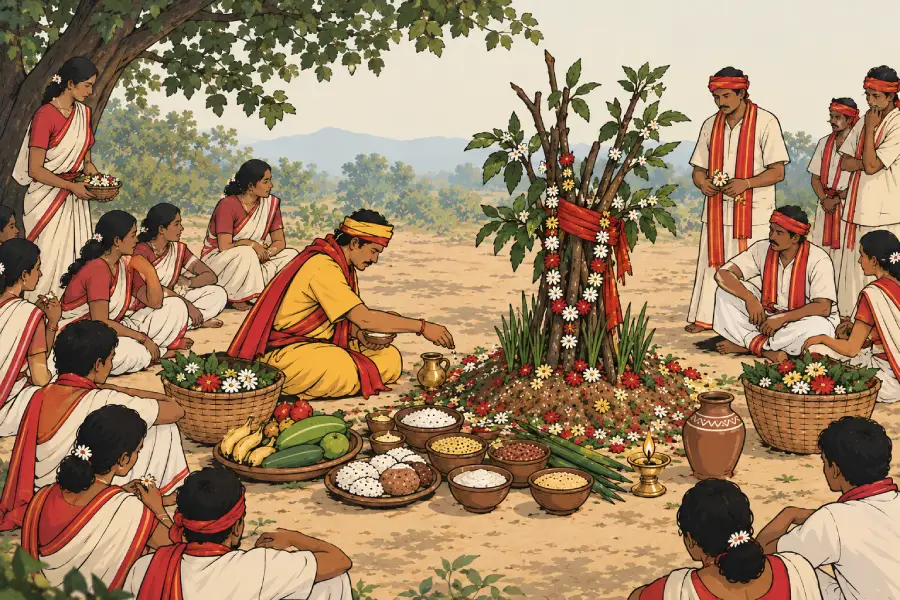
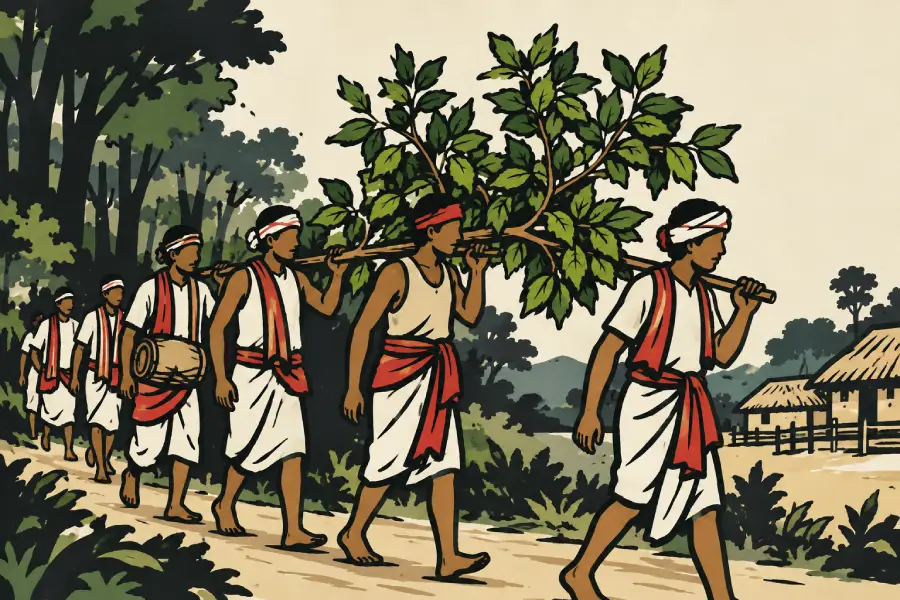
The Karam tree is the central physical symbol of the celebration. Its branch is brought into the village or household and installed in the principal ritual space, often the akhra or another community gathering place.
The sacred figure associated with the branch is known by different names. Karam Devta, Karam Raja, Karam Gosain, Karam Thakur and Karamsani occur in different traditions. Even the character of the sacred figure can vary. In some traditions Karam is understood as a male deity associated with power, youth and vitality, while in some Odisha traditions Karamsani is understood as a goddess.
The branch therefore represents more than a tree. It becomes the meeting point of the natural world and the social world. In Jharkhand, groups of young villagers traditionally go into the forest to collect the branch and other materials connected with the ceremony. In several traditions, young unmarried women have a prominent role in bringing the branch back to the village. In some regional accounts, a selected young man or bachelor cuts the branch according to prescribed custom.
The details differ, but the movement is symbolically similar: something sacred is brought from the natural world into the centre of community life. The branch may be planted at the akhra or installed in a household courtyard. That distinction itself reflects the diversity of Karam. In some villages it is essentially a collective celebration; in others, families observe it more closely at home before joining the larger festivities.
How Is The Festival Celebrated?
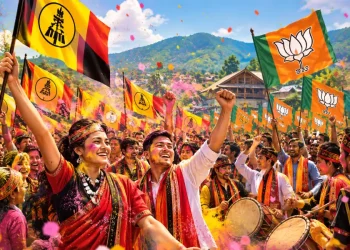
Once the formal worship ends, Karam becomes a festival of sound, movement and collective celebration. The mandar and other traditional drums set the rhythm. Young men and women dance in groups, elders participate or watch, and Karam songs carry stories of love, agriculture, family, separation, humour and community memory.
What Is Used In The Puja?
There is no universally prescribed shopping list for Karam Puja. The Karam branch and Jawa are the principal ritual elements in many traditions, accompanied by sand or soil, bamboo or other baskets, grains and pulses, flowers, seasonal produce, water, milk, curd, oil, ghee, lamps and other locally significant materials.
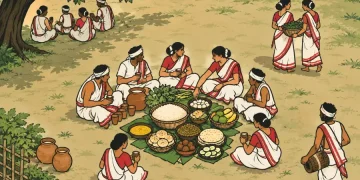
Food offerings can include rice, chura, gram, jaggery, cucumber, pulses, pitha, roti, seasonal vegetables and fruits. Some traditions also use handia or rice beer in the social or ritual setting, while animal sacrifice forms part of certain local traditions but is not a universal feature.
The diversity of materials reflects the agricultural and ecological setting of the community celebrating Karam. What is available locally and considered culturally significant often becomes part of the ceremony.
What Are The Jawa Seeds For?
One of the most distinctive elements of Karam is Jawa. Several days before the main festival, young girls in many traditions sow grains or pulses in baskets or other containers filled with sand or soil. Rice, wheat, barley, maize, gram and other pulses may be used, with the exact combination varying from place to place.
The seeds are watered and nurtured until they germinate. The resulting young shoots, commonly known as Jawa or Jawa Phool in different traditions, are taken into the main ceremony. They represent the transformation of seed into life and, ultimately, the hope of a productive crop.
The symbolism is particularly powerful because the ritual does not wait for the harvest to celebrate abundance. It begins with the fragile promise of a seed. The community nurtures the seed, watches it sprout and then places it beside the Karam branch. The ritual thus connects agriculture with human care: the crop needs soil and water, just as community life needs collective responsibility.
What’s The Story Of Karma And Dharma?
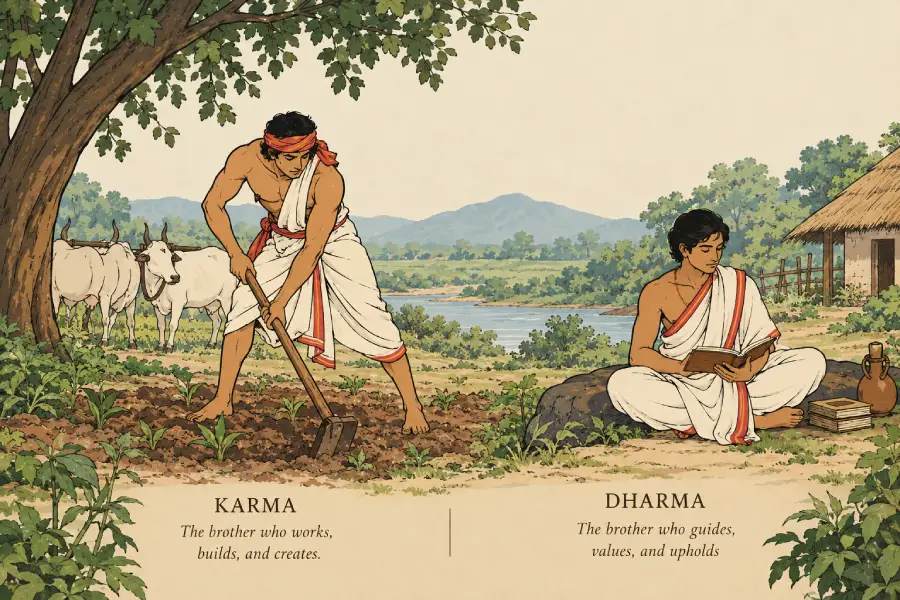
Among the many Karam legends, one of the best-known is the story of two brothers, Karma and Dharma, although the story appears in several versions among different communities. There is therefore no single canonical “Karam story” comparable to a fixed scripture.
In one widely circulated version, Karma and Dharma are brothers whose fortunes and conduct become entangled with their relationship to Karam. Another traditional account, recorded in the folklore of the Santal Parganas, tells of Karmu, a farmer, and Dharmu, a trader. In that narrative, an act that offends Karam Gosain is followed by misfortune and poverty, forcing the affected brother to confront the consequences of his actions.
Another popular version tells of brothers whose wives become absorbed in Karam celebrations. When the returning brothers find the women dancing around the sacred branch instead of attending to them, anger leads one of them to throw the Karam branch away. What follows is a collapse of fortune. Crops fail, prosperity disappears and hardship enters the household.
The repentant brother eventually sets out in search of Karam. His journey becomes a search not merely for a deity but for the reason behind his misfortune. In versions of the story, he encounters people, trees or other beings suffering from unexplained problems and promises to seek answers from Karam. When he finally restores his relationship with the sacred branch and performs the worship with humility, prosperity returns.
Part 2 to continue…