


• About
  • Contact
  • Sitemap
  • Gallery
No Result
View All Result
Vacancies
Friday, April 3, 2026
The Indian Tribal
  • Home
  • Achievers
    • उपलब्धिकर्ता
  • Cuisine
    • खान पान
  • Health
    • स्वास्थ्य
  • Legal
    • कानूनी
  • Music
    • संगीत
  • News
    • Updates
    • खबरें
  • Sports
    • खेलकूद
  • Variety
    • विविध
  • हिंदी
    • All
    • आदिवासी
    • उपलब्धिकर्ता
    • कला और संस्कृति
    • कानूनी
    • खबरें
    • खान पान
    • खेलकूद
    • जनजाति
    • भारत
    • विविध
    • संगीत
    • संस्कृति
    • स्वास्थ्य
    The Indian Tribal

    अरुणाचल की अनोखी जनजातीय कला ‘बोगरे’ में दिखती दो संस्कृतियों की कहानी

    The Indian Tribal

    बस्तर कॉफी की प्रीमियम ब्रांडिंग की तैयारी के बीच खेती पर पानी का संकट

    The Indian Tribal

    ब्रिक्स सीसीआई वी समिट 2026 में कल्पना सोरेन को ‘ट्रेलब्लेज़र अवॉर्ड’

    The Indian Tribal

    प्रकृति से ही सृजन और विलय: सरहुल पर्व पर मुख्यमंत्री हेमन्त सोरेन 

    The Indian Tribal

    प्रकृति, परंपरा और आदिवासी जीवन-दर्शन का जीवंत उत्सव है सरहुल

    The Indian Tribal

    बांसवाड़ा की दो सशक्त आदिवासी महिलाएं रच रहीं सामाजिक बदलाव की नई कहानी

    The Indian Tribal

    बेटियों की शिक्षा की बनी ढाल, रोके पाँच बाल विवाह

    The Indian Tribal

    घूंघट और घर से बाहर निकल नेतृत्व क्षमता की मिसाल बन रही हैं राजस्थान की ये आदिवासी महिलाएं

  • Gallery
    • Videos
  • Latest News
The Indian Tribal
  • Home
  • Achievers
    • उपलब्धिकर्ता
  • Cuisine
    • खान पान
  • Health
    • स्वास्थ्य
  • Legal
    • कानूनी
  • Music
    • संगीत
  • News
    • Updates
    • खबरें
  • Sports
    • खेलकूद
  • Variety
    • विविध
  • हिंदी
    • All
    • आदिवासी
    • उपलब्धिकर्ता
    • कला और संस्कृति
    • कानूनी
    • खबरें
    • खान पान
    • खेलकूद
    • जनजाति
    • भारत
    • विविध
    • संगीत
    • संस्कृति
    • स्वास्थ्य
    The Indian Tribal

    अरुणाचल की अनोखी जनजातीय कला ‘बोगरे’ में दिखती दो संस्कृतियों की कहानी

    The Indian Tribal

    बस्तर कॉफी की प्रीमियम ब्रांडिंग की तैयारी के बीच खेती पर पानी का संकट

    The Indian Tribal

    ब्रिक्स सीसीआई वी समिट 2026 में कल्पना सोरेन को ‘ट्रेलब्लेज़र अवॉर्ड’

    The Indian Tribal

    प्रकृति से ही सृजन और विलय: सरहुल पर्व पर मुख्यमंत्री हेमन्त सोरेन 

    The Indian Tribal

    प्रकृति, परंपरा और आदिवासी जीवन-दर्शन का जीवंत उत्सव है सरहुल

    The Indian Tribal

    बांसवाड़ा की दो सशक्त आदिवासी महिलाएं रच रहीं सामाजिक बदलाव की नई कहानी

    The Indian Tribal

    बेटियों की शिक्षा की बनी ढाल, रोके पाँच बाल विवाह

    The Indian Tribal

    घूंघट और घर से बाहर निकल नेतृत्व क्षमता की मिसाल बन रही हैं राजस्थान की ये आदिवासी महिलाएं

  • Gallery
    • Videos
  • Latest News
No Result
View All Result
The Indian Tribal
No Result
View All Result
  • Home
  • Achievers
  • Cuisine
  • Health
  • Legal
  • Music
  • News
  • Sports
  • Variety
  • हिंदी
  • Gallery
  • Latest News
Vacancies
Home » The Indian Tribal / Variety » From Sacred Hills To Global Shelves: Can Dongria Shawl Survive Demand For Uniformity?

From Sacred Hills To Global Shelves: Can Dongria Shawl Survive Demand For Uniformity?

As the prized Kapdaganda shawl celebrates its second anniversary of Geographical Indication (GI) status, Dongria Kondh artisans face rising market pressure and calls for uniformity. Recognition has brought visibility, but also new threats to tradition, finds out Deepanwita Gita Niyogi

January 9, 2026
The Indian Tribal

Shawl Is A Rich Tradition Of Dongria Kondhs inhabiting 112 villages In Niyamgiri (Pic -Deepanwita Gita Niyogi)

New Delhi

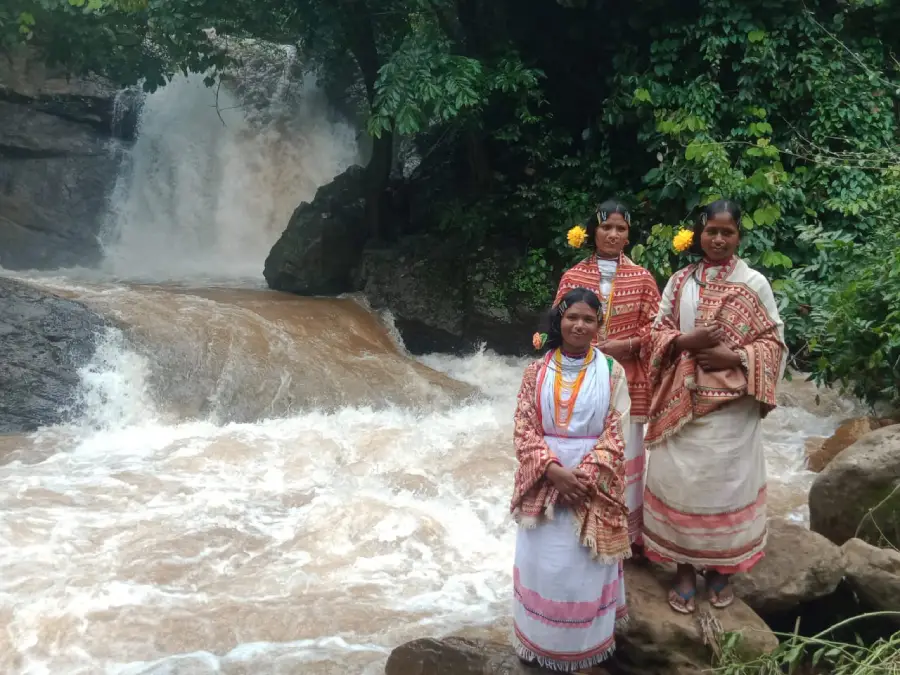
In the heart of Odisha’s Niyamgiri Hills, Sumita Wadaka, a Dongria Kondh woman from Khambeshi village, meticulously pulls a needle through coarse off-white fabric. Every stitch she makes is a testament to an ancient heritage that, as of January 2026, has navigated two years under the global spotlight of Geographical Indication (GI) status. Sumita is one of several women in her community specializing in the embroidery of the famed Kapdaganda shawl—a textile so unique it earned legal protection to prevent its imitation.

However, the view from the hills is a complex one. The GI tag, granted in January 2024, was meant to be a shield for the Dongria Kondh, a Particularly Vulnerable Tribal Group (PVTG) residing across the Rayagada and Kalahandi districts. While it has undoubtedly brought visibility and a much-needed hike in market prices, the recognition has arrived with a suite of modern challenges.

Today, the artisans of Niyamgiri find themselves at a delicate crossroads: they are enjoying a record-high demand but simultaneously fighting to prevent a dilution of the very traditions that made the shawl famous.

Sacred Language Of Embroidery

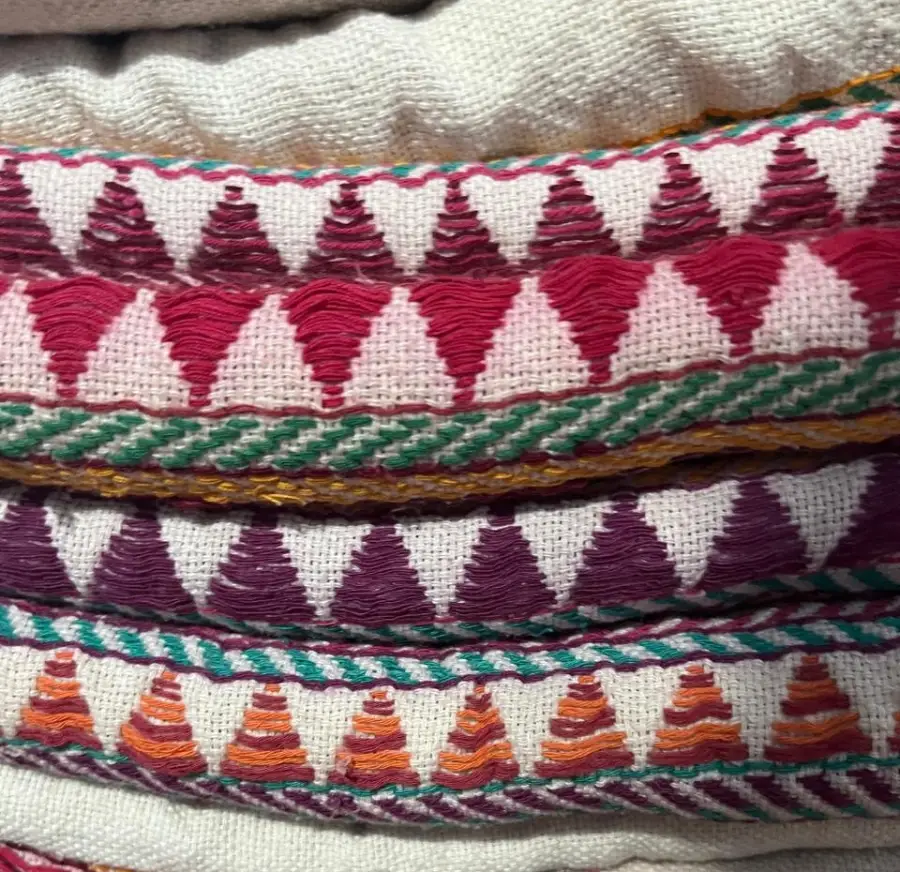
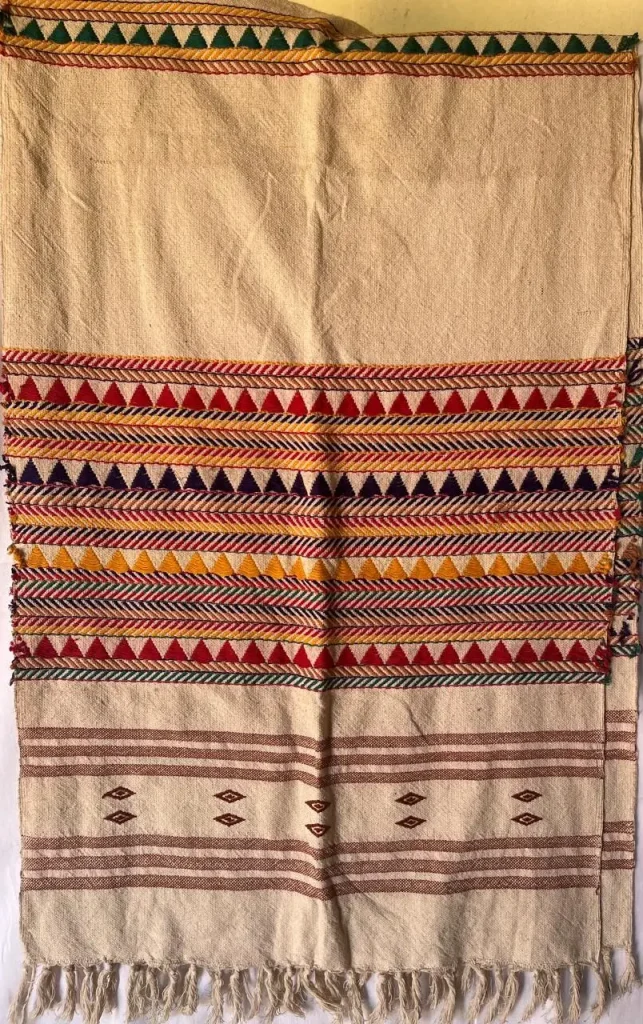
The Kapdaganda is far more than a garment; it is a spiritual and historical ledger of the tribe. “In my Kui language, the shawl is called Kapdaganda. The triangle designs are called Kudi Linga and the lines, Keri, stand for Niyamgiri’s history,” Sumita Wadaka explains.

The embroidery is deeply symbolic, acting as a visual bridge between the tribe and their environment. The triangular Kudi Linga patterns mirror the peaks of the Niyamgiri Hills, the sacred home of their deity, Niyam Raja. This connection to the divine is so profound that these patterns often transcend textiles; they are painted onto the walls of tribal homes when a vow is made to bring the God home during festivals, specifically during the worship of the female deity Dharani Maa, to appease her and seek her blessings.
The Indian Tribal
Triangles And lines Are Integral To The Shawl (Pic -DKDA)

The colours chosen by women like Sumita are not merely aesthetic choices but are rooted in the earth. Gobardhan Wadaka, a school teacher and resident of Khejuri village, elaborates on the significance: “Red symbolises sacrifice, the brown or coffee colour stands for the Earth and the mud houses, the green is for the forest and yellow stands for the turmeric cultivated in abundance in Niyamgiri.” In the broader tapestry of Indian tradition, red and yellow are considered auspicious, with the red often derived naturally from Manjistha or Palash flowers—colours that have defined Indian weddings for centuries.

A Shifting Landscape

Walking through the villages of Niyamgiri today, one notices subtle changes in the environment that mirror the shifts in the craft. Mud houses, once the inspiration for the shawl’s brown hues, are becoming rare, replaced by modern pucca houses. Yet, the work on the looms continues.

The economic impact of the GI tag over the last two years is quantifiable. Before the tag, shawl makers typically received Rs. 500 per piece. Today, that figure has risen to Rs. 1,000 through government agencies, and some specialized groups pay as much as Rs. 2,200. The retail price has seen an even sharper climb, rising from a range of Rs. 4,000–Rs. 5,000 to over Rs. 7,800 per shawl.

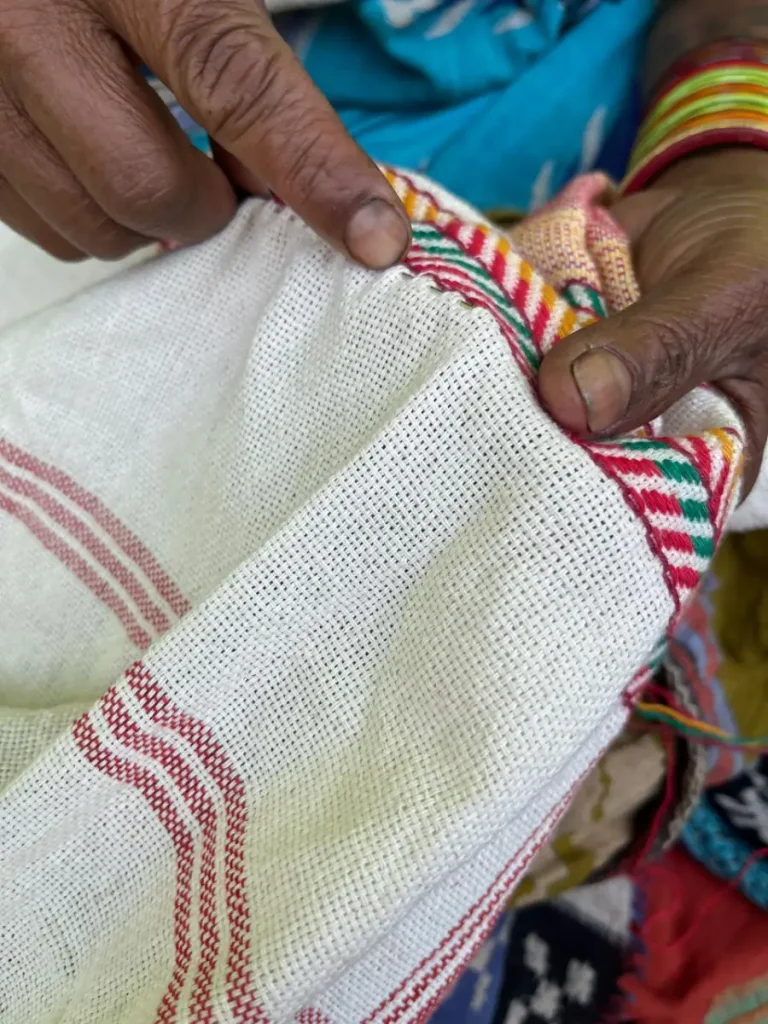
Despite the better pay, the labour remains gruelling. “If they embroider daily, it still takes over a month,” Wadaka notes. In many cases, it can take up to three months, as the women must balance their craft with agricultural work and daily household chores.

Apart from Rayagada district of Odisha, the Niyamgiri Hills where the Dongria Kondhs reside, also spans the Kalahandi district. Besides training, women like Wadaka also receive raw materials for the shawl from time to time.

The Dongria Kondh Development Agency (DKDA) and the Tribal Development Co-operative Corporation of Odisha (TDCC) have stepped in to provide training and raw materials. However, Suryanarayan Padhi of DKDA points out a recurring hurdle: “Training cannot be always continued as it depends on the availability of funding.” While non-profits occasionally fill the gap, the reliance on external funding creates an ebb and flow in production capacity.

Threat Of “Standardization”

The central tension in the post-GI era is the push for uniformity. K. Anuradha, a Koraput-based expert who works with 280 weavers across four districts—Koraput, Rayagada, Nabarangapur, and Malkangiri—has observed this trend with concern. Anuradha, who founded the brand Folk Weave in 2023, emphasizes that the Kapdaganda is “a tradition which holds nature in the form of the textile.”

She warns that as the shawl’s popularity grows, outsiders with textile and fashion backgrounds are entering the market and attempting to “fix” what isn’t broken. “They are changing the style of stitching. A tag doesn’t mean distorting traditional patterns,” Anuradha explains to The Indian Tribal.
The Indian Tribal
Weaving The Shawl was not a livelihood option, but part of community tradition (Pic – DKDA)

Because the shawls are handmade, no two pieces are identical—a feature Anuradha views as a strength but market-driven outsiders view as a flaw. These entities often provide “standard formulae” to the women during training sessions to ensure every shawl looks the same. “A handmade thing cannot be uniform, or else it becomes a mass market product. There should be no distortion of the traditional patterns,” she adds.

Diversification: Survival vs. Tradition

One of the most significant shifts in the last two years is the move towards product diversification. Because a single Kapdaganda shawl can last a lifetime, repeat customers are rare. To sustain livelihoods, artisans are now creating jackets, bags, and cushion covers, or using the embroidery as patchwork on sarees.

However, this diversification must respect tribal taboos. While new colours like purple and indigo are accepted because they appear in local flowers, other colours are strictly avoided. More importantly, the sacred nature of the embroidery means it has strict boundaries. “The embroidery should not be made on shoes as it is sacred,” Anuradha insists.

Efforts by NGOs like PRADAN are focusing on this diversification while trying to re-engage a younger generation that is increasingly distracted by modern technology. Nakula Batria, who overlooks the Kapdaganda project for PRADAN, recently organized a 15-day workshop in Chatikona. “Many young women have become addicted to the outside world, TV and mobiles. They are moving away from traditional cultural things,” Batria says. To encourage participation, the NGO paid the women Rs. 300 per day to compensate for the time they took away from their farms and homes to learn how to apply their traditional stitches to table runners and curtains.

Long Road Ahead

The struggle to maintain the purity of the Kapdaganda is, in many ways, an extension of the Dongria Kondh’s historic resistance against the mining giant Vedanta. Their fight to protect the Niyamgiri Hills was a fight for their god, Niyam Raja, and their environment.
The Indian Tribal
A Dongria Shawl On Display (Pic -DKDA)

The GI tag remains a subject of debate. Gobardhan Wadaka believes it will prove beneficial in the long run by making the product popular and increasing sales. Anuradha agrees that the visibility is a positive—noting that even if people don’t buy, they now recognize the shawl as a prestigious GI-tagged product—but she remains vigilant against the “downside” of market-driven distortion.

As Niyamgiri stands tall, the fate of the Kapdaganda hangs on whether the community can balance the lucrative demands of the global market with the uncompromising richness of their tradition. Two years after receiving its official “mark of origin,” the shawl remains a source of immense pride and identity, a woven piece of the hills that continues to tell the story of the Dongria Kondh—one unique, non-uniform stitch at a time.


Root Woot | Online Puja Samagri Root Woot | Online Puja Samagri Root Woot | Online Puja Samagri

In Numbers

49.4 %
Female Literacy rate of Scheduled Tribes

Update

Gujarat CM launches schemes worth Rs 362 cr for tribal belt

Aiming to improve access to basic services and agricultural support in Gujarat’s tribal regions, Chief Minister Bhupendra Patel on Monday launched a series of infrastructure and irrigation projects including road connectivity, public facilities, and large-scale water supply schemes. The State government said it sanctioned works worth Rs 362.57 crore under the 'Vanbandhu Kalyan Yojana' to strengthen infrastructure across the tribal belt stretching from Ambaji to Umargam. The package includes 293 projects, comprising 325.81 km of roads to connect tribal villages with schools and primary health centres, along with related structural construction works. "The works were approved to ensure that essential services such as education and healthcare reach tribal communities easily and promptly under the scheme, inspired by Prime Minister Narendra Modi," the Government said in a statement.
The Indian Tribal
Achievers

Orphaned Isak, Ailing Anai: Northeast Weightlifters Power Through Odds To Strike Gold At Khelo India Tribal Games 2026

by The Indian Tribal
March 29, 2026

The two young athletes are inspiring examples of turning adversity into achievement with stirring gold medal victories in Raipur. Their journeys reflect resilience shaped by grief, illness and relentless pursuit of excellence. The Indian Tribal reports

The Indian Tribal

बस्तर कॉफी की प्रीमियम ब्रांडिंग की तैयारी के बीच खेती पर पानी का संकट

March 27, 2026
The Indian Tribal

Inaugural Khelo India Tribal Games 2026 Gets A Grand Opening In Bastar

March 26, 2026
The Indian Tribal

ब्रिक्स सीसीआई वी समिट 2026 में कल्पना सोरेन को ‘ट्रेलब्लेज़र अवॉर्ड’

March 23, 2026
The Indian Tribal

Unique Tribal Art Form Of Arunachal Pradesh Tells A Story Of Two Cultures

March 22, 2026
The Indian Tribal

प्रकृति से ही सृजन और विलय: सरहुल पर्व पर मुख्यमंत्री हेमन्त सोरेन 

March 21, 2026
Previous Post

यह दुर्लभ सुपरफूड जनजातीय खानपान और स्वास्थ्य का सदियों पुराना आधार है

Next Post

Skateboarding Transforming Tribal Youth Culture In Gangtok

Top Stories

The Indian Tribal
Adivasi

PVTG Chenchu Youth Lead Tiger Conservation In Nagarjunasagar-Srisailam Reserve

March 30, 2026
The Indian Tribal
Achievers

Orphaned Isak, Ailing Anai: Northeast Weightlifters Power Through Odds To Strike Gold At Khelo India Tribal Games 2026

March 29, 2026
The Indian Tribal
आदिवासी

बस्तर कॉफी की प्रीमियम ब्रांडिंग की तैयारी के बीच खेती पर पानी का संकट

March 27, 2026
Load More
  • About Us
  • Contact
  • Team
  • Redressal
  • Copyright Policy
  • Privacy Policy And Terms Of Use
  • Disclaimer
  • Sitemap

  • Achievers
  • Cuisine
  • Health
  • Hindi Featured
  • India
  • News
  • Legal
  • Music
  • Sports
  • Trending
  • Chhattisgarh
  • Delhi
  • Gujarat
  • Jammu & Kashmir
  • Jharkhand
  • Kerala
  • Madhya Pradesh
  • Maharashtra
  • North East
  • Arunachal Pradesh
  • Assam
  • Manipur
  • Meghalaya
  • Mizoram
  • Nagaland
  • Sikkim
  • Tripura
  • Odisha
  • Telangana
  • West Bengal
  • Political News
  • Variety
  • Art & Culture
  • Entertainment
  • Adivasi
  • Tribal News
  • Scheduled Tribes
  • हिंदी
  • उपलब्धिकर्ता
  • कानूनी
  • खान पान
  • खेलकूद
  • स्वास्थ्य
  • संस्कृति
  • संगीत
  • विविध
  • कला और संस्कृति
  • खबरें
  • असम की ताज़ा ख़बरें
  • अरुणाचल प्रदेश की ताज़ा ख़बरें
  • ओडिशा की ताज़ा ख़बरें
  • केरल की ताज़ा ख़बरें
  • गुजरात की ताज़ा ख़बरें
  • छत्तीसगढ़
  • जम्मू और कश्मीर की ताज़ा ख़बरें
  • झारखंड न्यूज़
  • तेलंगाना की ताज़ा ख़बरें
  • दिल्ली
  • नॉर्थईस्ट की ताज़ा ख़बरें
  • पश्चिम बंगाल की ताज़ा ख़बरें
  • मध्य प्रदेश की ताज़ा ख़बरें
  • महाराष्ट्र की ताज़ा ख़बरें
  • त्रिपुरा की ताज़ा ख़बरें
  • नागालैंड की ताज़ा ख़बरें
  • मणिपुर की ताज़ा ख़बरें
  • मिजोरम की ताज़ा ख़बरें
  • मेघालय की ताज़ा ख़बरें
  • सिक्किम की ताज़ा ख़बरें
  • राजस्थान की ताज़ा ख़बरें

About Us

The Indian Tribal is India’s first bilingual (English & Hindi) digital journalistic venture dedicated exclusively to the Scheduled Tribes. The ambitious, game-changer initiative is brought to you by Madtri Ventures Pvt Ltd (www.madtri.com). From the North East to Gujarat, from Kerala to Jammu and Kashmir — our seasoned journalists bring to the fore life stories from the backyards of the tribal, indigenous communities comprising 10.45 crore members and constituting 8.6 percent of India’s population as per Census 2011. Unsung Adivasi achievers, their lip-smacking cuisines, ancient medicinal systems, centuries-old unique games and sports, ageless arts and crafts, timeless music and traditional musical instruments, we cover the Scheduled Tribes community like never-before, of course, without losing sight of the ailments, shortcomings and negatives like domestic abuse, alcoholism and malnourishment among others plaguing them. Know the unknown, lesser-known tribal life as we bring reader-engaging stories of Adivasis of India.

Follow Us

All Rights Reserved

© 2024 Madtri Ventures [P] Ltd.

No Result
View All Result
  • Home
  • Achievers
  • Cuisine
  • Health
  • Health
  • Legal
  • Music
  • News
  • Sports
  • Variety
  • हिंदी
    • उपलब्धिकर्ता
    • खान पान
    • कानूनी
    • खेलकूद
    • खेलकूद
    • संगीत
    • संगीत
    • स्वास्थ्य
    • स्वास्थ्य
    • विविध
  • Gallery
  • Videos

© 2024 Madtri Ventures [P] Ltd.