









RANCHI
The Jharkhand government’s decision to scrap the JSSC-Combined Graduate Level (CGL) examination and all examinations, results and selections linked to TSR Data Processing Private Limited (TDPL) since 2014 has triggered a fresh crisis even as it defused the most contentious part of the 24-day student agitation.
The biggest development on Tuesday was the emergence of a new protest by candidates who had cleared the JSSC-CGL examination and had already joined government service. These employees face the possibility of losing appointments obtained after clearing the recruitment process and have begun mobilising against what they describe as collective punishment for alleged irregularities for which they were not responsible. They are now set to challenge the State government’s decision in the High Court.
Their protest has given the Hemant Soren government a new and potentially more complicated challenge just hours after it appeared to have resolved the immediate confrontation with protesting aspirants.
As many as 1,975 successful candidates are reported to be affected by the cancellation. Many had joined government departments only months ago, after appointment letters were distributed in December 2025 and subsequent joining processes were completed. They now argue that any wrongdoing established in the examination should be pinned on those responsible rather than automatically invalidating the candidature of every successful candidate.
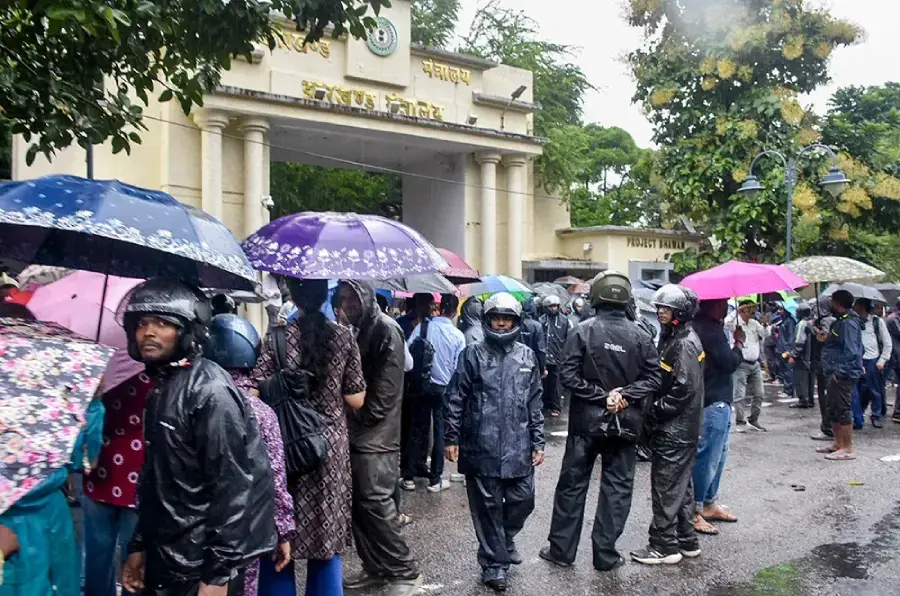
Braving continuous downpour, the employees staged a protest outside the Project Bhawan (housing the Jharkhand Mantralaya) on Tuesday, raising slogans and demanding that the government hear their side before acting against their appointments. Some said they had left other jobs or made major financial and family commitments after securing the government posts and now faced severe uncertainty.
The Government’s move has effectively produced an unusual situation: one group of candidates is celebrating the cancellation of the examination as a victory for merit and another group of candidates, who cleared the same examination and are already in government service, is protesting because the same cancellation threatens their livelihoods.
CGL-pass staffers become government’s new headache
The protest by appointed CGL candidates has emerged as the most immediate new challenge for the government. The employees insist that they are not responsible for any alleged paper leak, manipulation or malpractice and should not automatically lose their jobs if wrongdoing is established against officials, intermediaries or beneficiaries.
Their argument puts the government in a difficult position. Any attempt to preserve their appointments could be challenged by aspirants who have demanded a complete scrapping of the allegedly compromised recruitment process, while wholesale cancellation without individual consideration could invite legal challenges from employees who claim to have been genuine candidates.
The government has indicated that affected candidates can seek legal remedies, while the administration will have to determine the precise consequences of the cancellation.
The issue is particularly sensitive because the government itself had earlier celebrated the appointment of successful CGL candidates. The Chief Minister’s official website records the distribution of appointment letters to candidates selected through the JSSC examination in December 2025.
For the employees, therefore, the cancellation is not an abstract examination reform. It potentially means the loss of jobs they have already joined, salaries they have started receiving and financial commitments they made after receiving official appointment. Some protesters have demanded a fair hearing and argued that innocent candidates should not be made victims of an investigation into alleged malpractice. Reports from the protest described employees speaking of family responsibilities, loans, marriages and other commitments made after securing the jobs.
The government must now decide whether the fate of all appointees can be determined collectively or whether the investigation will have to distinguish between candidates allegedly involved in malpractice and those who cleared the examination without wrongdoing.
Hunger strike: not everyone ended it
The status of the hunger strike is more nuanced than a blanket announcement that all protesters have withdrawn.
Student leader, Devendra Nath Mahto, ended his 16-day hunger strike after the government announced the cancellation of the JSSC-CGL and TDPL examinations. He described the decision as a major victory, but made it clear that ending his fast did not mean the end of the student movement.
Other leading hunger strikers also ended their fast following the government’s decision. One set of reports said four protesters, including Mahto, ended their hunger strike after the announcement. However, reports also indicated that three protesters had ended their fast while three others continued, primarily because the government had not accepted the demand for a CBI investigation.
Thus, it is said, the hunger strike has not uniformly been called off by everyone under the different protest banners. The distinction is important because the student agitation has never been confined to the cancellation of one examination. The demand for an independent investigation has remained a central issue throughout the movement.
Protest at Jaipal Singh Munda Stadium continues in a new phase
The Jaipal Singh Munda Stadium, which became the epicentre of the agitation, witnessed celebrations after Soren announced the Cabinet decision.
But the celebrations did not amount to a formal end to the protest. The student movement has moved from its first-stage demand for cancellation towards demands for an independent probe, accountability and permanent recruitment reforms. The movement continues, although its character has changed following the government’s decision on cancellation. The demand for a CBI probe remains the principal unresolved issue.
CID intensifies probe as CBI demand remains unresolved
The timing of the CID’s latest action has added another layer to the dispute. On Tuesday, the Jharkhand CID questioned JSSC secretary Sudhir Gupta for several hours, apparently on the basis of evidence collected during a search of the commission’s office a day earlier.
The agency also questioned Akshay Tiwary, brother of Abhay Tiwary — described by investigators as a key figure in the alleged recruitment examination irregularities — and Akshay’s wife. Both were later arrested. The CID action followed Monday’s search at the JSSC office and the residence of its secretary. The agency has been investigating alleged irregularities in recruitment examinations and has already arrested persons in connection with the case.
The investigation has therefore become more active precisely when the students are demanding that it be transferred to the CBI. That is the fundamental disagreement between the two sides.
The government argues that the state investigation is producing results and that the CID has already unearthed significant evidence. The protesters, however, contend that a state agency cannot inspire the confidence required for investigating alleged irregularities involving the state’s own recruitment machinery.
Why the CBI demand has survived the cancellation
For the student leaders, cancellation and investigation are separate questions. The cancellation addresses the immediate consequence of an allegedly compromised examination: whether the recruitment process should stand.
The CBI demand addresses the larger question: who engineered the alleged irregularities, how extensive was the network, who benefited and who enabled it?
The government has chosen to rely on the CID investigation and the wider inquiry announced after the Cabinet meeting. The protesters want an investigation they believe would be institutionally independent of the state government.
Political parties claim victory but disagree on CBI
The political battle over the issue also continued on Tuesday. Congress, which is part of the ruling alliance in Jharkhand, welcomed the government-student understanding. Congress MP Rahul Gandhi praised the agreement as the “right way” of resolving the dispute and said the system must change so that students are supported rather than held back.
The ruling alliance and the opposition have thus sought political mileage from different aspects of the development: the government and its allies point to dialogue and cancellation, while the BJP continues to foreground the demand for a CBI investigation.
The BJP welcomed the cancellation but maintained pressure on the government over the CBI demand. Opposition leaders argued that cancelling examinations without handing the investigation to the central agency leaves the larger question of accountability unresolved.