








NEW DELHI
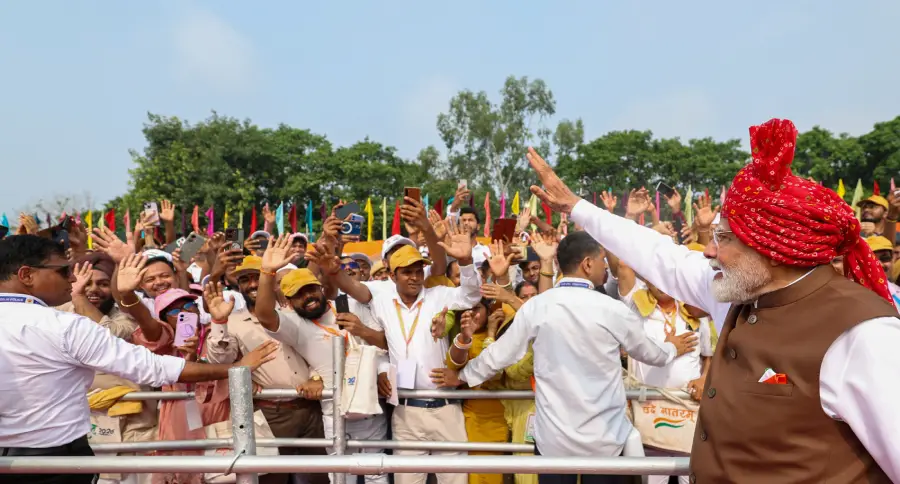
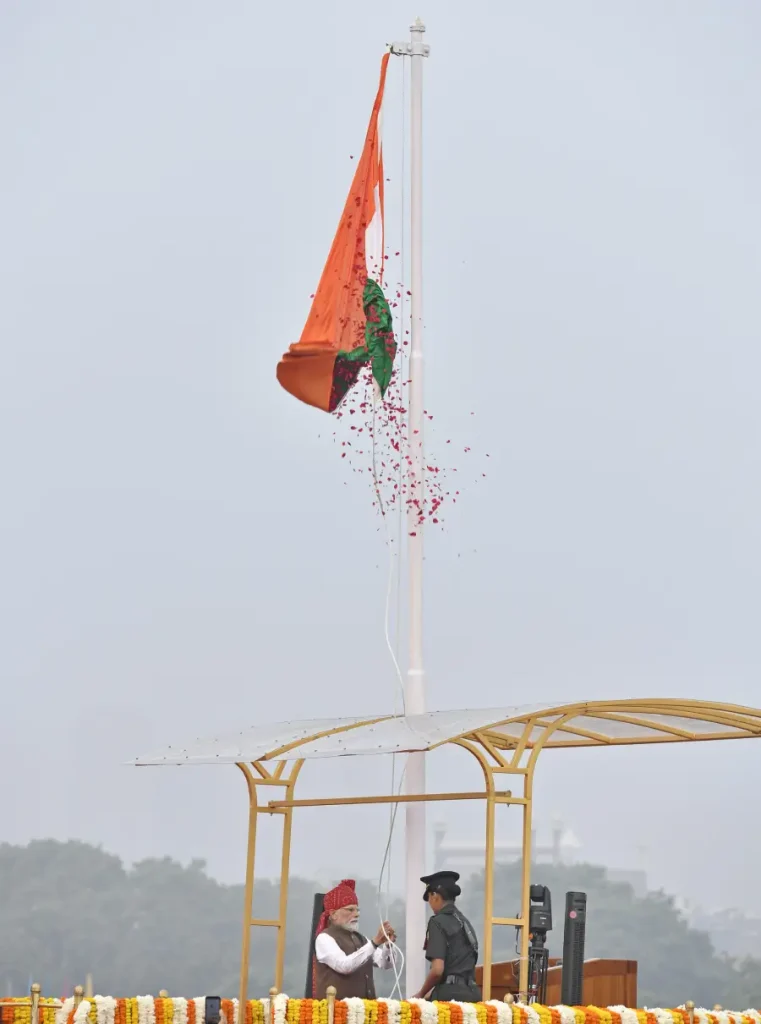
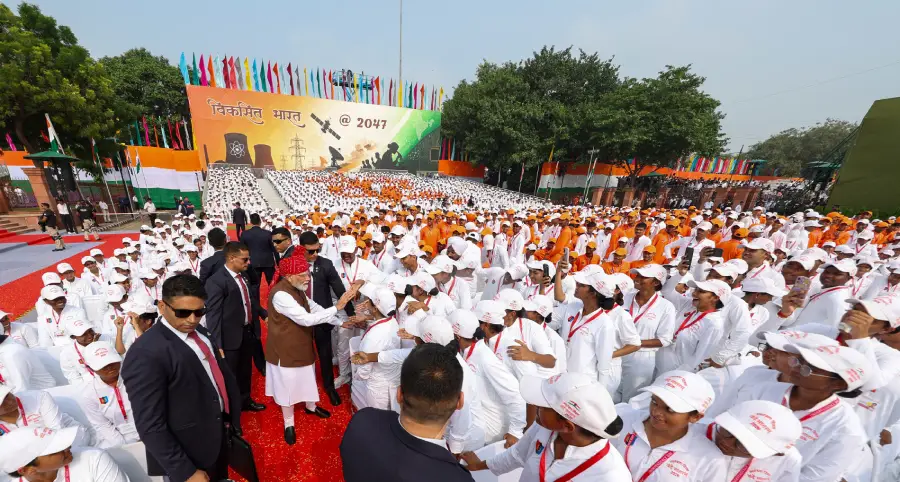
Prime Minister Narendra Modi on Saturday put India’s youth firmly at the centre of his 2047 Viksit Bharat (Developed India) vision, using his Independence Day address from the ramparts of the Red Fort to unveil a series of initiatives aimed at giving young Indians access to new-age skills, affordable education, sporting opportunities and a larger role in the country’s economic transformation.
The most prominent announcement was a nationwide programme to train one crore young Indians in artificial intelligence over the next year, as Modi sought to position India’s youth to lead rather than merely participate in an economy being reshaped by AI.
“From the Red Fort, I want to make an announcement for the country’s youth. We have decided that over the next one year, we will train 1 crore young people in AI skills so that India’s youth can develop the capability to lead in the world of AI,” Modi said.
The AI push formed part of a larger argument that India must become an innovation hub rather than remain a market for technologies developed elsewhere. Modi identified AI, quantum technology, robotics, space and data centres as areas that would define the next phase of technological competition and said India must develop leadership in these fields.
Free coaching to ease burden on students, families
In an announcement with a more immediate impact on students and their families, Modi said the government would create a network of free online coaching for young people preparing for various examinations.
He said competitive coaching had become a major financial burden, particularly for poor and middle-class families, while parents were increasingly under pressure to send their children to coaching centres.
“Therefore, we have decided to provide free online coaching for young people preparing for various examinations. We have digital public infrastructure, excellent talent and teachers. By bringing these resources together, we are going to create a complete network to provide free coaching to the country’s youth,” he said.
Modi said the initiative was intended to save families the thousands of crores they spend on coaching and allow children to remain closer to their families. The announcement comes at a time when competitive examinations and the coaching ecosystem have become a defining part of the educational aspirations of millions of Indian families.
‘Youth must be our highest priority’
Modi repeatedly returned to the role of young Indians in his vision of a developed India.
“The youth have a huge role in the journey towards a developed India. Not only are they the biggest contributors, they are also the biggest beneficiaries. Therefore, we must link the developed India goal with our youth and make young people our highest priority,” he said.
He cited the growth of Startup India, saying the country now has more than 2.5 lakh registered startups, and highlighted the government’s Rs 1 lakh crore innovation fund, inviting young Indians to bring their ideas and promising that resources would be available to back them.
He also cited Skill India, the opening of the space sector, the National Drone Policy, Khelo India and the National Education Policy as measures aimed at expanding opportunities for young people.
The education expansion, he said, was reflected in the rise in the number of universities and medical seats over the past decade. He also highlighted more than 10,000 Atal Tinkering Labs, aimed at introducing children to innovation and technology at an early age.
Sports talent hunt for children aged 5-15
Modi’s youth push extended beyond education and employment to sports, with the Prime Minister announcing a nationwide talent-identification campaign for children aged 5 to 15.
The campaign, he said, would cover villages, cities and schools, identify sporting talent and provide selected children with specialised training to prepare them for national and international competition.
The announcement was linked to India’s ambition to host the 2036 Olympics. Modi noted that India currently does not participate or qualify in a large number of Olympic disciplines and argued that the country needed to begin identifying potential athletes much earlier.
“If we need athletes for 2036, we must focus today on children aged five, 10 and 15,” he said, calling for a systematic search for sporting talent among both boys and girls.
He also highlighted the expansion of the sports ecosystem through Khelo India, the Target Olympic Podium Scheme, University Games, Winter Games and Beach Games, and said India would host the Commonwealth Games in 2030.
From startups to bioeconomy, a wider jobs pitch
Modi used the speech to underscore the emergence of sectors that could create new opportunities for India’s young workforce.
He said India’s bioeconomy had grown from around Rs 60,000 crore before 2014 to Rs 20 lakh crore, while electric-vehicle sales had increased from 1.5 lakh in 2009-10 to 25 lakh in 2025-26. He pointed to aviation, aircraft maintenance and overhaul, drones, space technology and defence manufacturing as other areas with significant employment potential.
The Prime Minister also highlighted the Swamitva scheme, saying drones had been used in villages and that around 3.25 crore families had benefited, with assets worth around Rs 140 lakh crore being unlocked.
Seven streams of strength for a developed India
The youth-focused announcements were embedded in a much broader economic roadmap that Modi described as seven streams of strength.
The first is manufacturing, with India expected to build complete value chains rather than merely assemble finished products. Modi called for a focus on “cost, quality and scale” and said “zero-defect precision manufacturing” should become India’s identity.
The second is agriculture and food production, with greater emphasis on food processing and exports. Modi said India’s millets, spices, fruits, flowers and traditional foods should become global brands.
The third is technology and innovation, where he placed AI, quantum technology, robotics, space, data centres and Made-in-India 6G at the centre of India’s future.
The fourth is Gati Shakti, involving high-speed rail, highways, inland waterways, airports, multimodal logistics and port-led development.
The fifth is defence power, with a push for domestic production and next-generation technologies, including drones, counter-drone systems and hypersonic defence.
The sixth is the green and blue economy, covering green hydrogen, renewable energy, energy storage, green mobility, green manufacturing, fisheries, coastal tourism and ocean technology.
The seventh is India’s soft power, with Modi identifying yoga, Ayurveda, healthcare, handicrafts, films, VFX, animation, gaming, digital content, tourism, sports and the concert economy as areas where India could exercise greater global influence.
Modi sets global ambitions for Indian companies
Taking the economic argument beyond sectoral growth, Modi challenged Indian industry to think in terms of global leadership.
“Why should 50 Indian companies not be part of the Fortune 500 within the next decade?” he asked. He similarly questioned why an Indian bank should not be among the world’s top five and why one or two Indian pharmaceutical companies should not feature among the world’s five largest.
He also called for Indian technology companies, law firms, consulting firms, accounting firms and other professional services to emerge as global leaders.
Self-reliance at the core of economic strategy
A substantial part of the address was devoted to Atmanirbhar Bharat, which Modi presented as both an economic and strategic necessity in a world where countries are increasingly protecting their own resources and supply chains.
He highlighted semiconductor manufacturing, saying three major plants had already begun and that another five to eight plants were expected in the coming years.
He also highlighted the National Critical Minerals initiative and the Critical Minerals Corridor, arguing that India needed greater control over resources essential to modern technologies.
On energy security, Modi set a target of 100 GW of nuclear power capacity by 2047 and said India would seek to start five new nuclear reactors in the current decade. He also said previously designated offshore “no-go” areas had been opened for exploration and cited an allocation of Rs 85,000 crore for the Samudra Manthan initiative.
On renewable energy, he pointed to the expansion of solar capacity from 2 GW to 160 GW and said the PM Surya Ghar Muft Bijli Yojana had crossed 50 lakh households, with government assistance of Rs 80,000 per family.
Security, Naxalism and a new civil-defence network
Internal and national security formed another important strand of the speech.
Modi said Naxalism and Maoism had destroyed the future of millions of young people and claimed that more than 3,500 police and security personnel had been killed in the conflict. He said armed Naxalism was now nearing its end but warned against what he described as “intellectual Naxals”, whom he accused of seeking opportunities to promote violence and anarchy.
The Prime Minister also announced plans for a modern civil-defence network, arguing that the nature of warfare had changed and that threats could now target refineries, banks, data centres and other critical infrastructure.
Women, social security and Census appeal
Modi highlighted women’s expanding participation in defence, aviation, sports, STEM and semiconductor manufacturing and said the government was moving from its achieved target of 3 crore Lakhpati Didis towards 6 crore.
He again urged political parties to support implementation of 33% reservation for women in Parliament and state assemblies, saying women must have a greater role in shaping national policy.
On social security, he said the number of people covered by social-security measures had risen from 25 crore before 2014 to 100 crore over the past decade. He highlighted Ayushman Bharat and said families had saved around Rs 2 lakh crore on medical treatment.
He also appealed to young Indians to help their families provide accurate information during the ongoing Census, including by using mobile phones to submit details digitally.
Praising the disadvantaged
Modi also acknowledged the contribution of India’s tribal communities to the country’s progress, placing them alongside Dalits, the deprived and marginalised, rural and urban residents, the poor and middle class, youth, women and other sections of society.
“Over the past 12 years, crores of citizens—Dalits, the oppressed, the deprived, tribals, people living in villages and cities, the poor, the middle class, the young, the elderly, women and men, and people from the north, south, east and west—have worked with resolve and dedication to take the country to new heights,” he said.
The reference was significant in the broader context of his Viksit Bharat narrative, in which Modi credited the collective efforts of historically disadvantaged and diverse social groups for India’s economic and developmental gains.
The generational message
Modi’s strong youth focus in his Independence Day speech comes against the backdrop of the Gen Z-led Jantar Mantar agitation over examination irregularities, which culminated in Union Education Minister Dharmendra Pradhan’s resignation on July 25.
In that context, his announcements of training one crore young people in AI, creating a free online coaching network for competitive examinations and launching a nationwide talent hunt for 5-15-year-olds can be seen as an effort to address some of the aspirations and anxieties of a generation increasingly demanding better opportunities, skills and fairness in education and employment.
The timing is particularly significant as the Jantar Mantar protests demonstrated the political force of youth mobilisation around examination and career concerns, with the agitation later resonating with student protests in Jharkhand over JPSC-JSSC recruitment irregularities.
However, Modi closed by returning to the larger national mission, saying India must change its work culture, thinking and speed and complete in the next five to seven years tasks that had remained unfinished for decades.
“The national interest must come above the self. The national interest must come above the self, and duty must be our identity. Let us turn dreams into resolve, resolve into capability and capability into success.” he said.