









Omkareshwar (Madhya Pradesh)
While lauding the success of India’s ambitious National Sickle Cell Anaemia Elimination Mission, President Droupadi Murmu on Friday drew attention to what she described as a critical next-stage challenge: understanding and addressing the implications of identifying more than 20 lakh carriers of the disease across the country.
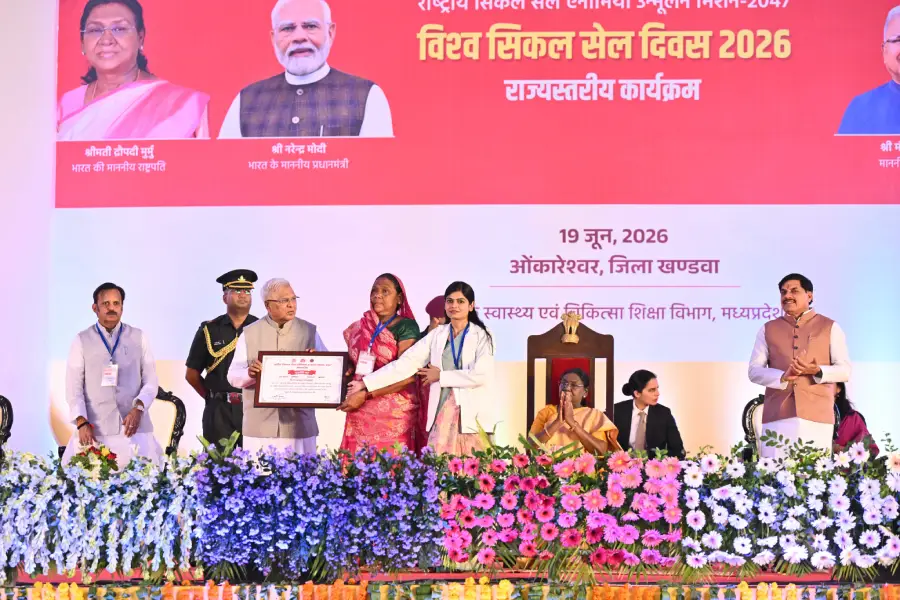
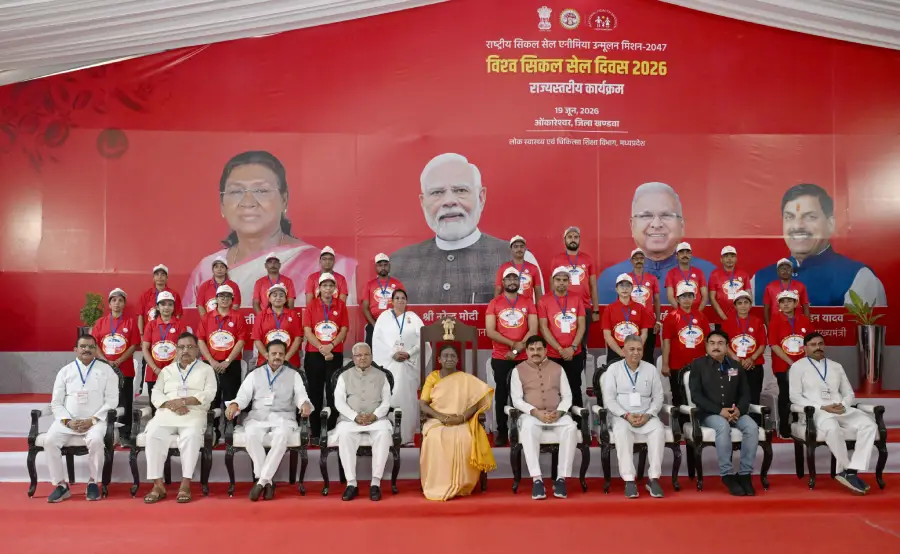
Speaking at the commemoration of International Sickle Cell Day 2026 in Omkareshwar, the President said the mission had already achieved a landmark public health milestone by completing the screening of seven crore people—from newborns to individuals up to 40 years of age—ahead of schedule. She described the exercise as one of the largest initiatives for genetic disease screening anywhere in the world.
The President noted that mission-mode screening has so far led to the detection of approximately 2.5 lakh people suffering from sickle cell disease, while more than 20 lakh carriers have also been identified. She emphasized that the sheer number of carriers requires careful attention from policymakers, healthcare providers and communities alike.
Explaining the significance of this challenge, Murmu said carriers generally do not exhibit symptoms of the disease and therefore often remain unaware of its long-term implications. Many carriers do not realise how the condition can be passed on to future generations or why their children may develop the disease. This makes awareness, genetic counselling and preventive healthcare interventions essential components of the national strategy.
The President’s remarks reflected the broader vision behind the National Sickle Cell Anaemia Elimination Mission, which was launched by Prime Minister Narendra Modi from Shahdol in Madhya Pradesh in 2023. According to her, the programme was conceived not merely as a health intervention but as a comprehensive effort encompassing tribal health, genetic awareness, preventive healthcare and behavioural change.
She highlighted that the mission emerged from extensive scientific and social research conducted by institutions including ICMR, Tribal Health Research Institutes, AIIMS, the National Health Mission and the World Health Organization. These studies found that the burden of sickle cell disease is particularly high in India’s tribal belt across central India, with many affected families having lived with the disorder for generations without even knowing its name.
Murmu observed that the prevalence of sickle cell disease in tribal regions is several times higher than in the general population. As a result, India has brought together public health systems, tribal welfare programmes, genetic science and digital monitoring under a single nationwide campaign operating across 17 states.
The President praised Madhya Pradesh for its significant contribution to the mission. More than 1.25 crore people have been screened in the state, with a large number receiving genetic counselling services. She also acknowledged the state’s efforts to expand point-of-care testing facilities for affected individuals, pregnant women and newborns down to the Ayushman Arogya Mandir level.
Particular praise was reserved for the “Swasth Nari, Sashakt Parivar Abhiyan” conducted between September 17 and October 2, 2025, during which Madhya Pradesh screened more than four lakh women for sickle cell disease. She described the achievement as an invaluable contribution to tackling the disorder.
The President further highlighted large-scale screening of students, outreach to tribal communities through counselling and treatment services, and the use of Mobile Medical Units in remote and inaccessible areas.
Referring to the “Sickle Mitra” initiative launched by the Madhya Pradesh government on International Sickle Cell Day last year, Murmu said representatives of government and non-government institutions, voluntary organisations and NCC cadets have been trained to spread awareness, assist patients and connect them with healthcare services. She said such community-driven efforts would play a crucial role in combating the disease.
Murmu identified three key pillars of the mission: widespread awareness and pre-marital genetic counselling, comprehensive screening for early detection, and continuity of healthcare and disease management. She said India’s large-scale genetic screening programme, supported by digital tracking, represents an unprecedented public health initiative.
Congratulating both the Centre and the states for identifying patients and carriers while ensuring proper healthcare support, the President called upon all state governments to intensify efforts towards eliminating the genetic disorder. She expressed confidence that through the combined strength and active participation of all states, India would achieve its national goal of eradicating sickle cell-related diseases well before 2047.
The President also noted that Madhya Pradesh and Odisha are home to the country’s largest tribal populations and expressed hope that Madhya Pradesh would continue setting new benchmarks in tribal development and healthcare.
The National Sickle Cell Anaemia Elimination Mission has already demonstrated the power of large-scale screening and coordinated public health action. However, President Murmu’s emphasis on the challenge posed by more than 20 lakh carriers underscores the next phase of the battle—ensuring that awareness, counselling and preventive interventions reach every identified carrier so that future generations can be protected from the disease.