





New Delhi/Bhopal
Water nourishes life. Sometimes, it also turns into a source of faith for communities living in close proximity with wild animals. And that is exactly the story in Pench, a tiger reserve spread over the Seoni and Chhindwara districts of Madhya Pradesh. A part of Pench also lies in the Nagpur district of Maharashtra.
Pench, which inspired Rudyard Kipling’s The Jungle Book, offers an interesting three-day trail to visitors, a part of which, about five-km in length, is known as the Bawanthadi river trail. Those who participate in the trail walk along the course of the river. The colonial Sakata resthouse is another attraction along the way.
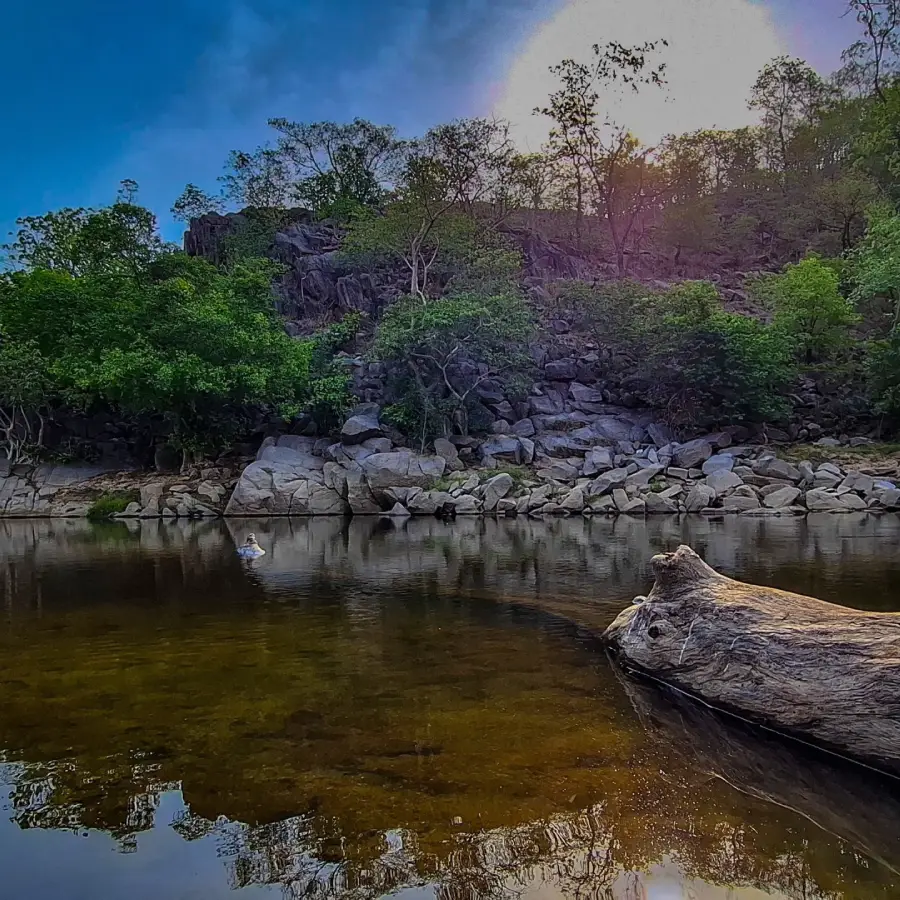
“The Bawanthadi is a big river which is connected to a dam in neighbouring Maharashtra. At one time, there were 52 water sources which originated and joined the river, and hence, the name. Today, the river recharges the buffer area of Pench which has about 112 villages,” Shubham Baronia, a ranger in charge of the Karmajhiri forest range in Pench’s core or critical habitat area, told The Indian Tribal. The tiger reserve has three ranges in the core and six in the buffer.
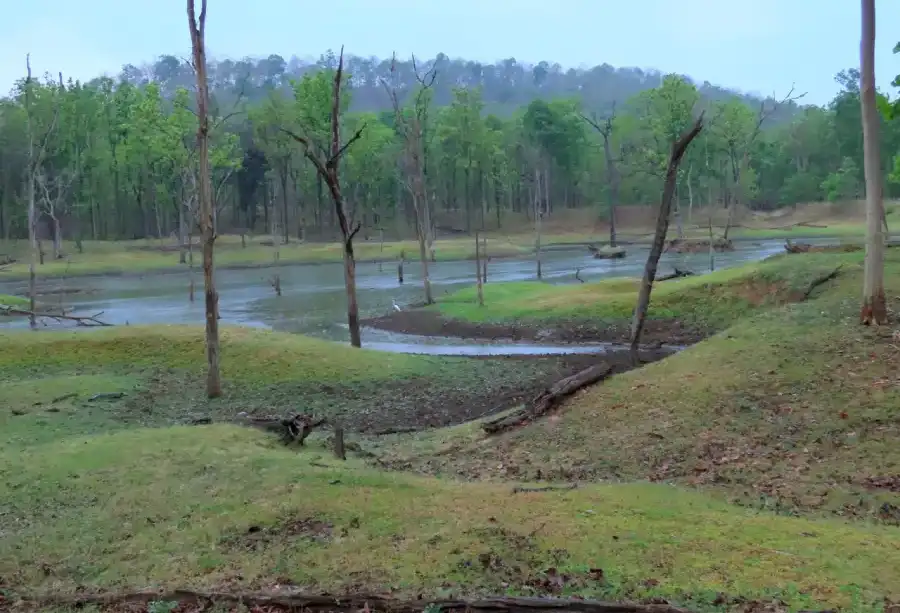
Though a point of attraction due to its scenic beauty, the Bawanthadi river holds a huge significance in many ways. The local residents, who live in Pench’s villages, depend on it for water supply and farm work. It is also culturally important. There is a place along the river which is considered holy by the Gond tribals of the region. Here, a chua or a natural source of water originates from the ground which is revered, as it never dries up.
Sacred Place Of Nal Baba
Apart from the Bawanthadi river, there is a forest village that goes by the same name in Pench’s buffer area. The village’s Gond tribal resident, Bisanlal Gedam, informed that at the interstate boundary of the two States, Madhya Pradesh and Maharashtra, lies the Rajiv Sagar Dam, some 35 km away from the village. It is here that the river damming has taken place.
The Bawanthadi river ultimately drains in Maharashtra and meets the Wainganga river near Tumsar, which lies in Bhandara district of Maharashtra. Gedam was born in Bawanthadi village which lies about 500 metres from the Bawanthadi river. It has about 20 households and a population of 100 people.
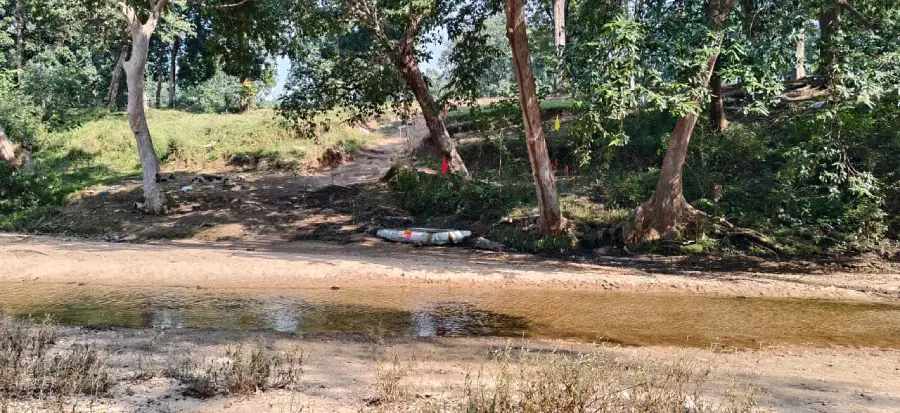
As tribals worship trees and other natural wonders, the residents of Bawanthadi village pray to Nal Baba even though there is no concrete structure at the site. “It is an ancient water source. As once upon a time, Bawanthadi was a small village with a single handpump, water shortage used to be severe in the summers. That is why many people relied on the river for drinking water. At present, the village has borewells. But crop cultivation in the Karif season is at the mercy of monsoon rains. In the winter or Rabi season, wheat cultivation is an impossible task. So, most of us either work for the forest department or try to find other sources of employment,” Gedam informed.
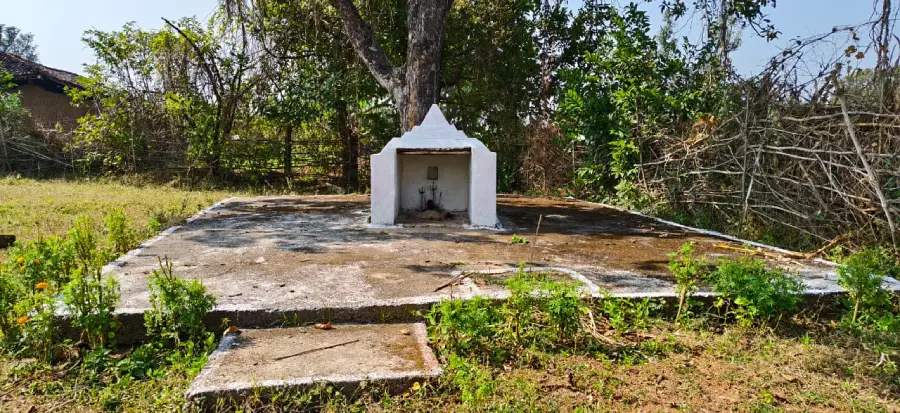
Nal Baba, who symbolises Shiva, is important for Gedam and the other residents of Bawanthadi. As a mark of respect, a fair is annually organised at the site on the occasion of Kartik Purnima which falls in the month of November. Apart from Nal Baba, the residents repose faith in the Mahua tree and offer prayers to tribal gods like the Gram Devi, a female deity, who is responsible for the safety of the village. At the place where she is worshipped, there is a place marked with stones and trishuls lodged inside a white structure.
A trishul is a weapon associated with Shiva. The Wagh Dev is also invoked for protection from tigers.
Invoking divine intervention against tiger attacks is not uncommon in India. In the Sundarbans, the Bon Bibi is said to offer protection against tiger attacks. In Maharashtra’s Tadoba-Andhari Tiger Reserve, which has a high incidence of human-tiger conflict, the Gond tribals worship tiger statues or the Waghoba deity.
Living With tigers
Gedam pointed out that though his village lies in the buffer zone, tigers still come from time to time. There have been two back-to-back deaths in Bawanthadi. Both the victims (Krishna Kumar Bhalavi and Rohit Pandre) were young men, one aged 18 and another 20. While the first attack took place on November 29, 2024, the second one occurred on June 20 this year.
“The tragic deaths have made the residents of Bawanthadi angry and many of us now want to relocate for protection. People feel afraid as the village is surrounded by forests. The NH-44, which passes through Pench, has underpasses through which tigers easily pass. This may be the reason why tigers stray near the village,” Gedam said.
As a mitigation measure, the MP Forest Department has set up a solar fence which has instilled a bit of confidence in the locals. But Gedam, who cultivates mainly paddy on his farm land about one km away from the village, pointed out that the fence sometimes fails to get charged.
To minimise human-tiger conflict, the Pench authorities pressed into service special messengers on bicycles attached with speakers in 2023. These bicycle riders visit all the villages in the buffer area to spread awareness on conflict mitigation. The core has no habitation.
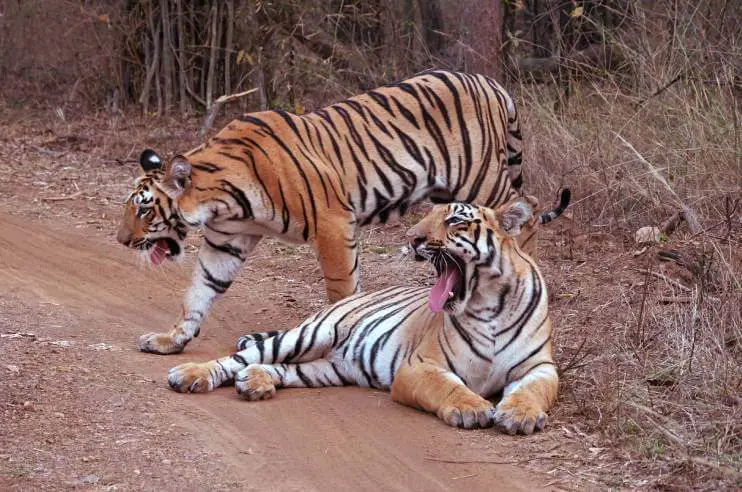
Thanks to conservation measures, India now hosts 3,682 tigers with Madhya Pradesh being tagged the tiger state with an estimated 785 tigers. Reserves like Pench, Kanha and Bandhavgarh, which promise good sightings, attract tourists from all over the world. But in reality, it is difficult to live in close proximity with tigers.
As the population increases on both sides, co-existence is fraught with difficulties and dangers.
Baronia echoed the difficulties faced by the Forest Department in the case of the twin deaths. “There is a need to protect tigers as well as safeguard people’s lives. But the forest is ultimately the home of tigers.”
He explained that the two deaths were most unfortunate and happened when the victims were out with their cattle for grazing. In one incident, when the tiger came close, the cattle ran away and the boy was killed.
The official shared that he had noticed a trend regarding tiger movement post-monsoon. After the rainy season is over, herbivores move out of the forest towards agricultural fields. So, tigers also follow them. Land use change is a big driver of human-wildlife conflict in India. In many areas, thanks to the availability of water, farming takes place throughout the year. But Baronia said that Bawanthadi is situated in the middle of the forest and hence, tigers do come.
In the village, there is a dearth of livelihood options as farm lands are getting divided among brothers with each generation. Sometimes, the residents of Bawanthadi leave for Nagpur for labour work.
“The road leading to the village is through the forest and the tiger attacks have made people apprehensive. The tiger Bajirao, who was responsible for both the deaths, has been sent to a zoo. It used to attack cattle and kill them. The people became angry and wanted to kill the tiger themselves. So, he had to be sent away,” Baronia added.
The forest official informed though most people of Bawanthadi have informally intimated the Forest Department about their wish to relocate due to tigers, there is a social reason behind the decision to settle elsewhere as well. The men in the village aren’t getting married as it is a remote area close to the forest. Nobody wants to send brides here.
Relocation in the buffer zone is different from that of the core area. When people relocate elsewhere from the buffer area, they only receive Rs 15 lakh per unit and no land, informed Baronia, whose daily patrols inside the forest involves taking the utmost precaution from tigers. Pench has an estimated 123 tigers.
Gedam added that the 20-year-old victim was a college student and came home for a brief stay during the holidays. One could have understood if it were an elderly man. In 2022, a man in his 70s was killed in Pench in a tiger attack.
“Though the people want to relocate, many are in favour of land instead of the cash amount. At times of such crises, the Gond residents keep faith in Nal Baba. This year the fair was held on November 6 right after Diwali. The annual fair started in 2004. Apart from stalls, cultural events take place during the event.”
Another resident from Bawanthadi village, Laksman Salame, listed the multiple problems the people face in his village. As irrigation facility is absent, lands lie fallow in winter. Electricity is present but its supply is highly unreliable. The primary health centre is 10 km away. In emergency cases, private cars are called, but the road is patchy and broken. So, the wish to relocate does not come as a surprise.
Rajnish K Singh, the Deputy Director of Pench, pointed out that the relocation process has not started. “The people have informally communicated the wish to relocate to the frontline staff. But they have to formally approach with a signed letter.”
In neighbouring Maharashtra, tiger numbers have swelled with 444 individuals. In Tadoba-Andhari, which lies in the Vidarbha region, the tiger population stands at over 100. As population is increasing, the surplus animals have to move somewhere, said Deepak Sawant, who has worked with the Forest Department in the past.
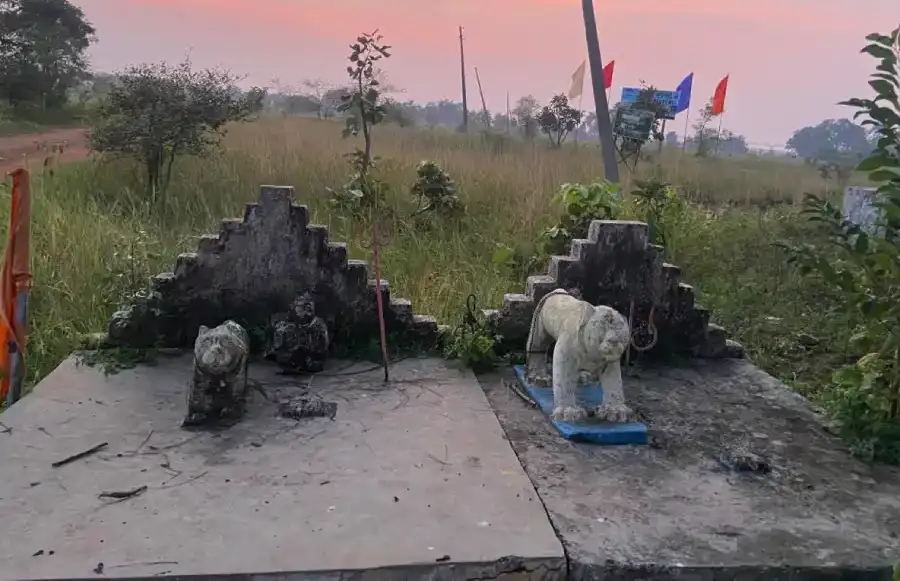
“Many people in Vidharba have accepted tigers in their lives. There is a tradition of worshipping tiger statues or the Waghoba deity in the villages nearby Tadoba which lies in Chandrapur district. When people are killed by tigers in the villages, the statues are built in memory of the deceased. At times, temples are also set up outside the villages. The Waghoba is the traditional deity here,” Sawant said.
In times of a changing climate, sharing space with wildlife is an increasingly challenging task. The forest has undergone changes with the expansion of agriculture. This throws both humans and wildlife in the same landscape, exacerbating conflict. “But these traditional beliefs are responsible for tiger conservation and has led to its increased protection in India,” added Sawant.
As a mitigation measure, the Maharashtra Forest Department has decided to relocate tigers from Tadoba-Andhari to the Sahyadri Tiger Reserve created in 2008. According to media reports, under this conservation programme called Operation Tara, a tigress has already been relocated to the latter. Still, according to Sawant, some people in Tadoba opposed the move, as they believe that tigers bring tourism benefits to local communities in the form of jobs.