







Prayagraj/New Delhi
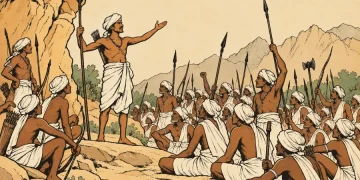
The Supreme Court of India ruled in April 2013 that the Dongria Kondh’s Gram Sabhas must decide. Between July and August 2013, all 12 villages in Odisha’s Niyamgiri Hills voted no. They voted against Vedanta Resources, one of the world’s largest mining companies, which had been pushing to mine their sacred mountain. The court upheld every one of those votes.
“All the tribals are ready to go to jail, but we will not bow down before the government’s pressure,” said Kumuti Majhi, President of the Niyamgiri Suraksha Samiti, the community body that led the resistance.
That single collective decision by the Dongria Kondh protected a biodiversity-rich mountain range that also functions as one of India’s significant forest carbon sinks. Now imagine what happens when communities like the Dongria Kondh no longer carry the legal power to say no.
Climate Commitment That Depends On Tribal Forests
India has made a firm pledge to the world. Under its updated Nationally Determines Contribution (NDC) submitted to the United Nations, India has committed to creating an additional carbon sink of 2.5 to 3 billion tonnes of CO2 equivalent by 2030, mainly through expanded forest cover.
That target is not theoretical. India’s biennial climate update submitted to the UNFCCC in December 2024 confirms that the forests and land use sector absorbed approximately 22 per cent of the country’s total carbon dioxide emissions in 2020. It is the single largest domestic carbon offset in India’s entire climate architecture.
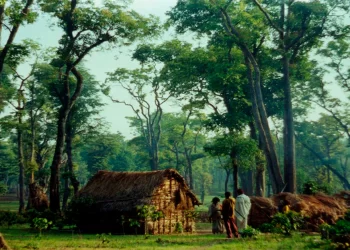
Who protects those forests? The National Mission for Green India states it plainly: 275 million rural people depend on India’s forests for their livelihoods. Of these, 89 million are tribal people, Adivasis who have lived in and managed these forests for generations. India is relying on its forests to meet international climate commitments, and it is relying on tribal communities to protect those forests. Yet the legal frameworks that would formally empower these communities to do so remain dangerously under-implemented.
The Law That Promised Everything And Delivered Little
The Scheduled Tribes and Other Traditional Forest Dwellers (Recognition of Forest Rights) Act, 2006, widely known as the Forest Rights Act or FRA, was supposed to fix this. It recognised the rights of forest-dwelling communities over nearly 40 million hectares of India’s forests and gave Gram Sabhas the authority to govern and protect Community Forest Resource areas.
In principle, the FRA made tribal communities the legal custodians of India’s most ecologically significant landscapes. In practice, the implementation has been a failure.
According to a report by the Rights and Resources Initiative, around 40 million hectares of forest land across 1,70,000 villages qualifies for Community Forest Resource recognition. But, barely 1.2 per cent of that eligible area has been formally recorded and recognised.
| What The Law Promises | What Has Actually Happened |
| CFR rights over 40 million hectares | Only around 480,000 hectares formally recognised (approx. 1.2%) |
| 1,70,000 villages eligible for recognition | Majority yet to receive titles |
| Gram Sabha authority over forest management | Undermined by state forest departments in multiple states |
| Community consent before forest land diversion | Removed as mandatory requirement by 2023 amendment |
The reasons are well-documented. Forest departments and revenue departments do not coordinate. State bureaucracies have historically treated forest-dwelling communities as encroachers rather than custodians. Political pressure consistently favours industrial land access over community tenure.
Law That Cut The Ground From Under Communities
In 2023, the situation got worse. The Forest (Conservation) Amendment Act, 2023 removed the mandatory requirement for Gram Sabha consent before forest land is diverted. The one institutional mechanism through which tribal governance could exercise binding authority over its own forests was quietly stripped away.
In Chhattisgarh, the state Forest Department moved to declare itself the nodal agency for Community Forest Resource management, effectively trying to displace Gram Sabha authority entirely. Meanwhile, the IPCC’s Sixth Assessment Report, the most comprehensive global climate science document produced in decades, concluded that community-managed forests consistently show lower deforestation rates, higher biodiversity, and greater carbon sequestration than forests under centralised state control. India’s policy is moving in the opposite direction to global scientific evidence.
Court That Sees What Policy Ignores
In March 2024, the Supreme Court delivered a landmark ruling in M.K. Ranjitsinh and Others Versus Union of India. The court expanded the constitutional right to life under Article 21 to include protection from the adverse effects of climate change. Forest-dwelling communities are not just victims of climate injustice. They are, as the court’s reasoning makes clear, essential actors in addressing it. Secure tribal governance of forests is climate infrastructure, and it deserves the same institutional protection and public investment as any dam or solar park.
What Needs To Change And What Has Already Started
In 2024, the Union government launched PM Janjatiya Unnat Gram Abhiyan to expedite forest rights recognition. The scheme is promising. But it will mean nothing unless it connects explicitly to India’s NDC commitments and receives adequate funding.
Three changes, experts and courts say, cannot wait much longer. The government must set a measurable Community Forest Resource recognition target and report it to the UNFCCC alongside other forestry metrics. It must restore mandatory Gram Sabha consent for any forest diversion in ecologically sensitive zones. And it must bring tribal ecological knowledge into State Disaster Management and Climate Adaptation Plans, not as decoration, but as working policy.
At COP30 in Belem, Brazil in November 2025, India presented itself as a climate leader. Indigenous voices were prominent at the conference, with over 5,000 participants, the highest representation at any COP to date. Yet India’s top leadership was absent from the leaders’ summit. As global climate negotiations now move toward COP31 in Antalya, Turkey, the credibility of India’s climate leadership will depend not on what it promises at international conferences, but on what a Gram Sabha in Chhattisgarh or Odisha can actually do to protect its forest.
The Dongria Kondh once protected a mountain with 12 collective decisions. India’s climate strategy needs that capacity across 1,70,000 villages, not just one mountain range.
(The author is an ICSSR Fellow at G.B. Pant Social Science Institute, Prayagraj. Views expressed are personal.)