




• About
  • Contact
  • Sitemap
  • Gallery
No Result
View All Result
Vacancies
Thursday, March 5, 2026
The Indian Tribal
  • Home
  • Achievers
    • उपलब्धिकर्ता
  • Cuisine
    • खान पान
  • Health
    • स्वास्थ्य
  • Legal
    • कानूनी
  • Music
    • संगीत
  • News
    • Updates
    • खबरें
  • Sports
    • खेलकूद
  • Variety
    • विविध
  • हिंदी
    • All
    • आदिवासी
    • उपलब्धिकर्ता
    • कला और संस्कृति
    • कानूनी
    • खबरें
    • खान पान
    • खेलकूद
    • जनजाति
    • भारत
    • विविध
    • संगीत
    • संस्कृति
    • स्वास्थ्य
    The Indian Tribal

    बांसवाड़ा की दो सशक्त आदिवासी महिलाएं रच रहीं सामाजिक बदलाव की नई कहानी

    The Indian Tribal

    बेटियों की शिक्षा की बनी ढाल, रोके पाँच बाल विवाह

    The Indian Tribal

    घूंघट और घर से बाहर निकल नेतृत्व क्षमता की मिसाल बन रही हैं राजस्थान की ये आदिवासी महिलाएं

    The Indian Tribal

    सिक्किम में स्केटबोर्डिंग बना जनजातीय युवाओं की नई पहचान

    The Indian Tribal

    बाघों का खौफ और शादी का संकट: क्या पलायन ही गोंड आदिवासियों का एकमात्र विकल्प है?

    The Indian Tribal

    मरांग गोमके जयपाल सिंह मुंडा: जिसने भारत को आदिवासी चेतना दी

    The Indian Tribal

    क्या एकरूपता की मांग में टिक पाएगी डोंगरिया कोंध शॉल?

    The Indian Tribal

    बीज, मिट्टी और गीतों के ज़रिये जैविक खेती मिशन पर है यह आदिवासी किसान

  • Gallery
    • Videos
  • Latest News
The Indian Tribal
  • Home
  • Achievers
    • उपलब्धिकर्ता
  • Cuisine
    • खान पान
  • Health
    • स्वास्थ्य
  • Legal
    • कानूनी
  • Music
    • संगीत
  • News
    • Updates
    • खबरें
  • Sports
    • खेलकूद
  • Variety
    • विविध
  • हिंदी
    • All
    • आदिवासी
    • उपलब्धिकर्ता
    • कला और संस्कृति
    • कानूनी
    • खबरें
    • खान पान
    • खेलकूद
    • जनजाति
    • भारत
    • विविध
    • संगीत
    • संस्कृति
    • स्वास्थ्य
    The Indian Tribal

    बांसवाड़ा की दो सशक्त आदिवासी महिलाएं रच रहीं सामाजिक बदलाव की नई कहानी

    The Indian Tribal

    बेटियों की शिक्षा की बनी ढाल, रोके पाँच बाल विवाह

    The Indian Tribal

    घूंघट और घर से बाहर निकल नेतृत्व क्षमता की मिसाल बन रही हैं राजस्थान की ये आदिवासी महिलाएं

    The Indian Tribal

    सिक्किम में स्केटबोर्डिंग बना जनजातीय युवाओं की नई पहचान

    The Indian Tribal

    बाघों का खौफ और शादी का संकट: क्या पलायन ही गोंड आदिवासियों का एकमात्र विकल्प है?

    The Indian Tribal

    मरांग गोमके जयपाल सिंह मुंडा: जिसने भारत को आदिवासी चेतना दी

    The Indian Tribal

    क्या एकरूपता की मांग में टिक पाएगी डोंगरिया कोंध शॉल?

    The Indian Tribal

    बीज, मिट्टी और गीतों के ज़रिये जैविक खेती मिशन पर है यह आदिवासी किसान

  • Gallery
    • Videos
  • Latest News
No Result
View All Result
The Indian Tribal
No Result
View All Result
  • Home
  • Achievers
  • Cuisine
  • Health
  • Legal
  • Music
  • News
  • Sports
  • Variety
  • हिंदी
  • Gallery
  • Latest News
Vacancies
Home » The Indian Tribal / Cuisine » Can Tribal Food Become More Mainstream In India’s Culinary Landscape?

Can Tribal Food Become More Mainstream In India’s Culinary Landscape?

Though nutritious and wholesome, tribal cuisine remains largely absent from mainstream restaurants. Marginalisation, vanishing forests and lack of awareness are key reasons, experts share with Deepanwita Gita Niyogi

March 5, 2026
The Indian Tribal

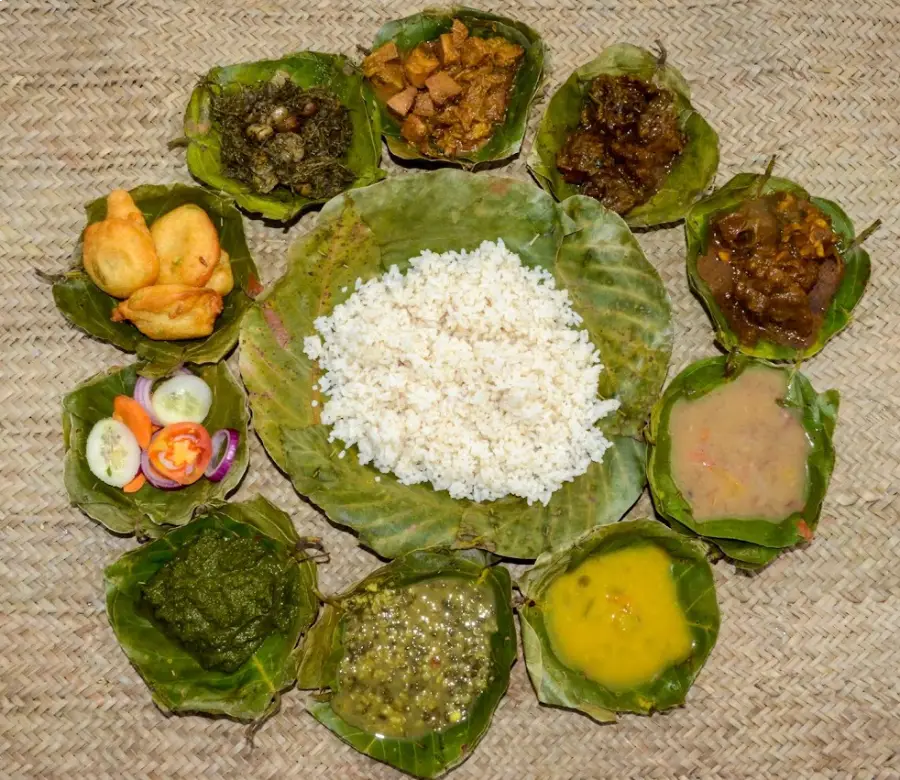
Tribal Cuisine Spread At Ajam Emba Restaurant, Ranchi

New Delhi

Tribal cuisine, despite being nutritious, seasonal and deeply ecological, remains largely absent from India’s mainstream dining spaces. Though wholesome and diverse, tribal dishes are rarely found in restaurants.

A few exceptions exist, such as Ajam Emba in Ranchi, Jharkhand, which positions itself as a space dedicated to reviving Adivasi culinary heritage. But such initiatives are limited.

The question is not merely about taste, but about visibility, dignity and survival of food traditions rooted in forests and indigenous knowledge.
The Indian Tribal
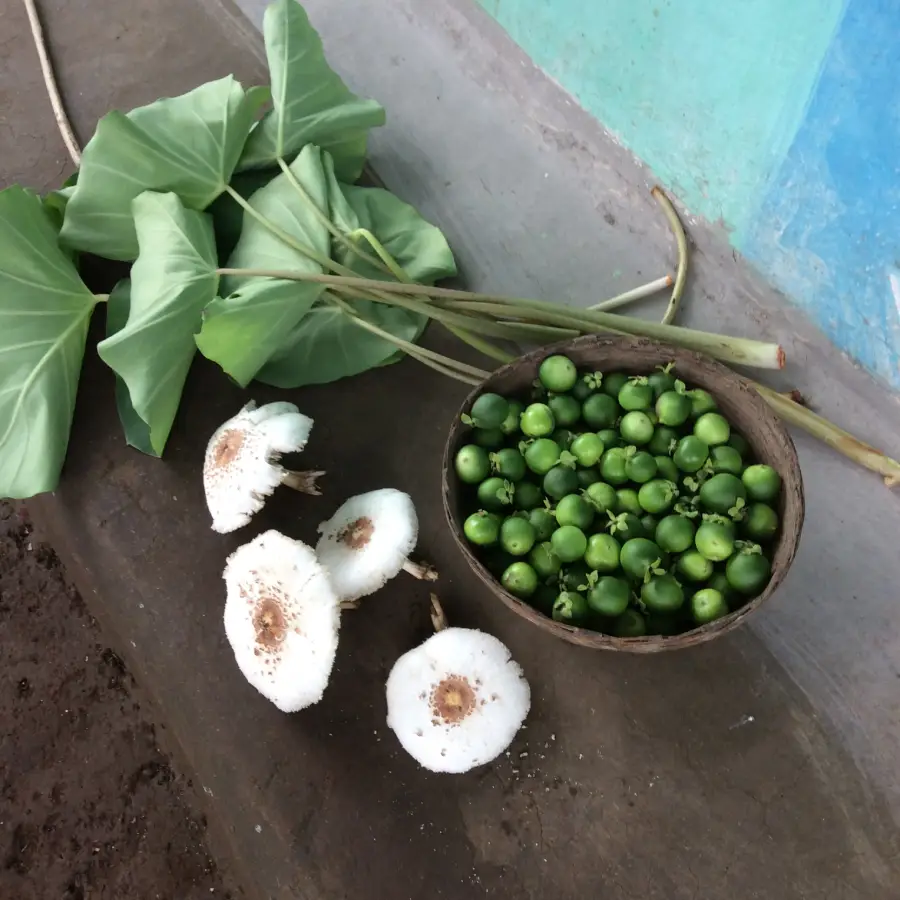
Fresh Food Collected From Forest During Monsoon In Dindori, Madhya Pradesh
The Indian Tribal
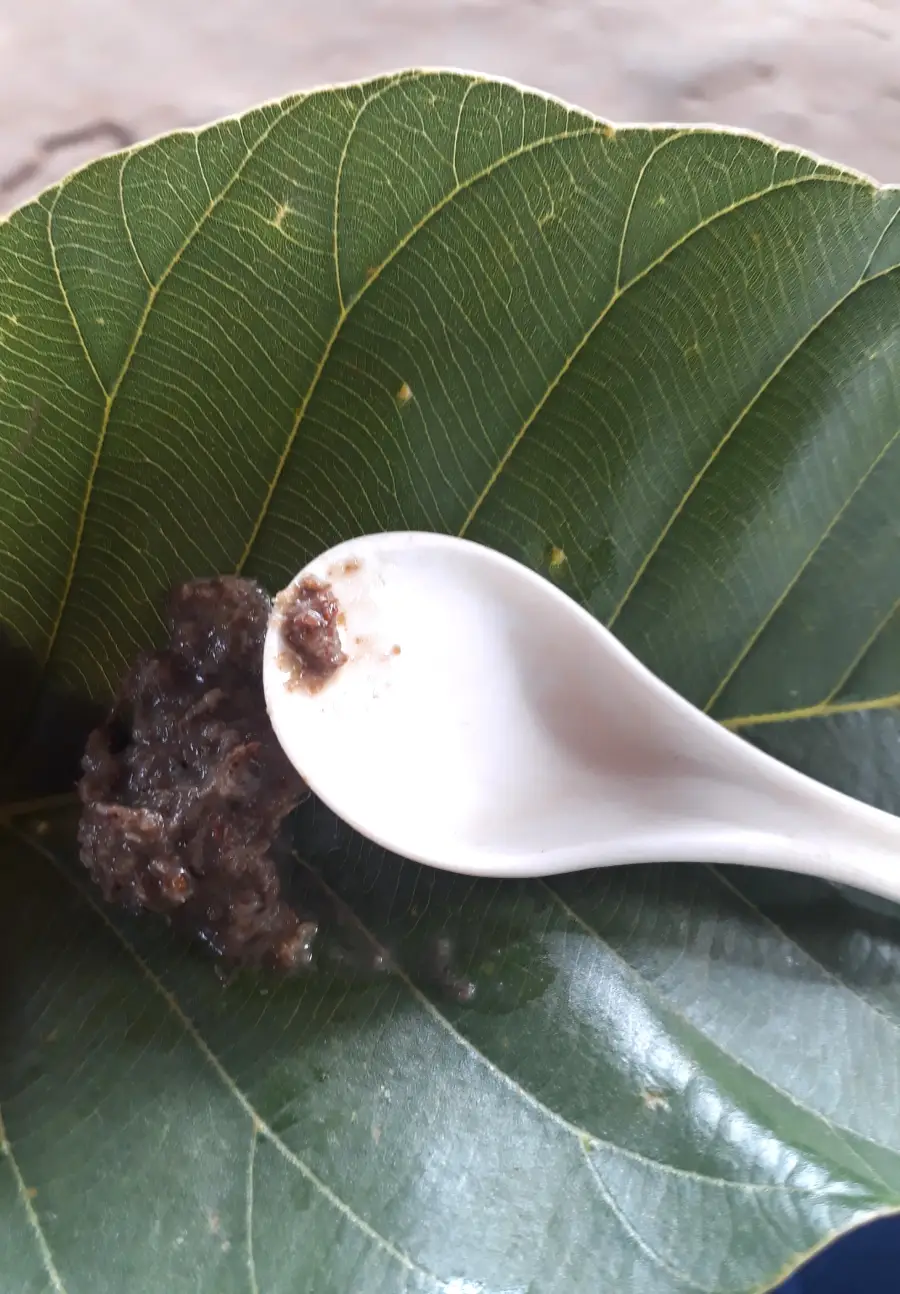
Red Ant Chutney

Forest As A Source Of Food

At the heart of tribal food practices lies the forest. Many ingredients are foraged — kanda or tubers, mushrooms and leafy greens collected seasonally and prepared at home. The Pihiri mushroom, for instance, is gathered and sold in villages within the Achanakmar Tiger Reserve in Chhattisgarh. It appears during the monsoon and disappears soon after. Such foods are largely collected by women and transformed into delicacies within households.

But ecological change is altering this cycle. As forests shrink and villages are relocated in the name of wildlife conservation, culinary traditions face rupture. If relocation from Achanakmar continues, the Pihiri itself may fade from collective memory. Plantation and commercial agriculture have also disrupted traditional cropping systems. In Araku, coffee cultivation has replaced millets once grown and consumed by tribal communities, while in the Niyamgiri hills, pineapples have displaced older food crops.

The forest remains central not only as a source of ingredients but as a way of tribal life. The Pihiri mushroom grows naturally during the rainy season and is not cultivated like urban mushrooms. Numerous saags — leafy greens often dismissed as weeds in mainstream agriculture — are nutrient-rich and widely consumed in tribal households.

Last November, Dr Geetanjali Singh, an Assistant Professor of Botany at the Dr Shyama Prasad Mukherjee University in Ranchi, delivered a lecture in Bangkok discussing 64 varieties of saags, including Kalmi Saag, at an international biodiversity conference attended by delegates from the Food and Agriculture Organisation (FAO) of the United Nations.

She also described indigenous cooking methods, arguing that the standardisation of food habits and cultural biases prevent wider acceptance of tribal cuisine.

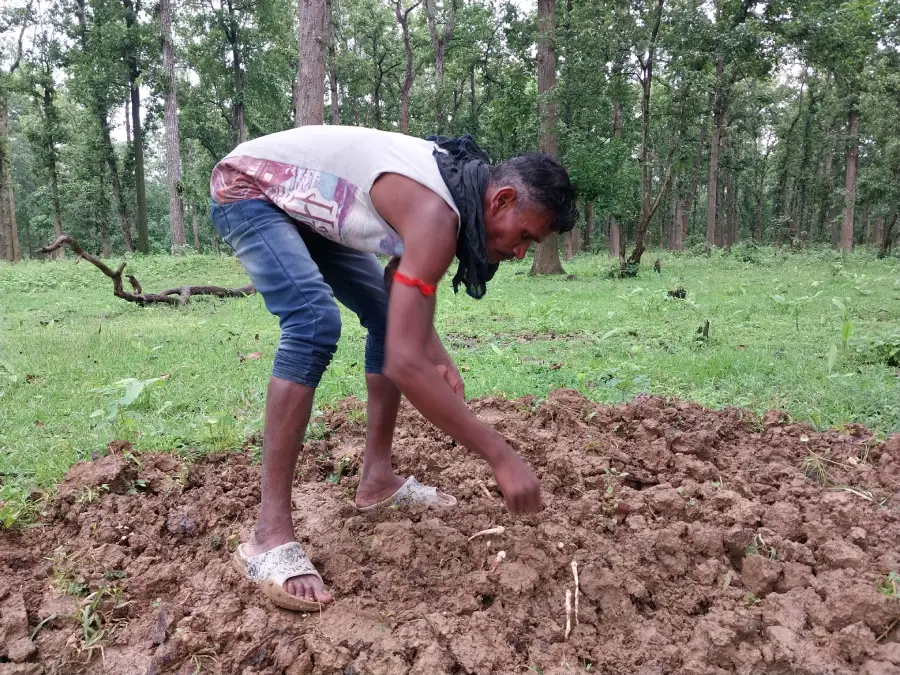
For communities such as the Pahari Korba in Chhattisgarh, forest foraging remains integral. Bhamru Hansda, based in Raigarh’s Dharamjaigarh division, regularly walks three kilometres into the forest to collect tubers — a tradition known locally as Basa. The most prized among these is the Pitharu kanda.

“They love these tubers. Whenever they enter the jungle, they stay there up to a week inside in make makeshift shelters. These tubers are dug in the winter till February,” said Naresh Biswas from Dindori district of Madhya Pradesh, who documents the life and food of the Baiga tribals.
The Indian Tribal
A Man Collects Pihiri Mushrooms (All pics – Deepanwita Gita Niyogi)

Biswas further explained the sustainable practices associated with harvesting. “The Pitharu kanda is the tastiest and one has to dig a few feet deep for this. There is a unique system of digging to ensure that the tubers sprout next year. Sometimes, the tubers collected are dried and stored for up to a year. Containers made of Mahul leaves are made to store these tubers.” Hansda added that elephant movement sometimes deters foraging, and climate change has reduced tuber availability.

In this context, documentation becomes crucial. The youth-led Lahanti Club, formed in 2017 in Jamui district of Bihar, has recorded several traditional foods through videos, some of which are available on YouTube. Such efforts attempt to create an archive for future generations.

Popularising And Serving Tribal Fare

While structural challenges persist, some chefs are attempting to bridge the gap between forest kitchens and urban tables. Odisha-based chef Rachit Kirtiman believes awareness is the biggest hurdle. To understand tribal cuisine, he argues, chefs must travel to interior regions rather than reinterpret from a distance. He cites chefs Manish Mehrotra and Varun Totlani, who visited Chhattisgarh after a state-led initiative invited mainstream culinary figures to recreate tribal dishes.

Kirtiman himself experiments with indigenous ingredients, presenting them in contemporary formats during food pop-ups. He has featured Kai — red ant chutney — often described as exotic in urban settings. He points out that jhil pitha, a baked Santhali preparation of rice paste and boiled chicken placed between Sal leaves, closely resembles a French quiche in structure, demonstrating how culinary parallels can build familiarity.

Institutional spaces, too, are engaging with indigenous food. In Mayurbhanj district of Odisha, Belgadia Palace serves traditional tribal dishes such as bamboo chicken, Enduri pitha wrapped in turmeric leaf, and Kai chutney, which has earned a GI tag. The idea, according to palace manager Soutam Pramanik, is to showcase tribal culture through cuisine.

Dr Singh, links this absence to a broader social reality. “Some tribal recipes are also time-consuming. Sometimes, the ingredients aren’t readily available in the cities. At the same time, there is an absence of good chefs who can promote tribal food in high-end restaurants and hotels.” According to her, the marginalisation of tribal communities as a whole has inevitably affected the visibility of their cuisine.
The Indian Tribal
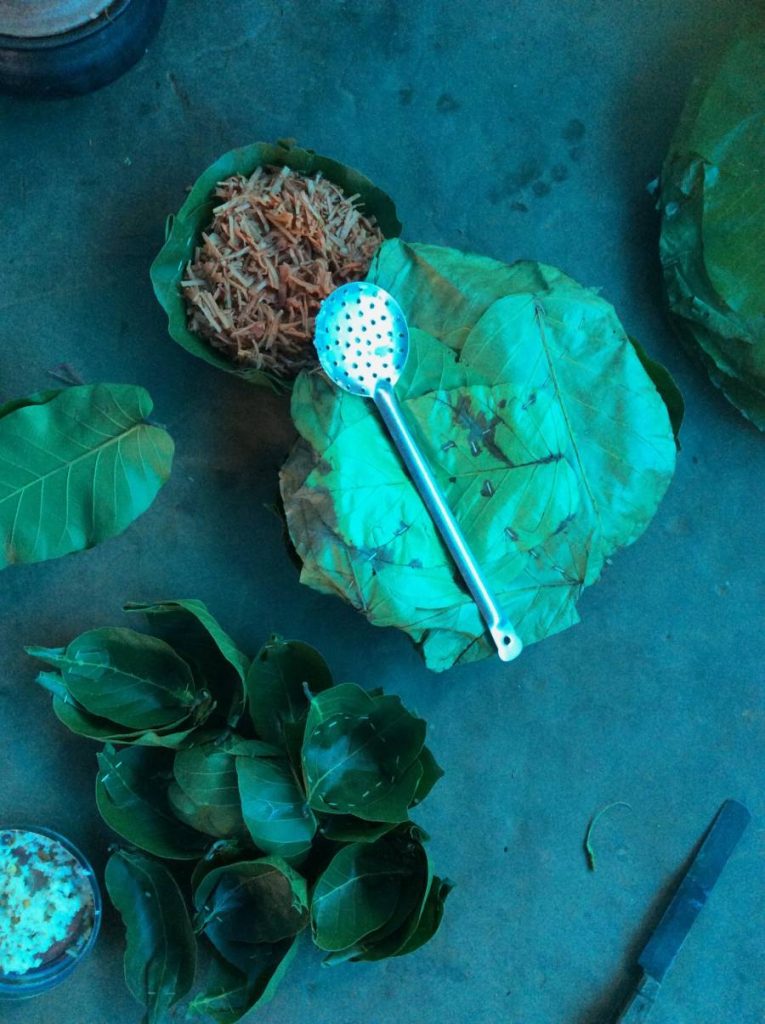
Cooked Bamboo Shoot At A Tribal Kitchen In Bastar, Chhattisgarh

For Singh, revival must also happen at the local level. She advocates for more restaurants in Jharkhand to serve tribal fare. The authenticity of these dishes, she explains, depends heavily on traditional preparation methods. Rice atta, a staple ingredient, is ideally processed using the dheki — a traditional wooden pounder — which has nearly disappeared.

Machines, she says, cannot replicate the same texture or taste. Fermented and dried bamboo shoots remain popular, and preparation techniques matter deeply. “The red ant chutney is best enjoyed when the sil batta is used instead of a mixer grinder.”

Among Dr Singh’s favourite dishes is paat pora — Arwa rice and chicken wrapped in fresh Sal leaves and slow-cooked over a smoky fire. “One can add garlic for taste and the time taken is roughly 45 minutes. Thankfully, I get many of the ingredients in Ranchi.” Yet she acknowledges the growing difficulty of sourcing forest produce amid rising deforestation. Younger generations, drawn to market foods and changing aspirations, are increasingly reluctant to forage.

Ultimately, making tribal food mainstream is not only about restaurant menus. It involves ecological preservation, cultural respect, culinary innovation and intergenerational transmission. Without safeguarding forests and indigenous knowledge systems, the ingredients — and the stories they carry — risk disappearing altogether.

Root Woot | Online Puja Samagri Root Woot | Online Puja Samagri Root Woot | Online Puja Samagri

In Numbers

49.4 %
Female Literacy rate of Scheduled Tribes

Update

Saura children to be imparted education in own language

In a novel move, the Gajapati district administration in Odisha has launched an initiative titled 'Aame Padhibaa Aama Bhasare' (we will learn in our own language) to impart pre-school education to children belonging to the Saura tribal community, one of the oldest Scheduled Tribes, in their own language. The programme will cover 30 anganwadi centres in Gumma and Rayagada blocks of Gajapati district which has around 90 per cent of the Saura population. In the first phase of the initiative, the State government has decided to implement the programme in six tribal-majority districts namely Gajapati, Malkangiri, Nabarangpur, Rayagada, Kandhamal and Keonjhar. The children will be taught in indigenous languages such as Koya (Malkangiri), Gondi (Nabarangpur), Kuvi (Rayagada) and Saura (Gajapati).
The Indian Tribal
आदिवासी

बांसवाड़ा की दो सशक्त आदिवासी महिलाएं रच रहीं सामाजिक बदलाव की नई कहानी

by The Indian Tribal
February 22, 2026

दोनों भील महिलाओं ने व्यक्तिगत संघर्षों को सामुदायिक नेतृत्व में बदलकर आदिवासी समाज में स्थायी परिवर्तन की मिसाल पेश की है। विकास मेश्राम बता रहे हैं कैसे जब महिलाएं आगे बढ़ती हैं तो पूरा समुदाय सशक्त होता है PART-3

The Indian Tribal

बेटियों की शिक्षा की बनी ढाल, रोके पाँच बाल विवाह

February 20, 2026
The Indian Tribal

घूंघट और घर से बाहर निकल नेतृत्व क्षमता की मिसाल बन रही हैं राजस्थान की ये आदिवासी महिलाएं

February 17, 2026
The Indian Tribal

Tribal Pad Woman Breaking Menstrual Taboos In Bengal’s Tea Gardens

February 11, 2026
The Indian Tribal

Sundargarh Artisans Revive Rare Bamboo Root Craft, Carve Out Eco-Friendly Designs

February 5, 2026
The Indian Tribal

सिक्किम में स्केटबोर्डिंग बना जनजातीय युवाओं की नई पहचान

February 4, 2026
Previous Post

Bastar’s Coffee Experiment Faces Water Crisis Even As Premium Branding Plans Take Shape

Next Post

Tribes Art Fest Beckons You To Travancore Palace In Delhi

Top Stories

The Indian Tribal
Cuisine

Can Tribal Food Become More Mainstream In India’s Culinary Landscape?

March 5, 2026
The Indian Tribal
Chhattisgarh

Bastar’s Coffee Experiment Faces Water Crisis Even As Premium Branding Plans Take Shape

February 24, 2026
The Indian Tribal
आदिवासी

बांसवाड़ा की दो सशक्त आदिवासी महिलाएं रच रहीं सामाजिक बदलाव की नई कहानी

February 22, 2026
Load More
  • About Us
  • Contact
  • Team
  • Redressal
  • Copyright Policy
  • Privacy Policy And Terms Of Use
  • Disclaimer
  • Sitemap

  • Achievers
  • Cuisine
  • Health
  • Hindi Featured
  • India
  • News
  • Legal
  • Music
  • Sports
  • Trending
  • Chhattisgarh
  • Delhi
  • Gujarat
  • Jammu & Kashmir
  • Jharkhand
  • Kerala
  • Madhya Pradesh
  • Maharashtra
  • North East
  • Arunachal Pradesh
  • Assam
  • Manipur
  • Meghalaya
  • Mizoram
  • Nagaland
  • Sikkim
  • Tripura
  • Odisha
  • Telangana
  • West Bengal
  • Political News
  • Variety
  • Art & Culture
  • Entertainment
  • Adivasi
  • Tribal News
  • Scheduled Tribes
  • हिंदी
  • उपलब्धिकर्ता
  • कानूनी
  • खान पान
  • खेलकूद
  • स्वास्थ्य
  • संस्कृति
  • संगीत
  • विविध
  • कला और संस्कृति
  • खबरें
  • असम की ताज़ा ख़बरें
  • अरुणाचल प्रदेश की ताज़ा ख़बरें
  • ओडिशा की ताज़ा ख़बरें
  • केरल की ताज़ा ख़बरें
  • गुजरात की ताज़ा ख़बरें
  • छत्तीसगढ़
  • जम्मू और कश्मीर की ताज़ा ख़बरें
  • झारखंड न्यूज़
  • तेलंगाना की ताज़ा ख़बरें
  • दिल्ली
  • नॉर्थईस्ट की ताज़ा ख़बरें
  • पश्चिम बंगाल की ताज़ा ख़बरें
  • मध्य प्रदेश की ताज़ा ख़बरें
  • महाराष्ट्र की ताज़ा ख़बरें
  • त्रिपुरा की ताज़ा ख़बरें
  • नागालैंड की ताज़ा ख़बरें
  • मणिपुर की ताज़ा ख़बरें
  • मिजोरम की ताज़ा ख़बरें
  • मेघालय की ताज़ा ख़बरें
  • सिक्किम की ताज़ा ख़बरें
  • राजस्थान की ताज़ा ख़बरें

About Us

The Indian Tribal is India’s first bilingual (English & Hindi) digital journalistic venture dedicated exclusively to the Scheduled Tribes. The ambitious, game-changer initiative is brought to you by Madtri Ventures Pvt Ltd (www.madtri.com). From the North East to Gujarat, from Kerala to Jammu and Kashmir — our seasoned journalists bring to the fore life stories from the backyards of the tribal, indigenous communities comprising 10.45 crore members and constituting 8.6 percent of India’s population as per Census 2011. Unsung Adivasi achievers, their lip-smacking cuisines, ancient medicinal systems, centuries-old unique games and sports, ageless arts and crafts, timeless music and traditional musical instruments, we cover the Scheduled Tribes community like never-before, of course, without losing sight of the ailments, shortcomings and negatives like domestic abuse, alcoholism and malnourishment among others plaguing them. Know the unknown, lesser-known tribal life as we bring reader-engaging stories of Adivasis of India.

Follow Us

All Rights Reserved

© 2024 Madtri Ventures [P] Ltd.

No Result
View All Result
  • Home
  • Achievers
  • Cuisine
  • Health
  • Health
  • Legal
  • Music
  • News
  • Sports
  • Variety
  • हिंदी
    • उपलब्धिकर्ता
    • खान पान
    • कानूनी
    • खेलकूद
    • खेलकूद
    • संगीत
    • संगीत
    • स्वास्थ्य
    • स्वास्थ्य
    • विविध
  • Gallery
  • Videos

© 2024 Madtri Ventures [P] Ltd.