








Bhubaneswar
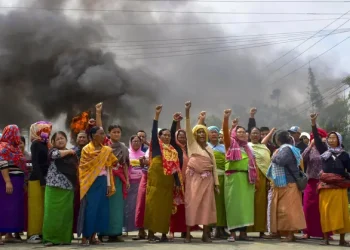
A standoff over mining rights in Odisha’s Rayagada district took a violent turn on Tuesday, leaving more than 60 people, around 40 cops and 20 tribal villagers. injured. The clash broke out at Shagabari village in the Kashipur block when local tribal residents attempted to block the construction of a three-kilometre access road leading to the Sijimali bauxite mine.
According to senior officials, the confrontation escalated when a team of police and district administration personnel moved in to disperse protesters who had been staging a dharna at the site.
ADG Sanjay Kumar said that approximately 40 security personnel were injured in the ensuing chaos. Protesters allegedly pelted stones and bricks and attacked officials with swords, axes, and other sharp traditional weapons. Rayagada SP, Swathy S. Kumar, stated that while security forces initially maintained “utmost restraint,” they were forced to deploy tear gas to bring the situation under control after the mob refused to retreat.
Among the injured are several senior officers, including Sub-Divisional Police Officer and Inspectors-in-Charge of both Kashipur and Andirakanch police stations. At least, 10 officers suffered severe head injuries. While most are being treated at the Rayagada District Headquarters Hospital, those in critical condition have been shifted to Visakhapatnam for advanced care.

Rayagada Collector Kulkarni Ashutosh C had attempted to negotiate with the agitators on Monday, but following the failure of these talks and the subsequent violence, the administration imposed prohibitory orders under Section 163 of the Bharatiya Nagarik Suraksha Sanhita (BNSS) in Shagabari village.
The Controversy: Land Rights vs. Industrial Development
The heart of the controversy lies in the Sijimali bauxite mine project, which the Odisha government recently allotted to Vedanta Ltd. Local tribal communities, who have inhabited the Kashipur region for generations, view the project as an existential threat. They fear that the extraction of the estimated 311 million tonnes of bauxite will lead to massive displacement, the destruction of sacred hills, and the loss of primary livelihoods rooted in the forest and agriculture.
For the protesters, the construction of the three-kilometre road—running from Purulang to Sagabari Ghati—is not merely a public works project but a “gateway” that will facilitate the entry of heavy mining machinery into their ancestral lands. Allegations of “fake and coerced” Gram Sabha consent have further fueled local resentment, leading to a climate of deep mistrust between the indigenous population and the state.
Vedanta’s Run-in With Tribals Earlier
This is not the first time that a project of the Vedanta has sparked a major clash with the tribals in Odisha. The Niyamgiri conflict remains one of the most high-profile corporate-tribal standoffs in Indian history, pitting the Dongria Kondh tribe against the mining giant.
Starting around 2003, the company sought to mine 72 million tonnes of bauxite from the Niyamgiri Hills to feed its Lanjigarh alumina refinery. For the Particularly Vulnerable Tribal Group (PVTG), the hills were not just a resource but the sacred abode of their supreme deity, Niyam Raja, making any mining an existential and sacrilegious threat.
The struggle gained global attention as a “David vs. Goliath” battle, drawing support from international rights groups and even the Church of England, which divested from the company. The legal battle culminated in a landmark 2013 Supreme Court verdict, which ruled that the cultural and religious rights of the tribal communities must be protected. The court mandated a historic “environmental referendum,” empowering local Gram Sabhas (village councils) to decide the project’s fate.
In a stunning display of grassroots unity, all 12 village councils voted unanimously against the mining project in 2013. They argued that mining would destroy their water sources, medicinal plants, and religious sanctity. Following this decisive rejection, the Ministry of Environment and Forests officially cancelled the forest clearance for the project in early 2014, marking a rare and total victory for indigenous rights over industrial expansion.
Currently, the Niyamgiri project remains permanently stalled, and the hills remain untouched by mining activity. While the Lanjigarh refinery continues to operate by sourcing bauxite from other regions and imports, the Dongria Kondh remain vigilant against any new exploration attempts.
The Niyamgiri case serves as the primary legal precedent for the current Sijimali protests, proving that tribal consent is a non-negotiable prerequisite for industrial projects on ancestral lands.