





Bhubaneswar
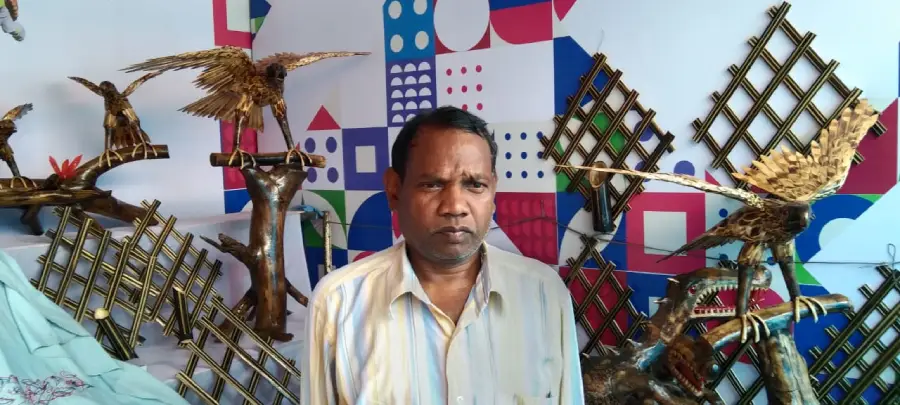
Tribal artisan Dubraj Mundari of Mandap village in Odisha’s Sundargarh district picks up bamboo root gnarls (knotted, twisted, or distorted growths on wood or trees) that people usually dump or discard as waste. Along with his partner Ismail Jatamara, he cuts and chisels, scrapes and scrubs, sizes and shapes these gnarls to craft eye-catching, eco-friendly decorative and utility items. The duo displays and sells their products to individual customers and at national- and state-level exhibitions.
Trained In A Rare Craft
Trained by the Sundargarh-based non-government organisation Self Employed Workers’ Association Kendra (SEWAK) on behalf of the government wing District Rural Development Agency (DRDA), Dubraj learnt the techniques of this rare craft in 2004. Earlier, tailoring had been his main occupation. However, prompted by a friend, he took up this unique craftsmanship after learning about SEWAK’s plan to train artisans in bamboo root gnarl craft.
“Engaged by DRDA, we imparted training to 30 artisans including Dubraj for a month on bamboo root gnarl craft under Swarnajayanti Gram Swarojagar Yojana, now named National Rural Livelihood Mission,” Digambar Upadhaya, Director (Programme) of SEWAK told The Indian Tribal.
However, none of the trained artisans continued with the gnarl craft. Only Dubraj and Ismail continued despite all odds stacked against them. Having failed to earn substantially until 2022, both joined hands to set up their outfit, ‘Mundari Bamboo Craft Arts’. They then started taking part in different fairs and exhibitions, and people gradually began to recognise their work. This resulted in a steady upturn in their income.
Earnings From Fairs And Festivals
Dubraj and Ismail now craft more than 120 designs from bamboo root gnarls, earning up to Rs. 25,000 per month. This income includes revenue earned at annual fairs such as ‘Sisir Saras’, ‘Pallishree’, Sundargarh Mahotsav and Toshali Craft Mela. While some fairs continue for five days, others last for 10 days, during which the two tribal partners earn up to Rs. 6,000 daily.
They also display and sell their crafts in the pilgrimage city of Puri during the Car Festival. Their sale proceeds exceed Rs. 8,000 daily during the nine-day span between Gundicha Yatra (the journey of Lord Jagannath and His siblings Balabhadra and Subhadra from the Srimandir, the main temple) and Bahuda Yatra (the return journey of the deities from Gundicha Temple, the abode of their aunt).
Struggle Before Recognition
“Before we set up our craft unit, we hardly earned Rs. 10,000 per month. Even before that it was almost nothing till we participated in Vedabyasa Mela about five years ago in Rourkela, the steel city of Odisha. We coughed up Rs. 6,000 to have our share of area in this mela where we erected our stall. We displayed our items worth about Rs. 50,000. But all our effort proved a dud, as we could not earn a pie,” Dubraj, a Bhumija tribal and a school dropout, shared.
However, Vedabyasa Mela proved a blessing in disguise, as the artisan duo came in contact with government officials. Through them, the two tribal partners connected with government agencies like Odisha Rural Development and Marketing Society (ORMAS) and non-government organisations such as the Sundargarh unit of Bhubaneswar-based Adarsha Odisha Foundation (AOF).
“ORMAS provided us with space in its different exhibitions that enabled us to display and sell our products. On the other hand, AOF employed us to train 14 male and female groups of artisans for a month with a remuneration of Rs. 30,000. Before that phase, our bamboo crafts like sofa sets, dining tables and pen stands that fetch us over Rs. 50,000 every month helped us sustain ourselves,” said illiterate Ismail, a Munda tribal who knows only to sign his name.
Bhumijas reside mostly in districts such as Koraput, Sundargarh, Nabarangpur and Mayurbhanj. They are largely agrarian and speak Bhumij, an Austroasiatic language written in the Ol Onal script. Mundas are primarily located in districts like Keonjhar, Sundargarh, Sambalpur and Mayurbhanj. They speak Mundari, an Austroasiatic language written in the Mundari Bani script, also called Nag Mundari. Agriculture remains the occupational mainstay for most members of both tribes, while some depend on minor forest produce or daily wage labour.
Dubraj and Ismail are believed to be the only duo involved in bamboo root craft in their region, as others have abandoned it for alternative professions.
“All artisans of 14 groups that we trained have now ceased doing this craft. Even the master trainer Rajesh Majhi of village Masina, who trained us on behalf of SEWAK, is now away from this root gnarl craft. He is now involved in tribal painting,” said Dubraj.
“Before we set up our unit, I visited states like Manipur, Assam, Tripura, Nagaland and Jharkhand to learn the technique of designing their own root gnarl craft. But nowhere did I find any form of gnarl craft in those states, though artisans there practise other methods of bamboo craft to make baskets, sofas, dining tables and several others of this ilk,” he added.
From Forest Waste To Finished Products
In the region, people often chop off bamboo stalks to use them for roofing their thatched houses, leaving the roots buried in the earth. If the roots are pulled out, they are usually burnt after the stalks are collected.
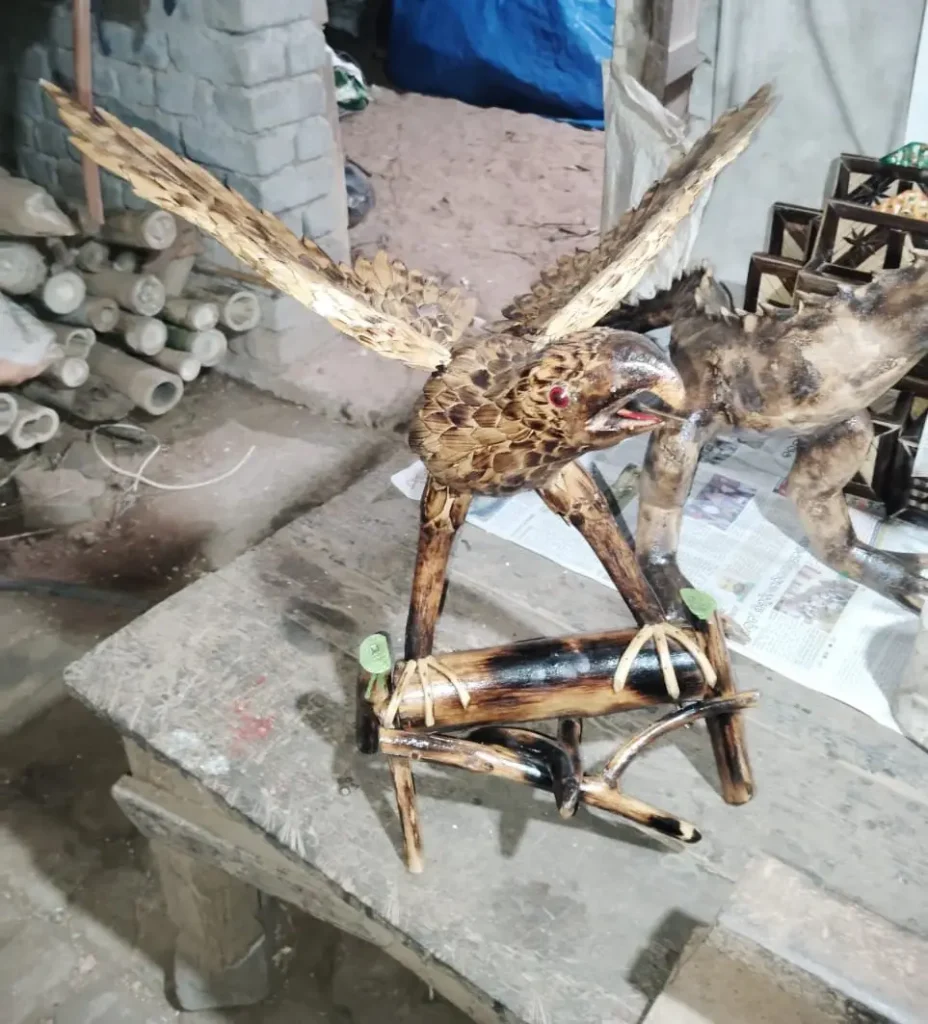
Each fully grown bamboo root has more than five gnarls. The artisans dig them out of the earth and transport them to their unit, where the gnarls are hacked off and dried in the shade for a month until the moisture content evaporates completely. Hard gnarls are essential, as soft ones pose problems in achieving the required shapes and sizes during the crafting phase.
Dubraj and Ismail collect gnarls from 40 to 50 adjoining areas every month and transport them to their village unit using tractors. Each trip, which includes labour and transportation costs, amounts to about Rs. 600 to Rs. 700 and carries nearly 200 to 250 gnarls of different sizes.
Designs, Tools And Pricing
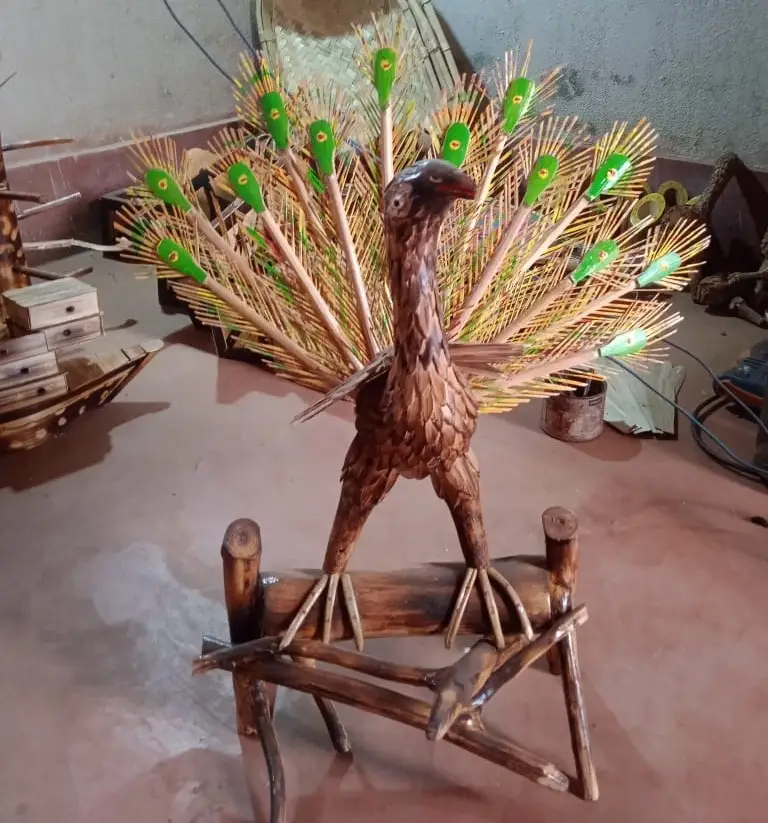
Their range of products includes decorative items such as small and large elephants, horses, dinosaurs, kangaroos, peacocks and falcons. Utility items include cups, glasses and pen stands.
A small falcon measuring one to 1.5 feet in height and selling for Rs. 400 or more is crafted from three gnarls. Larger falcons, nearly three feet tall and priced at Rs. 1,500 and above, are also made from three bigger gnarls. Similarly, small dinosaurs measuring three to four feet and priced between Rs. 1,000 and Rs. 3,500 are made using five small gnarls, while larger dinosaurs up to 4.5 feet tall, selling for Rs. 6,000 to Rs. 7,000, require five bigger gnarls.
Cups or glasses of standard height, priced between Rs. 100 and Rs. 150, are crafted from a single small gnarl. Prices vary depending on height and design intricacy.
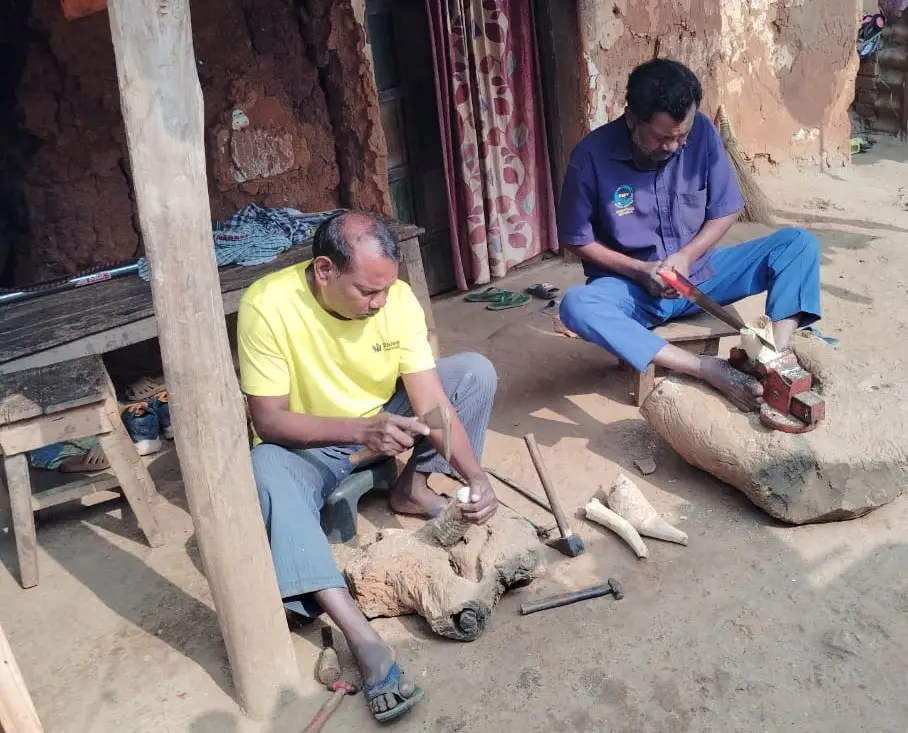
Implements such as knives, saws, scrubbers (called Barish and Basil), hammers (called Martul), and an instrument called Bindhani in Odia and Ruhna in the local dialect are used to cut, chisel, scrape, shape and size the gnarls. The duo owns seven sets of such tools, each costing Rs. 150, which are replaced every five years.
“We also use bamboo splits of required length and thickness to make feathers of a bird or hair at the tail end of an animal. We use strong glue like Fevicol to join different parts for a craft to come out,” said Dubraj.