


Bhubaneswar
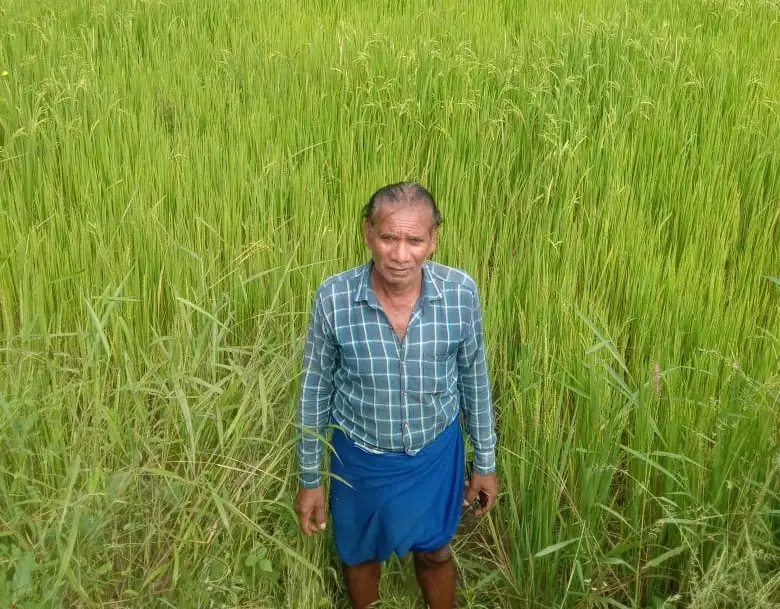
Pushing 60, Santosh remains fit, mobile and unwavering—a veritable model of organic farming of indigenous paddy varieties. Even in what many would call the evening of life, he continues to travel village to village, persuading and training farmers to shun health-hazardous high-yielding varieties.
A committed conservationist, he also spreads awareness on environmental protection by staging the Odia folk play Pala, weaving into it couplets on organic farming and the value of indigenous landraces.
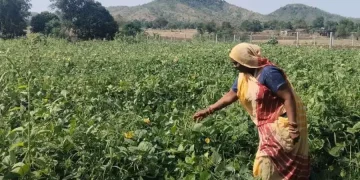
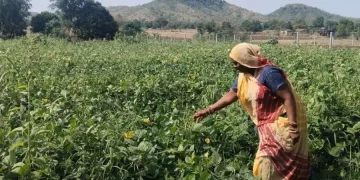
Santosh Dhurua, a tribal farmer from Jharjhari village under Jujomura block of Odisha’s Sambalpur district, has never fallen prey to the lure of “high production” promised by high-yielding varieties since the advent of the Green Revolution in the mid-1960s. On nearly three acres of land inherited from his late father Nrupani Dhurua, he cultivates indigenous paddy varieties such as Chinha, Suna Harini, Kusum Kali, Pimpudi Basa, Karpura Kanti and Kala Champa.
Over the years, Santosh has taken his farming a step ahead by blending traditional wisdom with modern organic practices. While his father relied solely on cow dung to manure the fields, Santosh adopted organic formulations like Bijamruta and Jivamruta, along with bio-insecticides such as Nimastra, Agniastra and Bramhastra to grow indigenous crops.

“Indigenous paddy varieties are mostly pest-resistant and drought-tolerant. If at all they fall prey to pests like Gentha, Kanda Bindha, Chakada Poka and Patra Kata, Nimastra, Agniastra and Bramhastra are applied to the plants at different stages,” Santosh, who belongs to the Dhurua tribal community, told The Indian Tribal.
The Dhuruas—also known as Duruas, Dharuas and Dhur Gonds—are primarily found in Malkangiri, Nabarangpur and Koraput districts of southern Odisha, with smaller pockets in Sambalpur and Bolangir districts of western Odisha. Members of the community mainly speak Parji, a Dravidian language. Traditionally agriculturists, they also collect minor forest produce, while a section is engaged in basketry.
Santosh discontinued his education in 1976 due to his family’s poor financial condition and took up farming under the guidance of his father. Like him, he initially relied only on cow dung to enhance soil fertility. His understanding of organic farming deepened significantly when he became the chairman of the Agricultural Technology Management Agency (ATMA) of his block, a post he held from 2004-05 to 2010-11.
During this phase, he came in contact with Saroj Kumar Mohanty, convenor of the Sambalpur-based non-government organisation Odisha Desi Bihana Manch (ODBM), which champions organic farming of indigenous varieties. Through ODBM, Santosh later met Padmashri awardee Dr. Sabarmatee Tiki, secretary of Sambhav, a non-government organisation based in Rohibanka of Nayagarh district, in 2013-14.
He subsequently came into contact with noted agriculturist and Padmashri awardee Dr. Subhash Palekar of Maharashtra during ODBM-organised training camps for farmers in Sundargarh and Bargarh districts in 2017-18. These interactions prompted Santosh to adopt bio-input-based agriculture, a practice he continues to follow unwaveringly.
“I learnt the technique of preparing Pejastra from Dr. Sabarmatee, while other organic manures and bio-pesticides from Dr. Subhash Palekar,” Santosh said.
“He also learnt their procedural uses at our bio-input centre in Gaisilet village in neighbouring Bargarh district,” said Saroj Mohanty, ODBM convenor.
Pejastra is prepared by collecting the thick liquid (peja in Odia) left after boiling rice, storing it in a pot for 10 to 15 days and later mixing it with bovine urine. The solution is sprayed over paddy plants as a preventive measure against pests like Kori.
Santosh begins cultivation by treating paddy seeds in Bijamruta, prepared from a mixture of bovine urine, cow dung, soil, water and lime. After soaking the seeds for 15 minutes to half an hour, he dries them in the shade before sowing them in fields already ploughed and enriched with Jivamruta. The latter is prepared by mixing cow dung, bovine urine, pulse flour (besana in Odia), soil and water, and allowing the mixture to ferment for five to seven days with intermittent stirring.
“Though pests rarely attack indigenous varieties, we use Nimastra and Brahmastra whenever they start damaging the plants. Nimastra is prepared by mixing neem and arakha leaves with bovine urine and water, while Brahmastra is made by boiling neem, dhatura, karanj, custard apple and castor leaves in bovine urine. I rarely use Agniastra, prepared from neem, garlic, chillies, ginger and cow urine,” Santosh said.
His yields underline the economic viability of indigenous organic farming. Half an acre of Chinha cultivated in June-July yields about 11 basta of paddy—each basta weighing roughly 75 kilograms—after harvest in November-December. One acre of Suna Harini produces nearly 25 basta, while half an acre of Kusum Kali yields about 12 basta. His 21 decimals of Pimpudi Basa and Karpura Kanti produce four and two basta respectively, while half an acre of Kala Champa yields about 13 basta.
Rice prepared from Karpura Kanti and Pimpudi Basa sells at Rs. 150 per kilogram, while their paddy seeds fetch Rs. 100 per kilogram. Rice and seeds of other varieties sell at Rs. 50 per kilogram.
“I sell rice and seeds only after keeping substantial quantities for domestic consumption and cultivation in the next season. Their sale fetches me an annual income of Rs. 50000 to Rs. 70000, though prices fluctuate every year,” said Santosh, who heads a five-member family.
His per-acre investment ranges between Rs. 7000 and Rs. 8000, covering labour, transportation and other costs. In contrast, farmers cultivating high-yielding varieties spend between Rs. 22000 and Rs. 35000 per acre, depending on soil conditions.
Interactions with farmers dependent on chemical-intensive high-yielding varieties during his ATMA tenure made Santosh acutely aware of their perilous long-term impact. He feared that over-dependence on such crops would one day wipe out indigenous varieties from Odisha’s rural granaries, prompting him to take up the mission of conservation.
In 2009, he underwent a five-day training on organic farming and indigenous crop varieties at the National Institute of Agricultural Extension Management (MANAGE) in Hyderabad. He later attended multiple training programmes in Bhubaneswar under the aegis of the Institute on Management of Agricultural Extension, an autonomous government body.
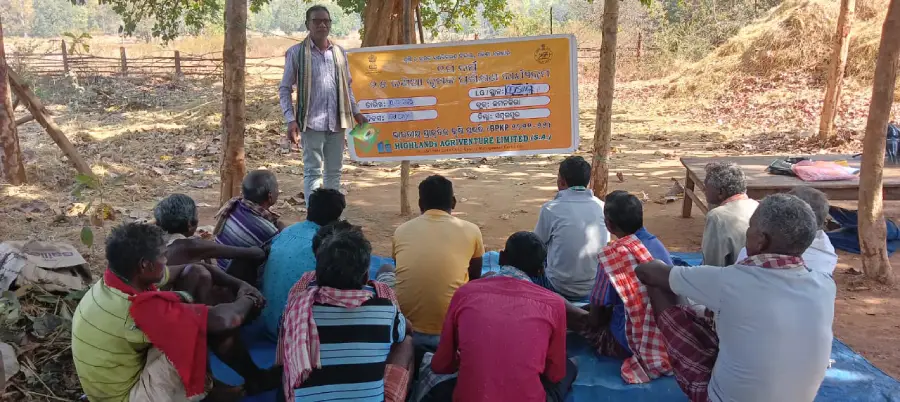
Armed with knowledge, Santosh launched a sustained effort to train, persuade and educate others. Engaged by government departments and non-government organisations, he has trained more than 7000 farmers across Sambalpur, Bargarh, Bolangir, Jharsuguda, Keonjhar and Mayurbhanj. His per-day training fee is Rs.1000, excluding food and lodging.
“Even when he worked with us as Senior Lead Resource Person between 2022 and 2024, he trained over 1000 farmers under our banner,” said Chandan Kumar Sahoo, Director of Bhubaneswar-based Highlands Agriventure Limited (HAL), which integrates modern techniques with traditional practices to manufacture value-added organic food products.
To many farmers, Santosh is more than a trainer. “Santosh Babu is my Guru,” said tribal farmer Ranjit Bagh of Chini Mahula village. “Under his guidance, I now grow indigenous varieties like Suna Harini on my five acres.”
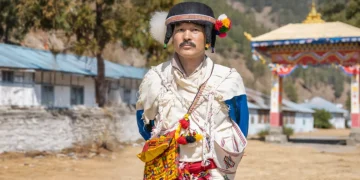
Beyond agriculture, Santosh is also an artiste. Through Odia folk play Pala, he educates villagers on ‘jungle bachao’ and forest fire control under programmes of the Forest, Environment and Climate Change Department. His self-composed poetry collection, Banya Kabya, forms the lyrical backbone of these performances.
Leading his five-member troupe, Samaleswari Pala Parishad, Santosh performs with traditional instruments like mridanga, jhanja and gini. As the gayaka (lead singer), he frequently incorporates couplets highlighting organic farming and indigenous paddy varieties.
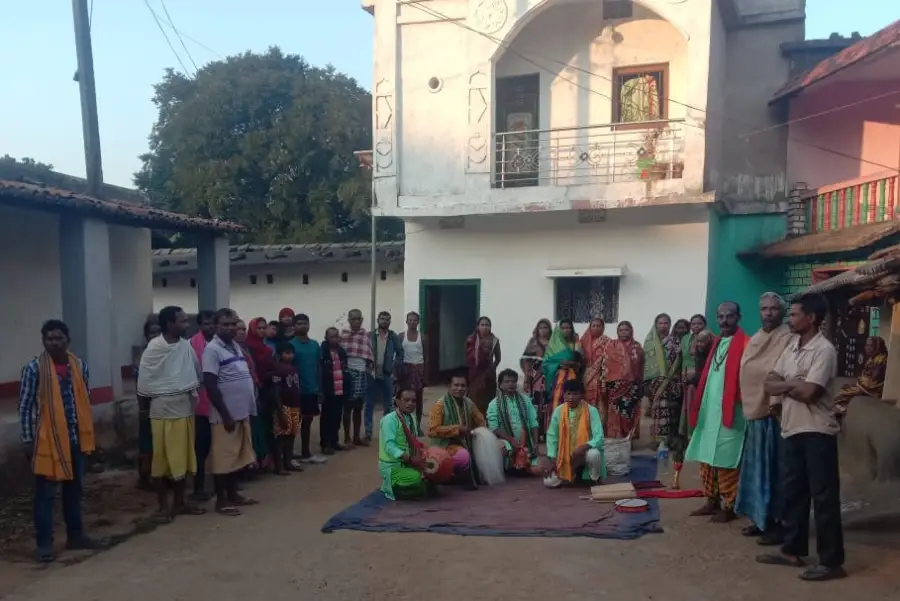
“Many a time I incorporate couplets into the lyrical presentation of Pala to highlight organic farming and indigenous paddy varieties,” Santosh said. “Every month, my team presents 10 to 12 programmes in different villages, and the department pays us Rs.7000 per programme.”
For Santosh Dhurua, the future of farming lies not just in fields and seeds, but also in culture and community—where soil is nurtured, seeds are preserved, and songs carry the message forward.