

Jamshedpur
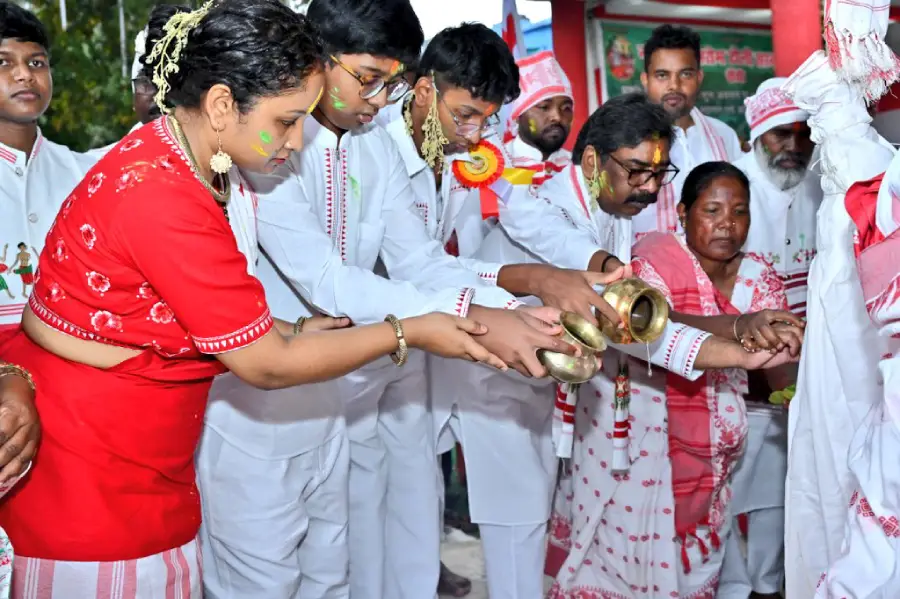
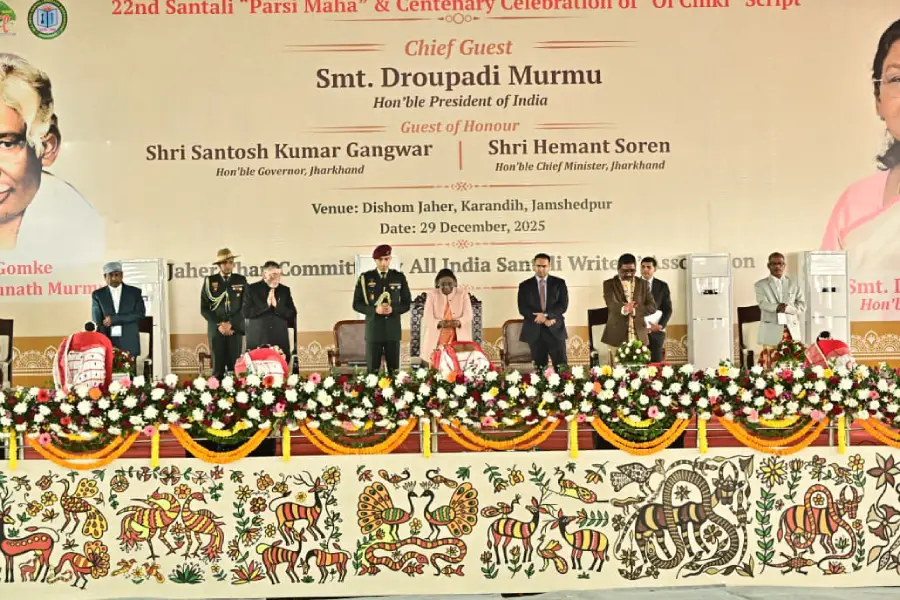
President Droupadi Murmu on Monday described the centenary of the Ol Chiki script as a historic milestone for the Santali language and the Santal community, underlining the script’s central role in strengthening cultural identity, education and dignity among tribal societies. Santali writers from different States were felicitated in the event, organised by the All India Santali Writers’ Association and Jaherthan Committee.
Addressing the closing ceremony of the 22nd Parsi Maha and the centenary celebrations of the Ol Chiki script in Jamshedpur entirely in Santali, the President said she felt immense joy in being part of the occasion. She noted that India is home to many tribal communities, including the Santals, who live not only in different parts of the country but also in Nepal, Bhutan, Bangladesh and Mauritius, and possess a rich language, literature and culture.
President Murmu even took everyone by a pleasant surprise as she sang a traditional Santali Nehor prayer song for over four minutes that she had picked up in her childhood. It invokes Jaher Ayo (Mother Nature) to guide society on the path of light, she pointed out. This was, perhaps, the first instance of a kind for a President to do so in a public event.

President Murmu recalled that before the invention of Ol Chiki, the Santali language was written in Roman, Devanagari and Bengali scripts, which could not accurately represent its pronunciation. She said that in 1925, in the village of Dandbos in the Rairangpur area of Mayurbhanj district in Odisha, historian and scholar Pandit Raghunath Murmu invented the Ol Chiki script, after which it came into regular use for writing Santali.
Describing Ol Chiki as a powerful tool for the Santal community, the President said that Santals across the world increasingly recognise their language, and the script has emerged as a strong medium to establish their identity. She said celebrating the centenary of a script is a significant historical event and expressed pride that programmes are being organised across India and abroad, with Ol Chiki also gaining rapid visibility on digital platforms. She added that the Odisha government has organised programmes to mark the centenary.
Highlighting institutional initiatives, President Murmu said that the website of Rashtrapati Bhavan, which was earlier available only in English and Hindi, has been made accessible in 22 Indian languages since July 2025, including Santali in the Ol Chiki script.
Recalling her tenure as Governor of Jharkhand, she said the name Raj Bhavan was written in the Ol Chiki script, and the names of all government languages were also displayed in Ol Chiki. She said special efforts were made in Santal-dominated areas to write the names of schools, colleges and institutions in the script, and to decorate classroom walls with attractive Ol Chiki calligraphy, making learning more appealing for children.
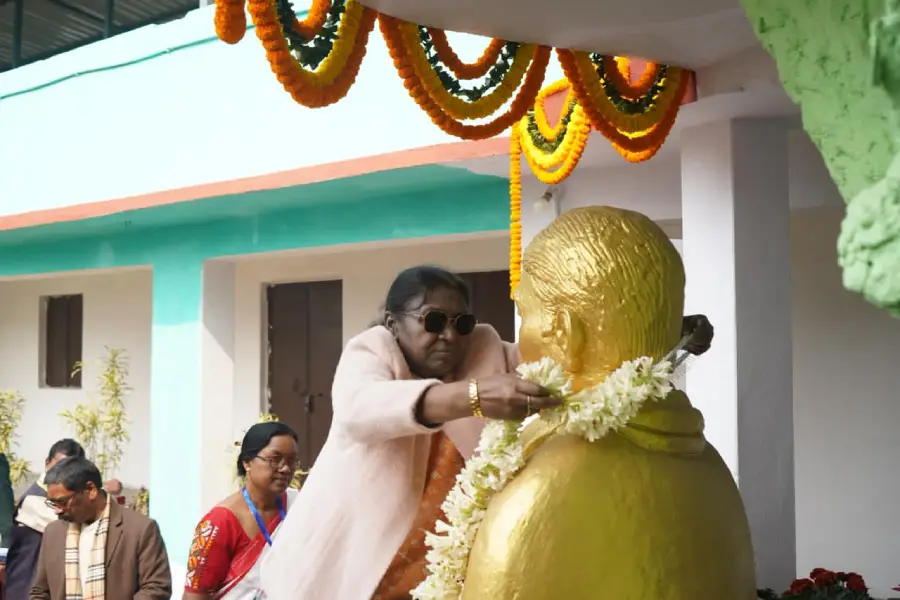
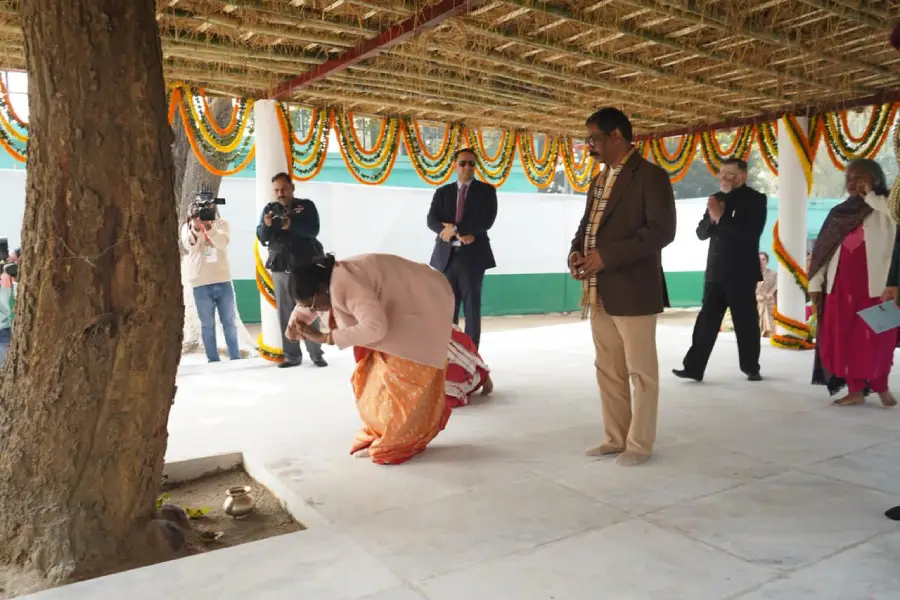
While welcoming the fact that children are learning Hindi, English, Odia and Bengali, the President stressed that it is equally essential for them to learn their mother tongue, Santali, in the Ol Chiki script. She said mother-tongue education enriches overall learning and strengthens cultural roots.
She thanked writers and language activists for their collective efforts in preserving, promoting and enriching Santali language and literature.
President Murmu also recalled her role in the constitutional recognition of Santali. She said that when she was a minister in the Odisha government, efforts were made to include Santali in the Constitution, and with the blessings of the late Atal Bihari Vajpayee, the language was included in the Eighth Schedule of the Constitution on December 22, 2003.
She emphasised that the use of one’s mother tongue not only aids education but also gives strength and dignity to life.
The President also mentioned children’s magazine Chandamama, noting that it was first published in the Ol Chiki script and that she had played a role in that effort. She added that since 2005, the Central Sahitya Akademi has been regularly honouring Santali writers, just like other Indian languages, calling it a matter of pride.
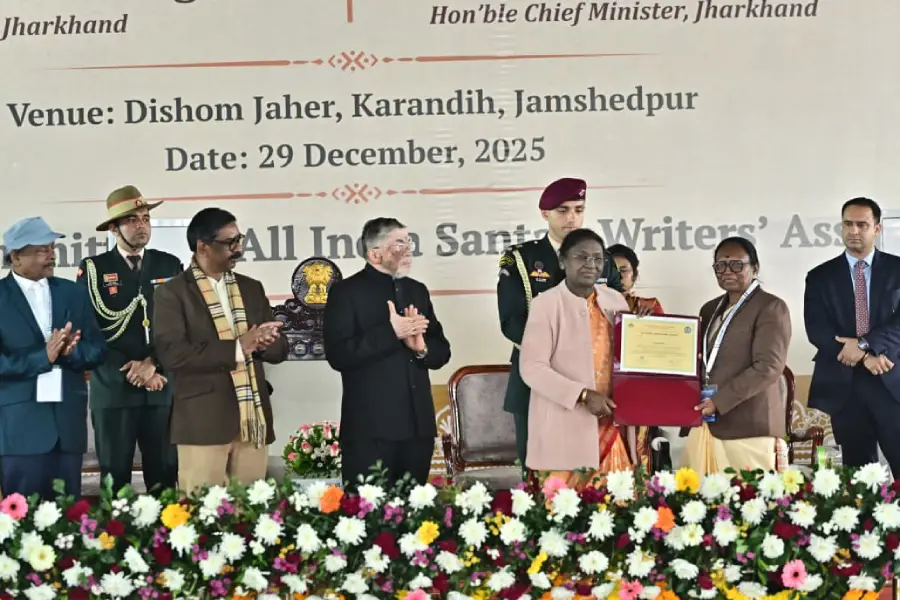
Speaking on tribal life and nature, Murmu said the lifestyle of tribal communities is deeply connected with the environment. She referred to the Jaherthan or sacred grove, filled with Mahua, Ajushan and Zeri’Zeri trees, as a symbol of this relationship. She warned against the threats posed by global warming and stressed the need to protect forests, promote environmental education for future generations, plant more trees and maintain a balance between environmental protection and modern progress.
The President further said that languages and literature weave communities together and flourish through mutual exchange and translation. She stressed that just as Santali literature needs translation into other languages, other languages too would be enriched by Santali literature. She expressed confidence that the Indian Santali Writers’ Association would play a leading role in this task.
FOR HIS PART
Jharkhand Chief Minister Hemant Soren said his government is firmly committed to giving identity and dignity to tribal languages and culture, and is continuously working in partnership with tribal communities to achieve this goal.
Addressing the gathering, the Chief Minister said the ceremony was special as it provided an opportunity to honour litterateurs and intellectuals for their contributions to the development of the Santali language and literature. He said the government felt proud to recognise those who have played a significant role in strengthening Santali language and cultural expression.
Emphasising the State’s commitment to education in the mother tongue, Hemant said the Jharkhand government is determined to ensure the teaching of the Santali language through the Ol Chiki script across the state. He added that the government is steadily moving forward to safeguard, preserve and enrich tribal languages. “Today, through tribal languages like Santali, the voice of the Adivasi community is reaching far and wide,” he said.
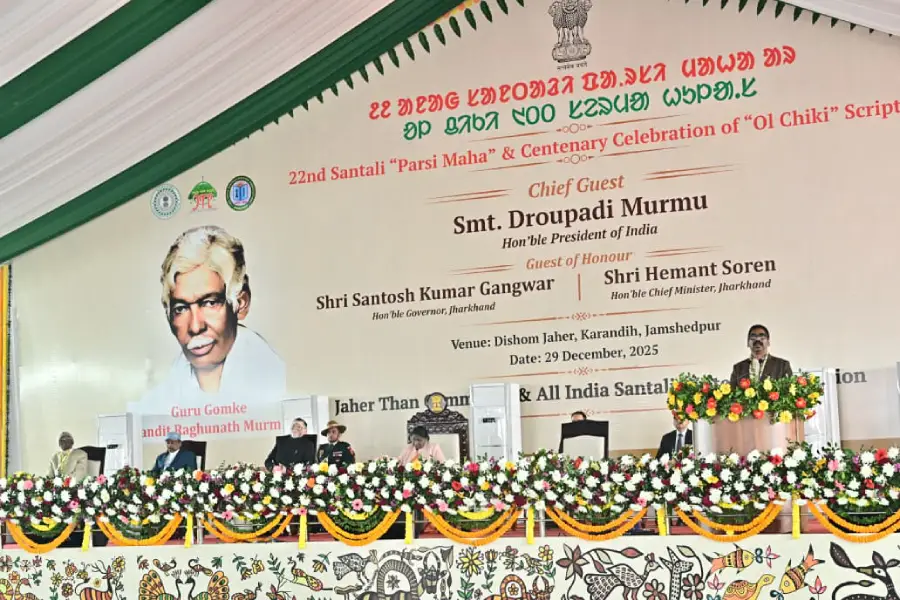
The Chief Minister said the growing empowerment of the tribal community has been significantly shaped by the leadership and initiatives of President Droupadi Murmu. He noted that at Rashtrapati Bhavan, several programmes have consistently highlighted tribal society, its culture, traditions and identity. He said the initiatives taken by the President have enhanced the dignity and respect of the tribal community, adding that her efforts deserve the highest praise.
Referring to the legacy of Pandit Raghunath Murmu, Hemant said the distinct identity of the Santali language and its Ol Chiki script is the result of his unforgettable contribution. “As long as the Ol Chiki script and the Adivasi–Santal society exist, Pandit Raghunath Murmu will remain immortal,” the Chief Minister said.
President Droupadi Murmu attended the event as the Chief Guest while Governor Santosh Kumar Gangwar and Chief Minister Hemant Soren were the Guests of Honour.