








Bhubaneswar
Pitabasa Sabar of village Bhalerikudia under Gunpur block in Rayagada district of South Odisha started earning his livelihood as a labourer in 2012. Then, he used to get Rs 90 as a daily wage, which was too erratic to feed himself and his four-member family.
Today, this former daily labourer has been awarded as a successful agripreneur, earning more than Rs 4 lakh annually from farming different varieties of marigold (Gendu in Odia), apple ber (Bara Koli in Odia) and vegetables.
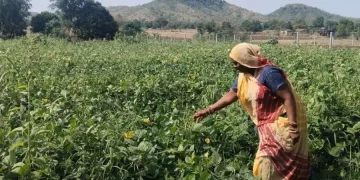
Labourer-turned-farmer Pitabasa now grows different varieties of hybrid marigold and apple ber in his 1.5 acres. He has even converted his tumbledown thatched house into a small four-room pucca home about five months ago by spending about Rs 7 lakh. Dubbed a progressive farmer, he now stands as a model for tribals in his village and neighbouring areas.
“Pitabasa who earned Rs. 90 per day in 2012 that increased to Rs.120 by 2018 is now a progressive who has now encouraged about 30 tribals in Gunpur block to toe his line. And it is never a mean achievement,” said Satyabrata Sahu, the Assistant Horticulture Officer of Gunpur block, told The Indian Tribal.
“Our Department has included him as a beneficiary under Mission for Integrated Development of Horticulture (MIDH), a scheme of the Union Government,” he added. Impressed with his efforts, the Horticulture Department provided about Rs 5000 under MIDH in 2022–23 for marigold farming. His spouse Sebati Sabar received around Rs 7000 under the same scheme in 2023–24.
Gunpur-based Krishi Vigyan Kendra (KVK) also played a key role in grooming him. “Our KVK and non-government agency Asha in Gunpur imparted one-day training to 25 farmers including Pitabasa before he initiated marigold farming. Besides, he always meets our scientists’ guidance whenever he faces any problem,” said Dr. Naram Ramu, a KVK scientist (Agronomy).
Over time, Pitabasa has won five awards as a progressive farmer at district and State levels. Notably, he received the district-level ‘Swakhyarita Krushak Samman’ in 2023 in Rayagada and the state-level ‘Krushak Ratna’ title in Bhubaneswar in 2024 with a cash prize of Rs 10000.
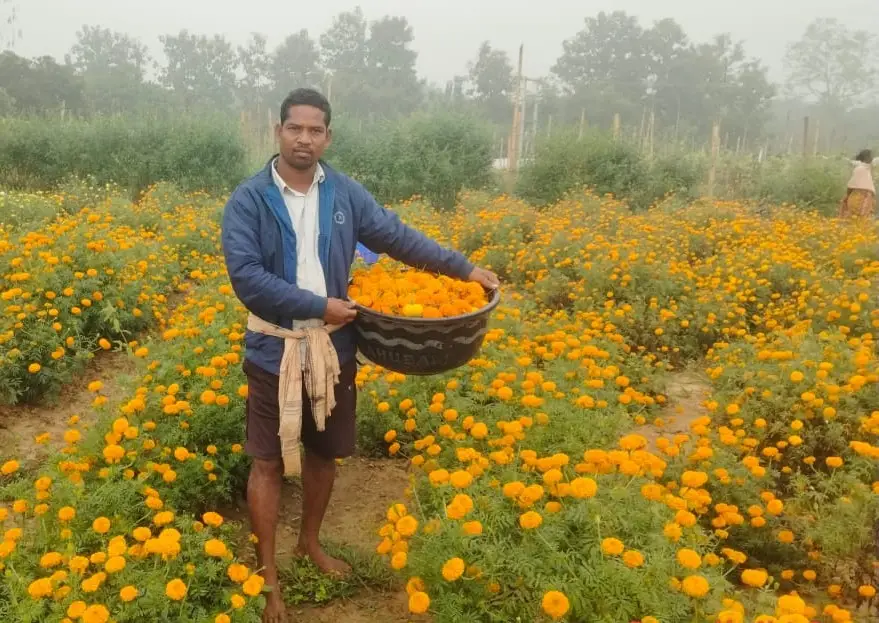
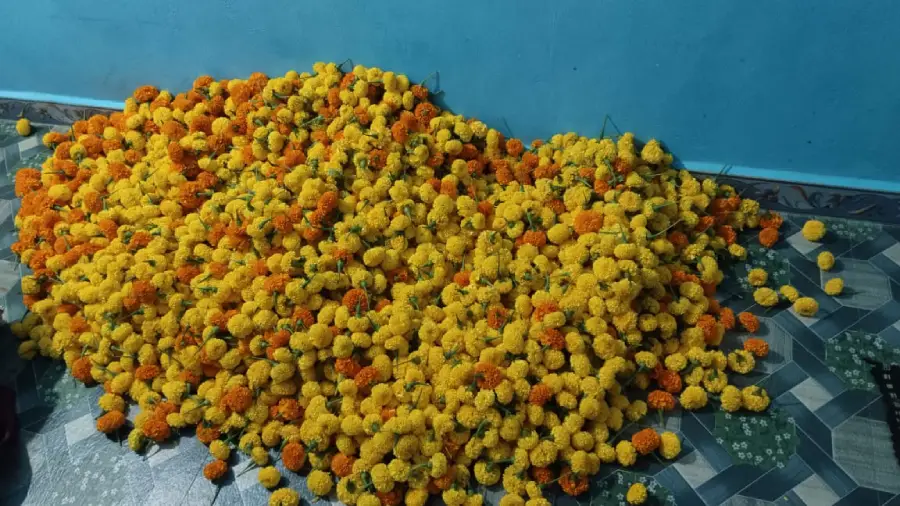
“Now I have nearly 8000 marigold plants of varieties like ‘Tennis Ball’, ‘Big Ball’, ‘Unisem’ and ‘Arkha Bhanu’. Each such plant yields flowers in 45 days to 60 days after their plantation,” said Pitabasa.
Encouraged by his own success, he began growing vegetables such as tomato, cucumber, pointed gourd (Potala) and ridge gourd (Janhi) in his 25 decimals of land. This fetched him Rs 1.35 lakh this fiscal, including nearly Rs 1 lakh from pointed gourd alone.
Life, however, was tough after he married Sebati in 2012. It became harder after the birth of his two children in 2013 and 2014, and toughest after his separation from his father and brothers in 2017. He preferred not to discuss the reason for the separation.
“When my earnings as a labourer proved too inadequate to run the show on my domestic front, I decided to take up farming to be self-dependent. But I wanted to grow the crops that my father Hari Sabar does not do. My father grows paddy and cotton in his three acres. So I made a shot at mandia (millet) farming in 2019,” Pitabasa told The Indian Tribal.
He invested Rs 2000 saved from earlier wages and borrowed Rs 3000 from friends, putting a total of Rs 5000 into indigenous millet (‘Bada Mandia’) farming in half an acre, using seeds he received from his father.
Using traditional methods, he harvested nearly five quintals. Keeping 50 kg for home consumption, he sold the rest at Rs 100 per ‘mana’ (three kilograms). In 2020–21, he grew millet in one acre, yielding over 12 quintals.
“I stopped adopting traditional method of farming to adopt SMI (System of Millet Intensification) method in 2021-22. Non-government agency Asha had trained me on SMI method that is akin to the System of Rice Intensification (SRI). This helped me clock income of over Rs. 70,000 that fiscal,” said Pitabasa.
However, he discontinued millet farming the next year as buyers dried up after the State government began distributing five kilograms of millet per month free to each BPL card holder in the district. “So, I solely concentrated on growing different varieties of hybrid marigold and apple ber,” he added.
He initiated hybrid marigold farming in 2020–21 after receiving 100 free saplings of the ‘Kolkata variety’ from KVK. After 45 days, he sold the flowers at Rs 100 per kilogram, earning Rs 3000. The next year, he procured 1000 ‘Tennis Ball’ seeds from Gunpur block headquarters. Only 700 germinated due to transportation stress, yet he earned over Rs 45,000 in November.
Earlier, he followed the ‘Tali Paka’ method—ploughing, mixing cow dung and organic manure, sowing seeds and later transplanting saplings. After training, he adopted scientific spacing: two feet between plants and three feet between rows. He applied this to over 400 rows. The results were remarkable—his turnover rose from Rs 80,000 in 2021–22 to Rs 1 lakh the next year, and over Rs 1.5 lakh in 2023–24.
“Each plant yielded more than 5.5 kilograms of flowers initially. But its market price varies drastically. While the flower sells at even Rs.120 per kilogram during holy Odia months like Kartika (October-November) and Margashira (November-December), and during religious occasions like Ganesh Puja and Saraswati Puja. In other times, per kilogram price of flowers drastically decreases to less than Rs.60,” said Pitabasa.
He not only encourages farmers to grow marigold but also trains them in SMI. When he buys seeds at Rs 3 per kilogram, he distributes them at the same rate, though he sells saplings at Rs 6–7.
“I got 3000 saplings from Pitabasa at concessional rate of Rs.5 per piece to do marigold farming in one acre this financial year. He also taught me on the nitty-gritty of farming,” said Saora tribal farmer Eshwar Sabar of Phajilibandha under Padamapur block, 25 km from Bhalerikudia.
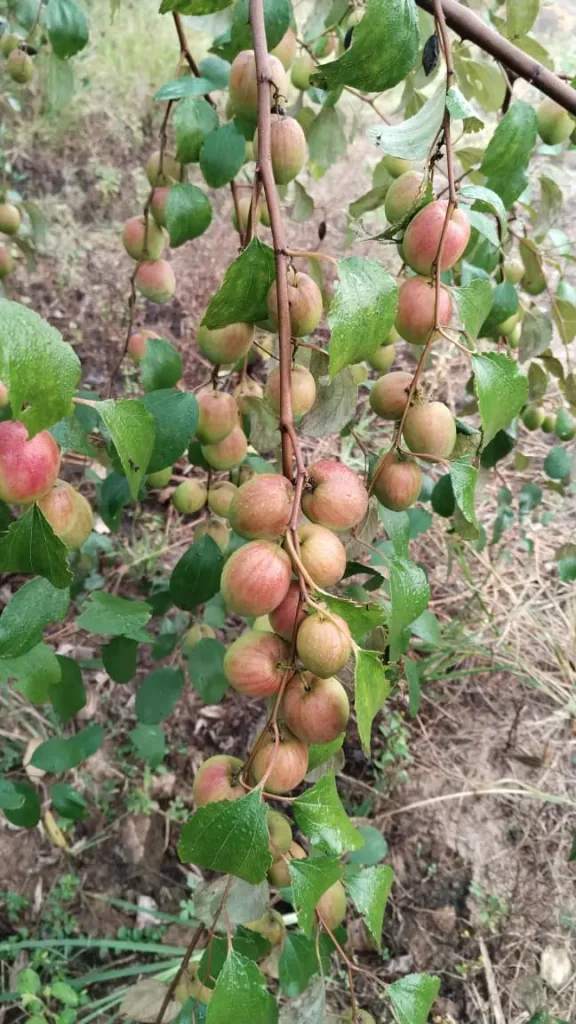
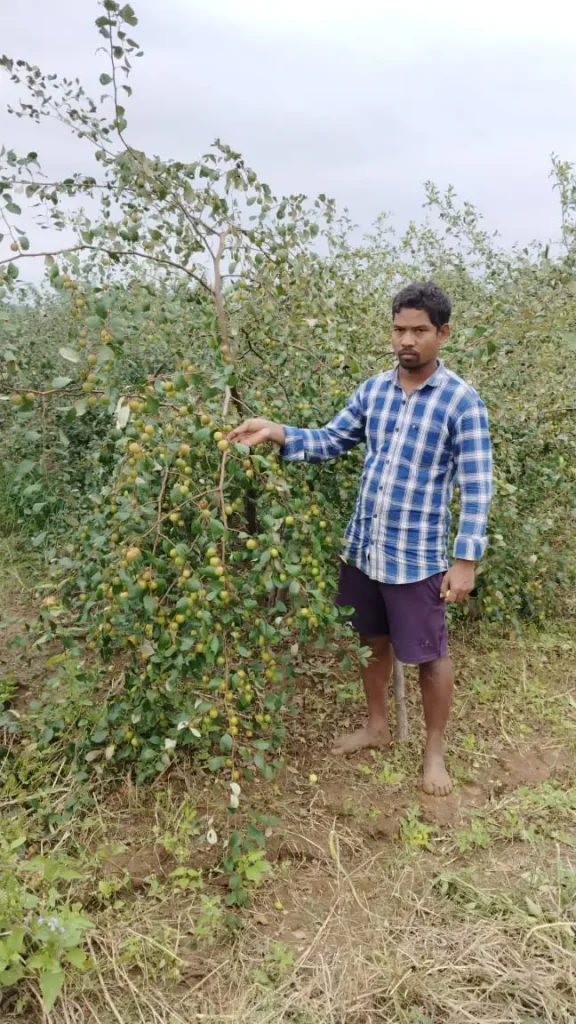
Pitabasa ventured into apple ber farming in 2021–22. He purchased 45 saplings of the ‘Kashmir Sundari’ and ‘Ball Sundari’ varieties and 10 of Green Apple from Cuttack. While the first two cost Rs 100 each, the Green Apple saplings cost Rs 75. In 2022–23, he bought 35 saplings of the ‘Miss India’ variety at Rs 100 each from Bhubaneswar.
Following SMI spacing, he kept 12 feet distance between all plants and rows. The plants flowered within six months, and fruits were harvested in January–February. Initially, each plant yielded 4.5–5 kg; once they reached 12 feet in height, yields rose to 30–50 kg each.
He sells all varieties of apple ber at Rs 100 per kilogram to individual customers and at Rs 75 per kilogram to traders. His apple ber turnover crossed Rs 30,000 in 2022–23, exceeded Rs 1 lakh in 2023–24, and continued rising in 2024–25.
Earlier, he irrigated plants through an indigenous method—carrying river water in large earthen pots (‘Handi’) with holes at the bottom, placed near plant roots. Later, he installed a petrol pump for Rs 21,000, and set up a modern drip irrigation system across half his land at a cost of nearly Rs 40,000.
“We engage five to 10 female and male labourers if their services are required. Each female labourer gets Rs.200 per working day, while a male counterpart of hers receives Rs.300. They irrigate the plants through each ‘batia’ (channel) between two marigold plant rows. They also weed out grasses and unnecessary shrubs from the field. I and my spouse spray ‘nimastra’ and sometimes pesticide to control pests like ‘lepi’ and ‘lipa minor’,” said Sebati, the spouse of Pitabasa.
Now, Pitabasa has planted pineapple, custard apple, litchi, dragon fruit, moringa, anjeer and other fruit-bearing plants along the borders of his land. “I have taken this step with the hope that my turnover would exceed Rs.7 lakh next fiscal,” he said.